Friday, December 30, 2022

Magical thinking

One of the king’s primary responsibilities was to defeat and contain these threatening beings, thus maintaining the stability of the world. This was of utmost importance in Egyptian ideology, and the king was often depicted in the act of annihilating rebels or symbols of evil, who usually took the form of foreigners. For example, in smiting scenes, the pharaoh strides forward with a weapon raised overhead in order to execute the one or more foreign enemies who are in his grasp (fig. 1.5). In other scenes, the king takes the form of a sphinx or griffin and tramples foreign enemies (fig. 1.6). This imagery, like all imagery in ancient Egypt, had a magical capacity: by depicting the king defeating his enemies, the Egyptians guaranteed that the king would continually do so. The image created the reality. In this way, such imagery was both apotropaic and effective.—Ancient Egyptian Prisoner Statues: Fragments of the Late Old Kingdom, 8–9

<idle musing>
In the old days, we used to call this sympathetic magic, but that term has fallen out of favor in the last thirty or so years. I don't recall what they call it now, but it's still the same: Like begets like.

Makes sense, doesn't it? As one of my seminary professors used to say, when you reason from the given to the divine, you end up with magic—the attempt to control your circumstances by manipulating them symbolically, i.e., magic.

Unfortunately, some of that thinking has invaded Christian thought, theology, and behavior. Now, I'm not trying to minimize or deny the effectiveness of acting out some things, such as the writing of offenses on a piece of paper and then burning the paper—we are embodied beings and actions help—but, to think the action in and of itself is effective? Well, no. Emphatically, no. It only becomes effective through the power of God in the Holy Spirit, working in and through you and your circumstances.

And as for the practice that I've seen of placing a Bible on someone as if the book is magical? That's just plain wrong. The Bible is just a block of wood, thinly sliced—unless the Holy Spirit quickens it. Nothing more; nothing less. And there is nothing magical about reciting scripture over someone either.

"Guard your thoughts" means more than just watch out for mean or sinful thoughts; it also means guard your thoughts (and practices) against sub-Christian ideas. You can't manipulate God, and that's what is happening in the above scenarios. Pharaoh was trying to manipulate the gods into striking his enemies. It didn't work! The Old Kingdom fell.

What's interesting is that this practice of destroying prisoner statues was prevalent at the end of the Old Kingdom, as it was getting weaker. Think about that for a minute.

Magic tends to run rampant when we feel like the world around us is out of control. But, if you really believe that God is in control (or as some prefer, in charge), then why should you need to perform magical actions?

Could it be that, as J. B. Phillips's 1952 book put it, Your God Is Too Small?

Consider that in you New Year's Resolutions…

Just an
</idle musing>

Divine hope

513 C. M.
The garner of God.

COME, thou omniscient Son of man,
   Display thy sifting power;
   Come, with thy Spirit’s winn’wing fan
   And throughly purge thy floor.

2 The chaff of sin, the’ accursed thing,
   Far from our souls be driven;
   The wheat into thy garner bring,
   And lay us up for heaven.

3 Whate’er offends thy glorious eyes,
   Far from our hearts remove; -
   As dust before the whirlwind flies,
   Disperse it by thy love.

4 Then let us all thy fulness know,
   From every sin set free;
   Saved to the utmost, saved below,
   And perfected in thee.
          Charles Wesley, from the Methodist Episcopal Hymnal (1870 ed.)

Thursday, December 29, 2022

For the love of…

Sir. 31:5    Whoever loves gold won’t be declared just,
      and whoever pursues profits
      will be led astray by them.
6 Many have been ruined because of gold,
           and their destruction has met them head-on.
7 It’s a stumbling block for those
      who are possessed by it,
           and it will take
           every senseless person captive. (CEB)

<idle musing>
We Protestants could do worse than reading the deuterocanonical books once in a while. There are some real gems in there…
</idle musing>

To what end salvation?

I return my reader to one of the key questions of this book: What is the goal of salvation? For too long, scholars and laymen alike have myopically viewed justification and salvation as ends in themselves, whether for the benefit of the individual or of the incorporative body of Christ. The goal of salvation is believers’ conformity to the Son of God—their participation in his rule over creation as God’s eschatological family and as renewed humanity—but only and always with the purpose of extending God’s hand of mercy, love, and care to his wider creation. This was humanity’s job in the beginning; it will be believers’ responsibility and honor in the future; it is God’s purpose in calling his people in the present.—Conformed to the Image of His Son, 266

<idle musing>
Indeed! We underestimate the purposes of God and are unaware of his ability to bring it about.

That's the final paragraph of the book. I hope you enjoyed the brief snippets I posted; they really don't do the book justice. It is definitely worth the time invested in reading it. But, be aware that it is loaded with untranslated Greek—both LXX and NT—so if your Greek is rusty/nonexistent, you will miss some of the nuances. But, it is still worth the time invested.
</idle musing>

A hymn for the new year

1128 C. M.
For a blessing on the truth.

O GOD, by whom the seed is given,
   By whom the harvest blest;
   Whose word, like manna shower’d from heaven,
   Is planted in our breast ;—

2 Preserve it from the passing feet,
   And plund’rers of the air;
   The sultry sun’s intenser heat,
   And weeds of worldly care.

3 Though buried deep, or thinly strown,
   Do thou thy grace supply:
   The hope in earthly furrows sown
   Shall ripen in the sky.
                  Reginald Heber (1783–1826)
                  from the Methodist Episcopal Hymnal (1870 edition)

Wednesday, December 28, 2022

Participation in Christ

God’s children will receive this glory in full when their own redemption and adoption is complete, but they also are currently glorified, even if in part. This is the reason believers are predestined, called, and justified: that, as God’s eschatological family, his children might be used by God to bring redemption to the world around them, in part by action and in part by prayer (Rom 8:26–27). This participation is the now of believers’ glorification, the present purpose for which they were called (Rom 8:28, 30). Believers are not yet glorified entirely or completely, but they nonetheless participate in the Son's glory in the present as those whose new identity is established in the Messiah, the Son of God.—Conformed to the Image of His Son, 250 (emphasis original)

Sanctified Knowledge

1011 1st P.M 6 lines 8s.
Sanctified knowledge.

COME, Father, Son, and Holy Ghost
   To whom we for our children cry
   The good desired, and wanted most,
   Out of thy richest grace supply;
   The sacred discipline be given,
   To train and bring them up for heaven.

2 Error and ignorance remove;
   Their blindness, both of heart and mind:
   Give them the Wisdom from above,—
   Spotless, and peaceable, and kind:
   In knowledge pure their minds renew,
   And store with thoughts divinely true.

3 Learning’s redundant part and vain
   Be here cut off, and cast aside:
   But let them, Lord, the substance gain;
   In every solid truth abide;
   Swiftly acquire, and ne’er forego
   The knowledge fit for man to know.

4 Unite the pair so long disjoin’d,
   Knowledge and vital piety:
   Learning and holiness combined,
   And truth and love, let all men see
   In those whom up to thee we give,
   Thine, wholly thine, to die and live.
                  —Charles Wesley, Methodist Episcopal Hymnal (1870 edition)

Tuesday, December 27, 2022

Tozer for a Tuesday

[Speaking of those who force an interpretation and call it "rightly dividing the word of truth," he says} Rightly dividing the Word of Truth turns out to be anemic and usually bleeds to death in the hands of the man who holds it. Then he carries a dead text around with him and rams it down everybody’s throat. The carnal urge to “rightly divide” arises from intellectual pride. And that is What we call trying too hard.—A.W. Tozer, Living as a Christian, 33

<idle musing>
We all know people like that, don't we? : (

Lord, deliver me from being one of them!
</idle musing>

Monday, December 26, 2022

Participation in Christ

God’s children are tasked with the role of participating in God’s restoration process in creation through the practice of prayer. In this way they participate with the Son's rule over creation as those whose new identity is in Christ. Just as the Son intercedes on behalf of the saints in his glory in Romans 8:34, so also the saints demonstrate their sonship, and thus their participation in the Sons glory, in the present. And they do so not in domination but in a Christ—modeled dominion (e.g., Phil 2:6–11) that leads to redemption. But because of their weakness, they can only fulfill this role with the help and intercession of the Spirit.—Conformed to the Image of His Son, 245

Saturday, December 24, 2022

Hymn for a Christmas Eve

493                                     L. M.
There remaineth a rest for the people of God.

COME, O thou greater than our heart,
   And make thy faithful mercies known;
   The mind which was in thee impart:
   Thy constant mind in us be shown.

2 O let us by thy cross abide,
   Thee, only thee, resolved to know,
   The Lamb for sinners crucified,
   A world to save from endless wo.

3 Take us into thy people’s rest,
   And we from our own works shall cease;
   With thy meek Spirit arm our breast,
   And keep our minds in perfect peace.

4 Jesus, for this we calmly wait;
   O let our eyes behold thee near!
   Hasten to make our heaven complete;
   Appear, our glorious God, appear!
            Charles Wesley, Methodist Episcopal Hymnal (1870)

Thought for the day

3 Rich people inflict injury,
   but then act as if they’re the ones
   who have been wronged;
     the poor suffer injury,
     but they’re the ones
     who must apologize.
4 If you are useful to the rich,
   they will work with you,
     but if you are in need,
   they will abandon you.
5 If you own anything,
   they will live with you;
     they will exhaust what you have,
     and they won’t suffer.
6 If they need you, they will deceive you
     and smile at you and give you hope;
     they will speak nicely to you and say,
     “What do you need?”
7 They will embarrass you
   with their fine foods,
     until they have cleaned you out
     two or three times over.
     In the end they will mock you,
     and after these things,
     they will see you and abandon you
     and shake their heads at you.

Sir. 13:8    Take care that you don’t go astray,
     and don’t be humiliated
     by your own foolishness.
9 When powerful people invite you,
   show yourself reluctant,
     and they will invite you all the more.
10 Don’t be forward,
   or you might be rejected;
     and don’t stand far off,
     or you might be forgotten.
11 Don’t think that you can speak
   with them as an equal,
     and don’t trust in their
   lengthy conversations,
     because they will test you
     with a lot of talking;
     and when they are smiling, they are really examining you.
12 Those who won’t guard your secrets
   are cruel,
     and they won’t spare you
     from mistreatment
     and imprisonment.
13 Be on guard and pay attention,
     because you are tiptoeing
     around your own downfall.—Sir 13:3–13 (CEB)

<idle musing>
I try to read through the Deuterocanonical books every year, usually in December. I'm a bit behind schedule this year, only being in Sirach now.

Every year I notice something new. This year I was struck by the similarity of Wisdom to sections of Romans and Hebrews. I'll have to pursue that a bit…
</idle musing>

Friday, December 23, 2022

Just because

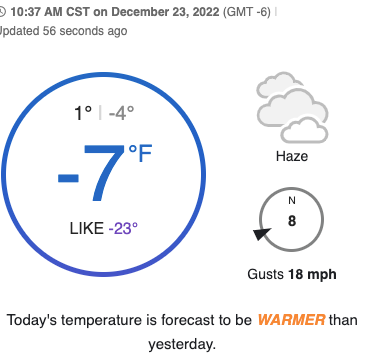
The weather right now:

That's warmer than yesterday??!! I didn't look yesterday when I was out shoveling (we got about 6 inches of snow), but it definitely was cold! I was outside for about 2.5 hours shoveling and the wind did feel cold. And when I looked at the temperature at about 8:00 last night, it was -12ºF. So I guess the wind chill would be lower than -27ºF.

Merry Christmas!

Hymn to God's holiness

100 L. M.
Holiness

HOLY as thou, O Lord, is none
   Thy holiness is all thine own;
   A drop of that unbounded sea
   Is ours,—a drop derived from thee

2 And when thy purity we share,
   Thine only glory we declare;
   And, humbled into nothing, own,
   Holy and pure is God alone.

3 Sole, self-existing God and Lord,
   By all thy heavenly hosts adored,
   Let all on earth bow down to thee,
   And own thy peerless majesty:

4 Thy power unparallel’d confess,
   Establish’d on the Rock of peace
   The Rock that never shall remove
   The Rock of pure, almighty love
              —Charles Wesley, Methodist Episcopal Hymnal (1870)

For whom do we groan?

I propose that nothing in the text warrants reading τὸ γὰρ τί προσευξώμεθα καθὸ δεῖ οὐκ οἴδαμεν [We don’t know what we should pray] in Romans 8:26 as a reference to the prayers believers should make only on their own behalf. Instead, what believers ought to pray for in Romans 8:26 and what the Spirit intercedes for in Romans 8:27 is not only for the believers’ own good but is also for the good of the creation, which currently groans, hence Paul’s transition from creation to believers in Romans 8:22–23.—Conformed to the Image of His Son, 244 (emphasis original)

Thursday, December 22, 2022

Coworkers!

I suggest that, though God’s children have not yet fully received their adoption as sons and thus are not yet in full possession of the inheritance, they are nevertheless called with the purpose of cooperating with God to bring restoration to his creation in the present. Discussions regarding humanity’s responsibility toward the nonhuman creation are increasingly popular, particularly within discussions surrounding the intersection of ecological concerns and theology. Byrne even goes so far as to suggest that “the future of the world (salvation) does to some extent lie in human hands.” He continues by stating, “Hope for the future in this sense takes human action into account. It remains hope in God but it is also hope in the prevailing power of God’s grace working through, not around or above human cooperation.”—Conformed to the Image of His Son, 242 (emphasis original in/quotation)

Wednesday, December 21, 2022

He shall glorify…

OK, I've been listening to Handel's Messiah, what can I say! Anyway, here's today's excerpt from Conformed to the Image of His Son:

Glorification, according to my working definition, occurs in two stages. On the basis of believers’ union with Christ, glorification is a present reality, at least in part. They are free from the powers of sin and death and have received the Holy Spirit, the firstfruits of their adoption. When believers’ bodies are resurrected to share in the glory of Christ, as in Philippians 3:21, then they will do so fully.—Conformed to the Image of His Son, 237

Tuesday, December 20, 2022

Tozer Tuesday

As soon as we accept the doctrine or the idea that the Bible is a book of theological toys to be played with by tender saintlings, we have missed the purpose of the Scripture and face the danger of slipping into false doctrine before very long. For the Bible was given to us not to satisfy our curiosity but to sanctify our personality.—A.W. Tozer, Living as a Christian, 33

Monday, December 19, 2022

An Advent hymn

118 C. M.
Design and object of His advent.

HARK, the glad sound! the Saviour comes,——
   The Saviour, promised long;
   Let every heart prepare a throne,
   And every voice a song.

2 He comes, the pris’ner to release.
   In Satan’s bondage held;
   The gates of brass before him burst,
   The iron fetters yield.

3 He comes, from thickest films of vice
   To clear the mental ray,
   And on the eyes oppress’d with night
   To pour celestial day.

4 He comes, the broken heart to bind,
   The wounded soul to cure,
   And, with the treasures of his grace,
   To’ enrich the humble poor.

5 Our glad hosannas, Prince of peace,
   Thy welcome shall proclaim,
   And heaven’s eternal arches ring
   With thy beloved name.
                    by Philip Doddridge
                    from the 1870 Hymns for the Methodist Episcopal Church

Sunday, December 18, 2022

Numismatic abbreviations

The last two books I've edited have had numismatic references, and therefore abbreviations. I'm not a numismatics guy—far from it! So, I had to dig around for a good site for abbreviations. The one I've had the best success with so far is this one called Wild Winds.

I also found a link to the Mionnet supplement volumes on google books here. There are nine of them!

This is mainly for my reference, but others might find it useful. If you have better sites, please add them in the comments.

See all the copyediting stuff here.

Friday, December 16, 2022

But what does the text say?

Contrary to Schreiner, Witherington, Moo, and others who maintain this guaranteed future reality, there is no indication within the context of Romans 8:30 that Paul writes from this future standpoint. Assurance alone is not a strong rationale for assuming Paul is writing about believers’ guarantee of glorification from a future perspective. I suggest that scholars take this view because their presupposed definition of δόξα [doxa] requires it: God’s people have clearly not yet been brought fully into the divine glory; therefore, the only explanation of the aorist is that, because it is so assured in the future, it can be spoken of as if it were a reality already in the present. This anticipatory interpretation, however, is unsupported.—Conformed to the Image of His Son, 236