Showing posts with label Just for fun. Show all posts

Thursday, December 26, 2024

Editing funny

In working through the bibliography of books you sometimes run into funny things. This one shows that people are quite ignorant of Latin:

Cross, Frank Moore, Werner E. Lemke, and Patrick D. Miller, eds. Magnolia Dei: The Mighty Acts of God; Essays on the Bible and Archaeology in Memory of G. Ernest Wright. Garden City, NY: Doubleday, 1976.

See the problem? I don't think the book is about magnolias! The correct spelling is Magnalia. But, the incorrect spelling shows up all over the place; it's even on JSTOR and de Gruyter's site!

Wednesday, November 22, 2023

Getting your goat

I'm copyediting a book for Lockwood Press, Cattle, Sheep, Goats, and Pigs in Pharaonic Egypt: A View from the Herd (it's not on the website yet), that will be appearing next year. The final paragraph in chapter 12, on goats, is too good not to share:
I include labor under goats because a recent article appeared by Donna Sutliff (2019) that suggests that goats may have been domesticated for use as pack animals, or, at the very least, their ability to carry loads was quickly appreciated and used in the Neolithic. Sutliff provides only two modern examples of the use of goats as pack animals. The first is in Tibet and the second in North America where, according to Sutliff, hiking with pack goats is a popular “American Pastime.” She cites several authors who have dismissed the idea and I would like to join them.
For the record: I can't see goats being used as pack animals!

Monday, November 13, 2023

I like this!

I'm in the midst of editing a commentary and they cited a text from Wisdom of Solomon. One of my jobs is to make sure that the version they are quoting from says what they say it does. In this case, they were quoting from Wis 13:1–2. In the process of checking it, I ran across the Good News Translation's version (I didn't even know that the GNT had done the apocrypha!). I really liked it, so I'm sharing it with you (don't you feel privileged!?):
1 Anyone who does not know God is simply foolish. Such people look at the good things around them and still fail to see the living God. They have studied the things he made, but they have not recognized the one who made them. 2 Instead, they suppose that the gods who rule the world are fire or wind or storm or the circling stars or rushing water or the heavenly bodies. 3 People were so delighted with the beauty of these things that they thought they must be gods, but they should have realized that these things have a master and that he is much greater than all of them, for he is the creator of beauty, and he created them. 4 Since people are amazed at the power of these things, and how they behave, they ought to learn from them that their maker is far more powerful. 5 When we realize how vast and beautiful the creation is, we are learning about the Creator at the same time.

6 But maybe we are too harsh with these people. After all, they may have really wanted to find God, but couldn't. 7 Surrounded by God's works, they keep on looking at them, until they are finally convinced that because the things they see are so beautiful, they must be gods. 8 But still, these people really have no excuse. 9 If they had enough intelligence to speculate about the nature of the universe, why did they never find the Lord of all things?

Sounds a good bit like Paul, doesn't it?

Thursday, March 02, 2023

Monday, January 30, 2023

Feel good story of the month

I received this link via an email list by Alan Jacobs. Delightful story. Here's a snippet to whet your appetite, but do yourself a favor and read the whole thing.
There are other luthiers with expertise in instruments from the Italian craftsman’s golden period, from 1700 to 1725, but master violin restorers are rare — around 20 worldwide now — and Becker is widely regarded as the best. At 64, he has worked on more than 120 Stradivarius violins — likely more, he says, than any other living person. David Fulton, a Seattle-based former software engineer and entrepreneur who once possessed the world’s largest collection of historic Cremonese instruments (named for the city where Stradivari and other renowned Italian luthiers worked) with 28, including eight Strads, entrusted Becker to care for them. (Fulton has since started selling off the bulk of them.) “He’s probably as fine a woodworker as lives on the planet today,” says Fulton. “Without men like him, these things would have decayed into splinters long ago.”

People travel from all over the globe to hand-deliver their instruments to Becker’s office, across the street from Grant Park. (When it comes to multimillion-dollar instruments, FedEx doesn’t cut it.) Once, says Becker, Nigel Kennedy, one of the most famous solo violinists of the 1980s, flew in from England for a day just so Becker could make him a new sound post, the small dowel that sits inside the violin and transfers vibrations from front to back. “He’s like a great surgeon,” says Bell. “His work is so meticulous. It’s like constructing a sailboat inside a bottle. There’s a reason I fly here to bring him my fiddle. He’s the master.”

Friday, December 23, 2022

Just because

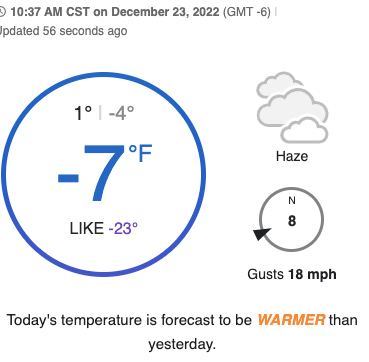
The weather right now:

That's warmer than yesterday??!! I didn't look yesterday when I was out shoveling (we got about 6 inches of snow), but it definitely was cold! I was outside for about 2.5 hours shoveling and the wind did feel cold. And when I looked at the temperature at about 8:00 last night, it was -12ºF. So I guess the wind chill would be lower than -27ºF.

Merry Christmas!

Wednesday, September 07, 2022

Understatement of the year

Blurb on the back of a massive commentary (700+ pages!) on the Aeneid, book 6:
This is Horsfall's fifth large-scale commentary on the Aeneid, and as his earlier commentaries on books 7, 11, 3, and 2, this is not a commentary aimed at undergraduates.
Yep. I would say that it gives grad students a good run for their money, too!

Monday, April 18, 2022

Knowing just enough Greek to get into trouble

Saw this over the weekend on JSTOR. It highlights the dangers of knowing some, but not enough Greek. The error is fairly easy to do, in that Greek upper case R looks like a P, but overcorrection is always fun :)

Again, it emphasizes the necessity of proof reading front matter! Check your work!

Wednesday, April 13, 2022

The importance of proofreading front matter

The most overlooked part of a book while proofreading is the front matter. I was discussing that the other day with Gary Rendsburg, and he forwarded this gem to me.
Yep, 1804! He added the [1904] to illustrate the actual date of publication. Anyone who is familiar with Akkadian knows 1804 is impossible; Akkadian wasn't even deciphered until the second half of the 1800s. Nippur itself wasn't seriously excavated until 1889 (Layard briefly excavated around 1850).

Moral of the story: Check the front matter—twice!

Table of Contents for copyediting stuff.

Tuesday, April 12, 2022

Seen in my wanderings

Saw this last week in a store. If I didn't already have too many mugs, I would have bought it. It pegs me. I suspect it pegs a lot of you also.

Monday, May 31, 2021

Some article titles…

I'm editing an article for an upcoming journal issue and ran across this bibliographic entry, which for some reason struck me as funny:
Fadhil, A. A.
2014 Die neuen spätaltbabylonischen Briefe des “königlichen Barbiers” aus Sippar. RA 108: 45–60.
Get it? "New, late, old..."

OK, I guess you have to be a bit slap-happy from too much editing…

Tuesday, May 25, 2021

Up to a point…

I'm in the process of proofreading a large project, and on page 250 (out of about 1008), I ran across this subheading:
Knowing that tribulation produces patience (... up until verse 5A).
Yep. Tribulation only produces patience until you get to verse 5A. I wonder what it produces after that?

Tuesday, February 16, 2021

It's even colder!

Yesterday was cold. I looked at the temperature at 8:00 AM and it was -20ºF. Then, at 8:30 last night, I checked the weather. Here's what I saw:

It's kind of scary when a prediction of 9ºF is considered "much warmer" out! But, it wasn't as bad as they said. I checked at 8:00 AM this morning, and it was only -18ºF! Heat wave!

Thursday, February 11, 2021

Baby, it's cold outside

Just checked the temperature, and it's -4ºF. But that's not what was the worst. Check out the screen shot. Tomorrow is supposed to be "much cooler" than today!

Wednesday, January 13, 2021

Tuesday, December 15, 2020

Is it broken? (the heart rate monitor, not the system!)

Last week I went to the doctor because I couldn't get rid of an infection; it required anti-biotics. I rarely use them, as I don't want to assist in the creation of super viruses, but sometimes they are necessary. But that's not the story here…

After going through the Covid-19 verbal questions and sitting in the appropriately spaced waiting room, the nurse called my name and escorted me back to the preliminary screening area where they check your weight, height, pulse, temperature, and who knows what else those things monitor now. Anyway, the pulse monitor said my pulse was 55, which is high for me, but I suffer from "white coat syndrome," which is a fancy term for the fact that I get elevated blood pressure, faster pulse, and all the rest of the stuff related to stress, when I visit a doctor. But that pulse caused the nurse to look at me and ask in somewhat alarmed voice, "Do you normally have a low pulse?" I assured her that my resting pulse was actually lower than that (about 45–50). She shook her head, readjusted the finger monitor, and then, because it didn't change, she manually checked my pulse. In an unbelieving tone, she said, "Hnh. It's correct."

OK, I thought it was humorous. Your mileage may vary. But I guess it just shows that clinics aren't used to getting healthy people—or maybe there just aren't enough of us left anymore? After all, they say that 2/3 of the people in the US are overweight and 1/2 of those are obese. There's no way that someone carrying around all that extra weight will have a pulse rate below 60!

Sunday, October 11, 2020

Beware what you say

Beware what you say, because it can be used in the future to show how far off the wall you were! Case in point, a very good scholar, Bernhard Duhm, said this about Ps 119 in 1922:
What sort of purpose the author had in view during the composition of these 176 verses, I do not know. In any case, this “psalm” is the most meaningless product that one ever used to blacken paper; one could more easily wear down a heretic with it than with all seven penitential psalms.
Original German:
Was der Autor bei der Abfassung dieser 176 Verse für einen Zweck im Auge gehabt hat, weiss ich nicht. Jedenfalls ist dieser ‘Psalm’ das inhaltsloseste Produkt, das jemals Papier Schwarz gemacht hat; mit ihm könnte man einen Ketzer eher mürbe Machen als mit sämtlichen sieben Bußpsalmen.—Bernhard Duhm, Die Psalmen, 2nd ed., KHC 14 (Tübingen: Mohr, 1922), 427–28
Cited in ch. 3 of Bernd Schipper, The Hermeneutics of Torah: Proverbs 2, Deuteronomy, and the Composition of Proverbs 1–9 (Atlanta: SBL Press, forthcoming). Needless to say, very few people would adhere to that view today!

Thursday, April 09, 2020

Some good news

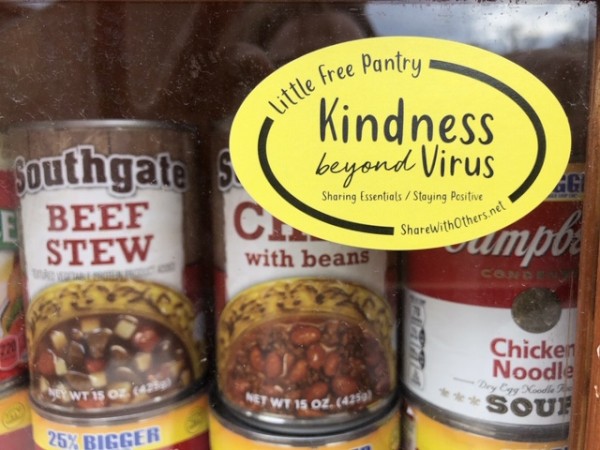
Little Free Libraries are being adapted to Little Free Pantries! From Publishers Weekly:
Ever since the novel coronavirus arrived on U.S. soil, disrupting lives and now, making access to food and other necessities more difficult for many, a number of little free library volunteer stewards -- both registered and unregistered with the Little Free Library organization – have switched from filling the mounted boxes in front of their homes with free books to filling them with household items: food, toilet paper, sanitizer, toiletries, and other necessities, all for the taking by passersby.

While many stewards are filling boxes with cans of food and packaged goods, some are taking a more personal approach: for instance, one woman in Ojai, Calif. is stocking her little free library box with fresh citrus fruit from her trees; another, in Anacortes, Wash. is placing hand-sewn face masks in hers.

Wednesday, March 18, 2020

SBL Press publishes surprise Fs for Jim Eisenbraun

Entitled He Inscribed upon a Stone, it was supposed to be presented at the AOS meeting this week, but a pandemic intervened. You can download the volume here. Below is a screenshot of the announcement, which you can read here.

Tuesday, January 21, 2020

And it all relates

Wyatt draws connections between Og and the Greek character of Ogygos, mythical founder of Thebes and survivor of a global ood (Eusebius, Praeparatio evangelica 10; Pausanius, Description of Greece 9.5.1). Ogygos is also the namesake of the island of Ogygia, which Homer describes as the “ὀμφαλός . . . θαλάσσης,” “navel of the sea” (Odyssey 1.50). Ὠκεανός (Ocean) and Ὤγυγος (Ogygos) are formed on the same root. For the Greeks, Ocean was a boundless sea that wrapped like a river around the world (Hesiod, Works and Days 168–71; Homeric Hymn to Aphrodite 227; Stasinos of Cyprus, Cypria 8). If one can draw a connection from Ocean to Ogygos to Og, Og of Bashan bears some resemblance to Yamm.

On the other hand, the image of Ocean is identified with an ageing Dionysus who descends to the underworld. Ocean as the transformation of Dionysus appears on two triumphal arches erected in Rome by Septimius Severus, whose wife Julia Domna was a Syrian priestess. Ocean appears as the transformation of Bacchus on a dish from the Roman Cunetio Hoard (late second century CE) and on a frieze on the temple of Bacchus at Baalbek. Dionysus is himself associated with the Green Man through his patronage of agriculture, his ability to make plants grow where he sets foot, and the ability of his followers, according to Euripides, to draw water out of the ground by striking it. So one might also propose a resemblance between Og and Khidr or Baal.

The term “Bashan” itself can be equated with the Ugaritic bṯn (cf. Akk. bašmu, Aram. ptn, Arab. bathan; KB3, 1.165), which is used to describe Yamm/Leviathan in KTU 1.5 i.2.16 Bashan appears several times in Psalm 68, which twice calls God “Rider of the Clouds” (68:7, 33), identical with rkb ʿrpt, an Ugaritic title of Baal used repeatedly in the Yamm stories (e.g., KTU 1.3 iv 4, 7). In Ps 68:16[15], Bashan is called the Mountain of God and mentioned right after Zalmon, which Ptolemy identified as Jebel Druze (Geography 5.14.12). This means that in Ps 68:17[16], it is Bashan that “God desired for his abode, where the Lord will reside forever.” Then in 68:23[22], Bashan is mentioned in parallel with Yamm. Perhaps God lives on Mount Bashan, then, in 68:15[16].19 John Day believes this use of geographical Bashan discounts translating Mount Bashan as “Serpent Mountain,” noting that bṯn already enters Hebrew as פתנ (e.g., Ps 91:13, in parallel with תנין; cf. Arabic baṯanun). But common sources can lead to two ulterior forms in a second language, either if the Hebrew bet and pe both correspond to the Ugaritic b because this is a composite set with overlapping segments or if Bashan and peten are a doublet, borrowed at different times from what is historically the same item in the single source language (cf. castle and chateau or gentle and genteel). The word Bashan need not be Hebrew in any case. Place-names are famously tenacious. Moreover, Deut 33:22, which says that Dan springs forth from Bashan, uses the oddly sea-serpentesque verb—hardly what one expects of the “whelp of a lion,” while Gen 49:17 actually calls Dan a serpent (both נחש and שפיפן). Del Olmo Lete pushes things too far in arguing that Bashan was the Canaanite “hell.” But a final link between Ugarit and Baal in particular and the Bashan region is the probable presence of Lake Hula as ṯmq in KTU 1.10 ii 6–12, a place “abounding in bulls” where Baal hunts (but not the ṯmk in KTU 1.22 i 17).—Robert Miller, Baal, St. George, and Khidr, pp. 25–27.

<idle musing>
Indeed! The whole book is like this. I won't extract anymore from it, but if you like this kind of thing (I do!), be sure to read it.
</idle musing>