What was it Eisenhower said? Something about every dollar spent on a weapon was a dollar stolen from education or some humanitarian cause. He should know. He saw the results first hand in Europe.
Showing posts with label Just peacemaking. Show all posts
Showing posts with label Just peacemaking. Show all posts
Thursday, October 19, 2023
What if?
I'm not going to say anything about the mess in the Middle East except that it's complicated. But, I can't help wondering, Would the results be different if we had taken a larger fraction of all the money spent on weapons and barricades and the like and spent them on humanitarian aid instead?

A peace ethic
"A peace ethic embodies the self-denial ethic of Jesus. A peace ethic volitionally and communally participates in the cruciform pattern of the life of Jesus. Through the power of God's grace and the indwelling Spirit of God the participant in the way of Jesus is transformed into the Christoform life."—Scot McKnight, Audacity of Peace, 10
Saturday, October 14, 2023
When will we ever learn?
From a Google books preview of Scot McKnight's Audacity of Peace (Minneapolis: Fortress, 2022), 8:
Indeed! When will we ever learn?
International saviors save little and sin lots.<idle musing>
Indeed! When will we ever learn?
I've got to get this book! The table of contents looks great, as do the few pages I can see in the Google preview
</idle musing>
Thursday, March 30, 2023
Tuesday, July 13, 2021
It's a matter of priorities, really
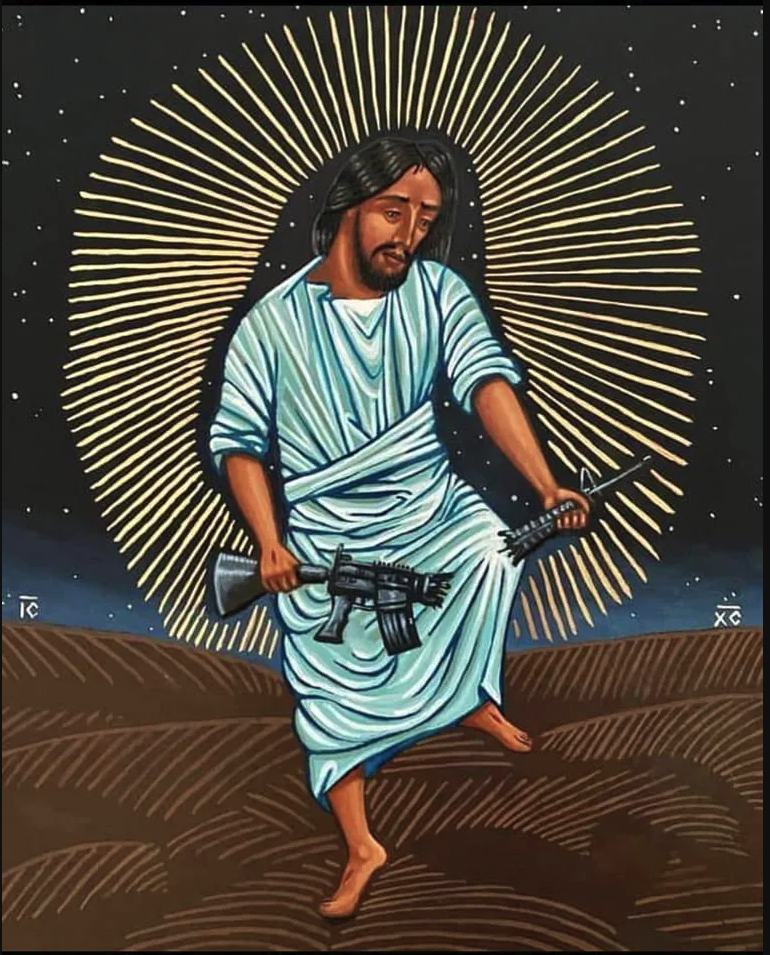
As they say, presented without comment, which is really a very strong comment!
I cannot say that I feel complacent about our chances for peace. Our terrible sin is in not giving peace absolute priority and in failing to realize that to attain peace, we have to make sacrifices. We are ready to make sacrifices for the sake of war, but not, apparently, for the sake of peace.—Abraham Joshua Heschel in Moral Grandeur and Spiritual Audacity: Essays, 255
Monday, December 21, 2015
Maybe it's time to repent?
The front page of any major newspaper is full of violence or threats of future violence. Ben Bradlee, editor of the Washington Post is reputed to have said, “We don’t cover safe landings at Dulles Airport.” What then makes it into our papers? In spite of peacemaker’s rhetoric and denunciations of violence, we gravitate to articles about violence in every part of the world. Some actually like it. We are used to it. It is as much a part of the American scene as McDonald’s and Coca-Cola. To be candid, our lives would be rather boring without it. What kind of people would Americans become without our fascination with aggression and violence?—America and Its Guns: A Theological Expose, page 33
<idle musing>
Personally, I think this love of violence is a major sin in our culture. It's so much a part of the texture of our society that we don't even see it. We talk about morality, sexual sins, maybe, if we're really daring, we'll talk about greed and materialism. And some—perish the thought!—might even talk about the sin of nationalism. But, no one talks about our obsession with violence.
Why?
Perhaps because it is so much a part of our culture we don't see it?
Lord! Open our eyes that we might see true peace and cooperate with you in bringing it to pass!
</idle musing>
Wednesday, May 13, 2015
What was the sin of Massah?
What, in Jesus’ eyes, might the community of believers whom he has called to be “sons of God” actually do that would be the functional equivalent of Israel’s sin at Massah? The answer to this question seems clear enough given all that I have said about Jesus’ understanding of what being faithful “sons” entails. The community would be rejecting the call from Jesus that it should regard as “of God,” and therefore be bound by, the principle of nonretaliation and especially the constraint to love the enemy. For, as we have seen, a posture of nonretaliation and the willingness to love the enemy are together the epitome and the essence of the way that the community of Jesus’ disciples has been charged to show itself faithful to the God it acknowledges as Father. This is what Jesus declares the disciples must commit themselves to if they are to be acknowledged by God as “sons.” This is the way of God that “this generation,” the antitype of the community Jesus tries to form, refuses to accept as the path God has ordained for those of Israel to follow.—The Disciples’ Prayer, page 159
<idle musing>
Strong words, aren't they? And ones that the church, at least in the U.S., needs to hear. We are called to be ministers of reconciliation. And we spew hate all too easily. Lord, forgive us! And keep us from putting you to the test!
</idle musing>
Wednesday, January 07, 2015
Are we asking the wrong question
I simply want to clarify that the debate between pacifism and just war theory focuses on the question of permission to make war. that diverts attention from the equally important question of practices that prevent war. These are two different questions. Most authors of the new paradigm of just peacemaking are just war theorists, and some are pacifists. They disagree on the permissibility of just war, but they agree that practices of just peacemaking need to be made articulate and to be enacted. Just peacemaking theory does not answer the question of the permissibility of war. Its question is a different one, and we think an equally important one. I believe Jesus teaches more about the transforming initiatives of just peacemaking practices than about the impermissibility of war.—Glenn Stassen
Transforming initiative
First, Matthew's Jesus points us to the traditional teaching of the Ten Commandments against murder. Second he diagnoses ongoing anger and insulting as a vicious cycle that leads to judgment (5:22). No imperative, no command against anger, is present. Rather, its central verb is a continuous-action participle. (Had the Jesus of the Sermon on the Mount commanded us never to be angry, that would have been a hard teaching, a high ideal, impossible to practice. Instead he diagnoses a vicious cycle that leads to judgment, destruction, and murder, as when a doctor diagnoses an illness that will lead to death if I do not take actions of treatment.) The third member of the triad, vv. 23–26, is the transforming initiative—not merely a negative prohibition of murder or anger, but a way of deliverance. It is a command to take initiatives that transform the relationship from anger to peacemaking.—Glenn Stassen (emphasis original)
More on just peacemaking
I have worked to demonstrate that the Sermon on the Mount, from 5:21 to 7:12, is not dyadic antitheses, but triadic transforming initiatives. The Sermon is distorted if it is interpreted as "high ideals," or "hard teachings," or merely as renunciation; its fourteen transforming initiatives are realistic ways of deliverance from our vicious cycles—grace-based breakthroughs of the reign of God. Thus understood, the teachings become much more accessible and doable for living and action.—Glenn Stassen.
You can find the article here; a summary of the 14 points can be found here.
Withdrawal? Hardly!
Pacifism isn’t quietism or withdrawal or inactivity, and it isn’t simple submission. Pacifism’s root is connected to the peacemaking beatitude, rooted in love and expressed when the follower of Jesus actively seeks peace. Pacifism isn’t a lack of interest or noninvolvement, but the hard work of seeking peace. Pacifism is nonviolent resistance, not nonresistance. What Jesus teaches his followers to do illustrates the sort of pacifism he advocates: turn the other cheek, surrender even more clothing, go the extra mile, lend and do not charge interest or require a payment back. Hardly the stuff of the inactive. These acts subvert the Roman system.— Sermon on the Mount, pages 131-132
<idle musing>
And, I would add, subvert the American system as well...
It's too bad that pacifism sounds so much like passive. I've found the work of Glen Stassen on just peacemaking very helpful. I just ran across this on the SBL website while looking for the previous link. Looks interesting...
</idle musing>
Subscribe to:
Posts (Atom)
