Friday, March 24, 2006

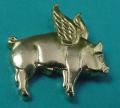
Pigs Fly!

When I first started here in October, 2004 (oops, that should be 2003!), I was told that there were two things that would never happen.

One, Hendrickson's long awaited release of:
A Dictionary of the Targumim, the Talmud Babli and Yerushalmi, and the Midrashic Literature

and second:
The City of Ugarit at Tell Ras Shamra

Well guess what?


Hendrickson released Jastrow in February, and we just sent the final revisions of Yon to the printer! Watch out for those pigs!

Atonement and evil

Scot McKnight has a good series on Atonement going on, today's post is about justification and atonement. The discussion following it is about imputation, impartation, Eastern Orthodox theosis and other similar items.

Scot's post ties in nicely with the latest Blogthings quiz making the rounds—How evil are you? And that, of course ties in with the book I am currently reading: Why I Am Not An Arminian and total depravity.

Of course, the million dollar question is to what extent the death of Jesus is efficacious in removing the sinful bent in a person's heart...

I come down strongly on the Keswick side here as popularized by such authors as Andrew Murray (a Reformed pastor), Watchman Nee (a Plymouth Brethren pastor), Hudson Taylor (of China Inland Mission fame) and, although he predates Keswick, Charles Finney (Arminian in theology). In a nutshell what they say is that by faith we can allow the Holy Spirit to keep us from sinning (see I John). Mind you, if is all God's grace, not anything of human ability.

Comments?

Wednesday, March 22, 2006

Why I am not an Arminian Chapter 2 "Augustine versus Pelagius"

As I said in the disclaimer here, I am not a Calvinist, but a classic Wesleyan/Arminian, therefore I read this chapter expecting to be accused of being a Pelagian. I was pleasantly surprised. Not only did the authors not level the charge of Pelagian, they even said that semi-Pelagian is a misnomer. They called the classic Wesleyan/Arminian position "semi-Augustinian."

Without a context that can be taken several ways, but the context was that a semi-Augustinian sees that salvation is all by God's grace, from the first stirrings of the soul until the final glorification at death. Where they differ from Augustine's views is in their views on predestination. I can live with that definition. I find much about Augustine that I like. Total depravity is not a problem for me, I don't need to read much history to confirm it. The human soul is definitely bent on doing evil, to quote from another book I'm reading ( First, Break All the Rules), citing the parable of the frog and the scorpion. The scorpion convinces the frog to give him a ride across the pond by saying that it would not be in his best interest to sting the frog, since they both would die. He then proceeds to sting the frog anyway. The frog asks why he did it as they both begin to drown: "I know," relied the scorpion as he sank into the pond. "But I am a scorpion. I have to sting you. It's in my nature." It is the same with humans...

The next chapter is on predestination with a subtitle "Conditional or Unconditional." As I mentioned in a previous post, this book seems to be balanced and free from polemics. I doubt I will be convinced, since reading Calvin himself didn't convince me, but at least they aren't creating a straw man of the other viewpoint.

Tuesday, March 21, 2006

Christmas in March

Well, not quite Christmas :) I love my job, I get to see all these new books come past. Today we got the new Word Biblical Commentary on Isaiah (revised edition) and the latest `Atiqot and you saw that yesterday we got the newest edition of Rosenthal's Aramaic Grammar. The best part is that there are still some more boxes to receive this afternoon. Off to lunch!

Isaiah 34-66

Isaiah 34-66
2nd edition
Word Biblical Commentary - WBC 25
by John D. W. Watts
Thomas Nelson,2005
xvii + 503-958 pages,English
Cloth
ISBN: 0785250115
List Price: $39.99
Your Price: $27.95
www.eisenbrauns.com/wconnect/wc.dll?ebGate~EIS~~I~WAT2ISAI

Atiqot 50 (2006)
Atiqot 50
Edited by Zvi Gal
Israel Antiquities Authority,2006
English and Hebrew
Paper
ISBN: 9654061856
Your Price: $36.00
www.eisenbrauns.com/wconnect/wc.dll?ebGate~EIS~~I~ATIQOT50

Blogging tools, part 2

Andy, our webmaster, has been at it again. He has added another little tool for our blogging pleasure.

Now there are three ways you can link to a book:

  • 1. Full bibliographic information:

  • The Edited Bible

    The Edited Bible
    The Curious History of the "Editor" in Biblical Criticism
    EIS - Eisenbrauns
    by John Van Seters
    Eisenbrauns,Forthcoming March 30, 2006
    xvi + 428 pages,English
    Cloth
    ISBN: 1575061120
    Your Price: $39.50
    www.eisenbrauns.com/wconnect/wc.dll?ebGate~EIS~~I~VANEDITED

  • 2. Just a simple text link:

  • The Edited Bible


  • 3. Just a small graphic:

  • The Edited Bible

    Enjoy the new toys! I know I will.

    New edition available

    We just received the latest edition of A Grammar of Biblical Aramaic yesterday:
    A Grammar of Biblical Aramaic

    A Grammar of Biblical Aramaic
    7th expanded edition, augmented with an index of biblical citations compiled by Daniel M. Gurtner
    Porta Linguarum Orientalium - PLO 5
    by Franz Rosenthal
    Harrassowitz Verlag,2006
    x + 107 pages,English
    Paper
    ISBN: 3447052511
    Your Price: $38.00
    www.eisenbrauns.com/wconnect/wc.dll?ebGate~EIS~~I~ROSGRAMMA

    The main difference is the addition of the index of biblical citations.

    Just for kicks, I looked at my copy: 5th printing, 1983. It must have just been printed when I bought it, because I took Aramaic in the summer of 1983. That is a scary thought :)

    Quote for the day

    "In a word, much of the teaching, both of the pulpit and the Christian press really amounts to this: sanctification is by works and not by faith." C.G. Finney

    Monday, March 20, 2006

    Quote for the day

    “It is heartbreaking to see the way professed Christians today are being swept into the swirling rapids of worldliness. Believers today do not distinguish themselves by ‘the victory which overcomes the world.’ Worldly pleasures, worldly fashions, worldly lusts and ambitions are only too apparent today in the life of the Church and the manner and outlook of Christians. Is there no way out of what the Germans call the ‘Weltgeist?’ We live in the world as a fish in water—must the water soak in, or is there hope that the Saviour’s high-priestly prayer: ‘they are not of the world, even as I am not of the world…Holy Father, keep through thine own name those whom thou hast given me’—be answered? Must ‘the prince of this world,’ who according to Jesus our Lord is the devil, hold sway over Christians in spite of God, the Church, the Cross and the Empty Tomb?” — F.J. Huegel

    Why I am not a Calvinist finished

    The final chapter of Why I Am Not A Calvinist sums up their arguments. I found one section to be particularly good, beginning on page 218:

    “In a fascinating historical study, British theologian Colin Gunton identifies key points at which he believes some central Christian doctrines got off track. One particularly interesting development is that in Western theology since Augustine, ‘the theme of love becomes subordinate to that of will.’ Gunton sees this manifested in the way the doctrine of double predestination is understood in some traditions. Part of the fundamental problem, Gunton believes, is a deficient understanding of the doctrine of the Trinity. The doctrine of the Trinity above all shows that God necessarily exists in an eternal relationship of perfect love between Father, Son and Holy Spirit…

    “When love is subordinated to will, then the fatherhood of God, which is emphasized in the Trinity (Mk 1:11; Jn 1:18; 5:19-20; 17:20-26; 20:17; 1 Cor 15:20-28), takes a back seat to the image of God as King or Ruler. God’s essential relational nature as a being who exists in three persons becomes secondary to the notion that God is a sovereign monarch whose will cannot be thwarted.”

    <idle musing>
    This reminds me very much of Brunner in A Christian Doctrine of God, where he develops a fascinating image of the eternal love that flows between the persons of the Godhead from eternity to eternity, a wonderful and awesome image. I think this captures the essence of who God is and why the doctrine of predestination as expounded by Calvinists is a faulty image of God.

    Over all, a very good book. I just started its companion, Why I Am Not An Arminian, and so far it is very good also. I was very glad to see that they refuse to take the extremes on the Arminian side as normal, just as they would wish for no one to take the extremes on the Calvinist side as definitive. I will post more as I read more.
    </idle musing>

    Friday, March 17, 2006

    Persona

    <idle musing>
    We all do it to a greater or lesser extent. We choose a persona we want to project to a particular audience and that is who we become for them. We are very careful to always wear the correct one with the correct audience. The only problem comes when there is a mixed audience—then we have to choose which persona we want to portray. Tough decision, the mask won't fit both crowds, which one is more important to me?

    That is when more of who I really am shows through. The persona I choose under pressure or before a mixed audience reveals it. I can talk a pretty picture, dance a nice dance; but when I am forced to choose between two or more options, the one I choose shows people and myself what I am made of.

    This is hypocrisy! It is unworthy of the gospel and shows that my Christianity is only skin deep; that I value the judgment of humanity more than the judgment of God. Jesus has pretty harsh words for people like that in the gospels. But, I justify it, blow it off and say it is just hyperbole—a great word to use to be more self-righteous and self-satisfied.

    What caused this introspection, you ask? The "books I am reading" list, that's what. I rarely read popular Christian stuff, it isn't part of who I am. But, there is a Christian bookstore that is going out of business and listing everything at 50% off. I picked up a few—OK, more that a few—books. Some of them were pretty much popular. Last weeekend I started reading one of them, Living in His Presence: Experiencing 'God With Us'-the Immanuel Factor. Do I list this book? It isn't in the normal persona that I project? What will people think? Et cetera...

    Well, as you can clearly see, I listed it. I am 2/3 done with it and it isn't very good. He is sloppy in his exegesis and pretty basic in his insights. There are a few jewels, but it barely justifies the time spent. But, that is all an aside. The point is that I am a bookseller for an academic publisher; that is the persona I was trying to protect and portray here. Is it accurate? Usually! But, God calls us to an honesty and openness that is beyond usually. To do otherwise dishonors what He has done in my life, it allows me to protect the "old self" that is dead, to try to revive it and pretend that my life is my own. To deny that I was "bought with a price" by something much more valuable than what persona I project in what venue.

    I could say more, but it is time to go to work. Another persona or more of who I really am? Trusting in God, more of who I really am...to do otherwise is to disobey, and as the quote for today says, "unbelief is ever the cause of disobedience."
    </idle musing>

    Quote for the day

    "Unbelief is ever the cause of disobedience." &mdash Andrew Murray

    Thursday, March 16, 2006

    Another blog

    The other day an e-mail showed up in my Inbox announcing a new blog. I have no idea how they got my name, but perhaps they subscribe to BookNews. Anyway, it is a blog on Hebrew etymologies for some English loan words—as if there were any English words that aren't loan words from somewhere :) Today their post is on pita, that delicious Greek pocket bread, delicious if you make it yourself, cardboard if you buy it in the store. Worth a read, a previous post covered asphalt; interesting tidbits of useless information :)

    Quote for the day

    "What should happen in genuine conversion? What should a man or woman feel in the transaction of the new birth?

    "There ought to be that real and genuine cry of pain. That is why I do not like the kind of evangelism that tries to invite people into the fellowship of God by signing a card.

    "There should be a birth from above and within. There should be the terror of seeing ourselves in violent contrast to the holy, holy, holy God. Unless we come into this place of conviction and pain, I am not sure how deep and real our repentance will ever be." — A.W. Tozer

    Wednesday, March 15, 2006

    Demosthenes a prophet?

    Christopher Heard was at WECSOR and chairing a session, which he comments on here. One of the papers sounds intriguing to me—"Is Demosthenes Also among the Prophets? Ancient Greek Orators as a Potential New Analogy for the Israelite Prophets". As a Classicist, the title and description intrigue me. Take a look at this excerpt:

    "He argues that the Greek political orators of the fourth century BCE—Brad drew most of his examples from Demosthenes—function in ways analogous to the socio-rhetorical functions of the "classical" Israelite prophets. Brad emphasized three comparisons:

    1. The Israelite prophets and the Attic orators spoke in long public addresses characterizable as argumentative oratory.
    2. The Israelite prophets and the Attic orators used a large variety of genres and styles, with stylistic variation determined by the pragmatic needs of the immediate communicative context rather than by convention.
    3. The Israelite prophets and the Attic orators responded to specific social conditions and circumstances—without always rehearsing the context explicitly, verbally—and tried to move their audience to action."

    Intriguing, I hope a version of it is available on-line soon.

    Quote for the day

    “My brother, only the heart is hard that does not know that it is hard. Only he is hardened who does not know that he is hardened. When we are concerned for our coldness, it is because of the yearning God has put there. God has not rejected us.” Bernard of Clairvaux

    Tuesday, March 14, 2006

    Blogging tools at Eisenbrauns

    Our webmaster, Andy, came up to me this morning and asked how he could make the blogging tools on Eisenbrauns' website easier. So, we fiddled around for about 45 minutes and came up with two separate listings. One is the full listing, complete with graphic and the other is perfect for the sidebar.

    We had the full listing before, but to make it work right you had to delete a whole bunch of stuff. Not anymore, just cut and paste. Sweet! The "What I'm Reading" code is perfect for the sidebar of the Blogger template. Just copy and paste and it looks perfect. Saves me having to remember to include the <a> and </a>. He even included the code to have it open a new tab or window, so the person clicking it doesn't lose their place on your blog. Thanks Andy!

    If you have an idea on how we can do something to make linking to Eisenbrauns easier, let me know. We can't do an affiliates thing yet, but I'm sure there are other things we haven't thought of.

    Quote for the day

    “God is not asking you to come to Christ just to attain peace of mind or to make you a better businessman or woman. You were created to worship. God wants you to know His redemption so you will desire to worship and praise Him.” A.W. Tozer

    Monday, March 13, 2006

    What I am reading now: Why I am not a Calvinist

    I started a new book, which is actually a pair of books. I am reading Why I am not a Calvinist first, then I will read its companion Why I am not an Arminian next.

    First, a couple of disclaimers:
    1. I am a hard-core classical Wesley-Arminian. What that means is I do not believe in free will, but in free grace. This book does an excellent job on pages 69-72 of explaining the difference.

    2. I went to graduate school with one of the authors, Joe Dongell. Joe was one of those students you both loved and hated to have in class. You loved it because if the prof asked a tough grammatical question, he knew the answer. You hated it because it made everbody else look bad. Joe is careful, thorough and fair. So, whatever he says, you can be sure is backed up with far more research than necessary!

    I am on page 160 or so of 218 pages. So far my only complaint is the chapter on "Calvinsim and Divine Sovereignty." They list three options:
    1. Divine fore-ordination of all things
    2. Molinism or middle knowledge
    3. Open view of God

    Why don't they list simple foreknowledge? To me that seems to be the one that passes the Ockam's razor test. I have a very hard time with the "Open view."

    I did find it amusing that they quote J.I. Packer as calling Wesley a confused Calvinist. That is humorous :)

    OK, off to work...

    Gendered Language of Warfare

    I finished The Gendered Language of Warfare in the Israelite-Assyrian Encounter on Friday (my books read on the side is hopelessly out of date...). It suffered from what I call "dissertationitis"—the same point is made about 10 times just to make sure everyone knows that the author knows their stuff. But, it was worth reading despite that. Her basic thesis is that by comparing the Neo-Assyrian warfare texts with the prophetic texts relating to warfare, we can see how they both used gendered terms to discredit the other side. In the Neo-Assyrian texts, the enemy is shown to be "feminine" and the king is portrayed as a "man's man." On the other hand, in the Hebrew texts, the enemy is also feminized, but it is YHWH who is shown to be the true man and Jerusalem is the bride/daughter of YHWH who spurns or whores with (depending on the time period) the enemy.

    She has a tantalizing final chapter that examines the iconography of the Neo-Assyrians. I wish she had developed that further...maybe in an article or another book?

    Quote for the day

    "Some people claim to be normal Christians when actually they mean they are nominal Christians" A.W. Tozer (italics his)

    Saturday, March 11, 2006

    A Theology of pews

    Vintage Faith has a good post on the theology of pews! After tracing the history of the pew, he makes some observations. Here is a good excerpt:

    "The theology in this is fascinating - as how we sit when we meet reflects what we place as important in worship. The original vintage church met in homes, it was communal, looking at each other in small rooms, discussing and teaching Scripture, praying for one another and eating a meal together. You could walk around, have dialog etc. Then the church moved into buildings where the Table (the Lord's Supper) was the focal point and we stood, moved around the room, interacted etc. Then we moved into buildings where the pews caused people to sit in stationary positions, not looking at each other, but looking at the pulpit and all facing the same direction. This drastically changes the culture and climate of how we view when the church gathers to worship. It becomes more of a sit and watch and listen meeting, than an interactive community type of a meeting."

    <idle musing>
    I never liked pews, nor do I like rows of chairs, which is the new pew. Sure, chairs are easier to move around and re-arrange. But, does anybody ever do that? The average church just sets them up in a row like pews! So, instead of fostering community (the intent of moving from pews to chairs) it just reinforces personal space. How ironic. Personally, I like the floor, always have.
    </idle musing>

    Friday, March 10, 2006

    Friday family funny


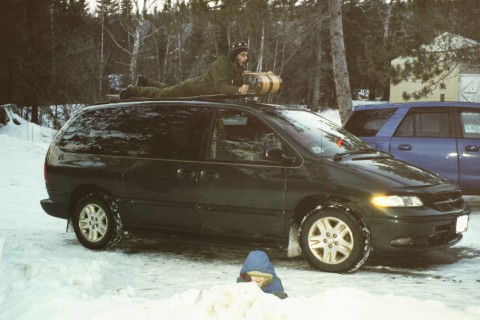
    This is a picture of my crazy Canadian son-in-law, Joel. In the foreground is our grandson, Joshua, who just turned one on Wednesday.

    For those of you in Kentucky, what he is on is a toboggan, what he has on his head is a toque—pronounced tuk, long u (I have seen it spelled other ways). I know you think toboggans go on the head, but as you can see, that would be ridiculous :)

    Whatever Happened to Worship Chapter 2

    "There is all around us, however, a very evident and continuing substitute for worship. I speak of the compelling temptation among Christian believers to be constantly engaged, during every waking hour, in religious activity.

    "We cannot deny that it is definitely a churchly idea of service. Many of our sermons and much of our contemporary ecclesiastical teaching lean toward the idea that it is surely God's plan for us to be busy, busy—because it is the best cause in the world in which we are involved.

    "But if there is any honesty left in us, it persuades us in our quieter moments that true spiritual worship is at a discouragingly low ebb among professing Christians.

    "Do we dare ask how we have reached this state? If you are willing to ask it, I am willing to try to answer it.

    "Actually, I will answer it by asking another obvious question. How can our approach to worship be any more vital than it is when so many who lead us, both in the pulpit and in the pew, give little indication that the fellowship of God is delightful beyond telling?"

    <idle musing>
    Amen!
    </idle musing>

    Thursday, March 09, 2006

    Quote for the day

    "Philology is that venerable art which requires of those who honor her one thing above all: to turn aside, to take one's time, to become still and slow.... Precisely for this reason, she is more necessary today than ever, precisely on this account, she attracts and enchants us most powerfully, in an age of "work," which is to say, haste, the unseemly and sweating hurry that wants to be "done" with everything right away, even with every old and new book. She herself will not so easily be done with anything, she instructs reading well, that means, slowly, deeply, carefully, regardfully, looking forward and backward, with second thoughts, with doors left open, reading with delicate fingers and eyes..." F. Nietzsche, Morgenröte

    Compliments of John Cook, acquisitions editor, Eisenbrauns.

    Whatever Happened to Worship

    I just began Tozer's Whatever Happened to Worship. It is a selection of his sermons from when he was in Toronto. He was intending to write a book on worship, so was preaching sermons along those lines to get ready. Before he could write the book, he died. So, they have collected a selection of 10 of these sermons and put them in book form. This is from page 14, the title of the sermon is "Worship in the Christian Church:"

    "...nowadays there is a deadly, automatic quality about getting saved. It bothers me greatly.

    "I say an 'automatic' quality: 'Put a nickel's worth of faith in the slot, pull down the lever and take out the little card of salvation. Tuck it in your wallet and off you go."

    "After that the man or woman can say, 'Yes, I'm saved.'

    "How does he or she know?

    "'I put the nickel in. I accepted Jesus and I signed the card.'

    "Very good, there is nothing intrinsically wrong with signing a card. It can be a very helpful thing so we can know who made an inquiry.

    "But really, my brother or sister, we are brought to God and to faith and to salvation that we might worship and adore Him. We do not come to God that we might be automatic Christians, cookie-cutter Christians, Christians stamped out with a die.

    "God has provided His salvation that we might be, individually and personally, vibrant children of God, loving God with all our hearts and worshiping Him, in the beauty of holiness."

    <idle musing>
    I love Tozer, he is my favorite 20th century "popular" Christian author. He never leaves you in doubt where you stand. If you have never read any Tozer, I would recommend you start with The Pursuit of God, especially the first and last chapters. You would never know he wrote over 40 years ago, it sounds just as applicable today.
    </idle musing>

    Wednesday, March 08, 2006

    A new book from Eisenbrauns

    Long delayed, because the author was struck by a car while crossing the street before finishing the revisions, this book finally has been published.


    Two Strange Beasts

    Two Strange Beasts
    Leviathan and Behemoth in Second Temple and Early Rabbinic Judaism
    Harvard Semitic Monographs - HSM 63
    by K. William Whitney Jr.
    Harvard Semitic Museum / Eisenbrauns, 2006
    Pp. xvi + 216, English
    Cloth, 6 x 9 inches
    ISBN: 1575069148
    List Price: 34.95
    Your Price: $32.50
    http://www.eisenbrauns.com/wconnect/wc.dll?ebGate~EIS~~I~WHITWOSTR

    Final note from The Training of the Twelve

    Bruce’s exposition on the coming of the Holy Spirit is good. Bear in mind that this was written in 1871, before Azusa Street and the modern Pentecostal movement.

    “Such being the power promised, it was evidently indispensable for success. Vain were official titles—apostles, evangelists, pastors, teachers, rulers; vain clerical robes, without this garment of divine power to clothe the souls of the eleven. Vain then, and equally vain now. The world is to be evangelized, not by men invested with ecclesiastical dignities and with parti-colored garments, but by men who have experienced the baptism of the Holy Ghost, and who are visibly endued with the divine power of wisdom, and love and zeal.

    “As the promised power was indispensable, so it was in its nature a thing simply to be waited for. The disciples were directed to tarry till it came. They were neither to attempt to do without it, nor were they to try to get it up. And they were wise enough to follow their instructions. They fully understood that the power was needful, and that it could not be got up, but must come down. All are not equally wise. Many virtually assume that the power Christ spake of can dispensed with, and that in fact it is not a reality, but a chimera. Others, more devout, believe in the power, but not in man’s impotence to invest himself with it. They try to get the power up by working themselves and others into a frenzy of excitement. Failure sooner or later convinces both parties of their mistake, showing the one that to produce spiritual results something more than eloquence, intellect, money, and organization are required; and showing the other that true spiritual power cannot be produced, like electric sparks, by the friction of excitement, but must come sovereignly and graciously down from on high.”

    <idle musing>
    Well, I finished the book 27 years after starting it. Of course, I had to start over again when I started reading it. On the whole, the book was good, but not great—certainly not as great as I had been led to believe. There were some gems in it, as you can see from the last month or so. I would say the last 120 pages were the best. This quote certainly is right on. We so often try to do it ourselves, either by ignoring the Holy Spirit or by trying to induce him ourselves. God will have neither extreme, since they both are not God, but man.
    </idle musing>

    Tuesday, March 07, 2006

    Yet again from The Training of the Twelve

    This is from page 528-529, Jesus' discourse with Peter at the end of gospel according to John.

    "The responsibility of even the highest in the Church is restricted within comparatively narrow limits. The main business, even of the chief under-shepherds, is not to make others follow Christ, but to follow Him themselves. It is well that our Lord made this plain by the words addressed to the representative man among the apostles; for Christians of the active, energetic, and earnest natures are very apt to have very exaggerated ideas of their responsibilities, and to take on themselves the care of the whole world, and impose on themselves the duty of remedying every evil that is done under the sun. They would be defenders-general of the faith wherever assailed, redressers-general of all wrongs, curates-general of all souls. There is something noble as well as quixotic in this temper; and it were not the best sign of a man’s moral earnestness if he had not at some time of his life known somewhat of this fussy, over-zealous spirit. Still it should be understood that the Head of the Church imposes on no man such unlimited responsibility, and that, when self-imposed it does not conduce to a man’s real usefulness. No one man can do all other men’s work, and no one man is responsible for all other men’s errors and failures; and each man contributes most effectually and surely to the good of the whole by conducting his own life on godly principles. The world is full of evils—skepticism, superstition, ignorance, immorality, on every side—a sight saddening in the extreme. “What then, am I to do?” This one thing above all: Follow thou Christ. Be thou a believer, let who will be infidels. Let thy religion be reasonable, let who will pin their faith to a fallible human authority, and place their religion in fantastic ritualisms and gross idolatries. Be thou holy, an example of sobriety, justice, and godliness, though all the world should become a sweltering chaos of impurity, fraud, and impiety. Say with Joshua of old, “If it seem good unto you to serve the Lord, choose you this day whom ye will serve; but as for me and my house, we will serve the Lord.”

    "The repeated injunction, “Follow thou me,” whilst restricting individual responsibility, prescribes undivided attention to personal duty. Christ demands of His disciples that they follow Him with integrity of heart, without distraction, without murmuring, envy, or calculations of consequences.”

    <idle musing>
    How like us to want to take more responsibility than God is calling us to. Ever since Genesis 3, we want to play God. And just as then, we can't! We are called only to follow Christ and let him be God. I've found that he does a much better job of it than I do. Maybe because I am not God and he is?
    </idle musing>

    Monday, March 06, 2006

    Yet more from The Training of the Twelve

    Another gem from The Training of the Twelve , he is discoursing on Jesus' upcoming death by crucifixion and he says:

    “The prince of this world has found none of his spirit in Him, and for that very reason is going to crucify Him. But by that proceeding Satan will not nullify, but rather seal His victory. Outward defeat by worldly power will be but the index and measure of His spiritual conquest. The world itself knows well that putting Him to death is the second best way of overcoming Him. His enemies would have been much better pleased if they had succeeded in intimidating or bribing Him into compromise. The ungodly powers of the world always prefer corruption to persecution as a means of getting rid of truth and righteousness; only after failing in attempts to debauch conscience and make men venal, do the have recourse to violence.”

    <idle musing>
    Interesting and very true observation. Compromise is what the world desires, singleness of intention is what God wants. True then, true now.
    </idle musing>

    Saturday, March 04, 2006

    First Break All the Rules Chapter 2

    Continuing from chapter one, where the 12 questions are laid out and the first 6 are declared to be basic, chapter two says:

    "To warrant positive answers to these questions from his employees, a manager must be able to do four activities extremely well: select a person, set expectations, motivate the person, develop the person. These four activities are the manager's most important responsibilities. You might have all the vision, charisma, and intelligence in the world, but if you cannot perform these four activities well, you will never excel as a manager." p. 59 (italics theirs)

    And they continue on page 67 (emphasis theirs):
    "People don't change that much.
    Don't waste time trying to put in what was left out.
    Try to draw out what was left in.
    That is hard enough.


    "If you apply their insight to the core activities of the catalyst role, this is waht you see:

    *When selecting someone, they select for talent...not simply experience, intelligence, or determination.
    *When setting expectations, the define the right outcomes...not the right steps.
    *When motivating someone, they focus on strengths...not on weaknesses.
    *When developing someone, they help him find the right fit...not simply the next rung on the ladder."

    <idle musing>
    Of course, the problem is in applying it :) We are doing a chapter a week, so I will be posting on this book about once a week. We'll see how I do at applying this stuff. It is equally valid in more than just work, seems like the advice about trying to change someone applies in marriage and friendships, too...
    </idle musing>

    Thursday, March 02, 2006

    Why I don't follow professional cycling anymore

    The Boulder Report has an article about the decision to uphold the ban against Tyler Hamilton for doping.

    Tyler was generally considered the "good guy" in cycling, until the Olympics 2 years ago and then the Tour of Spain when he got busted for "doping." His version wasn't drugs, it was using blood transfusions to boost his body's ability to carry more oxygen in the bloodstream—by as much as 20%!. Until 2.5 years ago this was undetectable, but not anymore and Tyler was one of the big fish they caught.

    I had pretty much given up following professional cycling by then, anyway, but this was the final nail in the coffin. Until cycling cleans up it's act, I won't follow it. I haven't followed the Tour de France for 3 years now, and I used to be avid.

    I will continue to ride because I love cycling. But, I won't follow who is doing what. Of course, there is also the obscene amounts of money that the big names make...

    More from The Training of the Twelve

    I’m still slogging my way through The Training of the Twelve. There are some good insights, but they are far between. Normally when I read a book, I mark interesting sections with a part of a yellow sticky note to read to Debbie later. On some books that results in something looking like a fruit tree bearing much (yellow) fruit. Well, this book has managed to garner 5 in over 400 pages. Not a good harvest.

    But last night I ran across this on page 423:

    “To be hated and evil entreated is one of the penalties of moral greatness and spiritual power; or, to put it differently, one of the privileges Christ confers on His ‘friends.’

    “Hatred is very hard to bear, and the desire to escape it is one main cause of unfaithfulness and unfruitfulness. Good men shape their conduct so as to keep out of trouble, and through excess cowardly prudence degenerate into spiritual nonentities.”

    <idle musing>
    “degenerate into spiritual nonentities!” Wow, that hit me hard when I read it last night. Is that what happens to “good men?” The context of the statement is in a discussion of the upper room discourse in John. Jesus is talking about what will happen to the disciples once he is gone—they will suffer persecution. Either they endure it by the indwelling power of the Paracletos, or they will succumb and become “spiritual nonentities.”

    I don’t know about you, but I don’t want to be a spiritual nonentity. That sounds too boring and dull—quite apart from the eternal consequences. May we all become spiritual entities worthy of the name of Jesus!
    </idle musing>

    Wednesday, March 01, 2006

    Marriage

    A Place for the God-Hungry has the first 10 items, out of a projected 41, that married people ought to know. Good thoughts, worth reading. He starts out strong:

    1. Married people are called to move away from self-centeredness and toward self-lessness. The "self" has a way of getting in the way of a good marriage.

    and ends just as strongly:

    9. Married people need to come to grips with the reality of the sin they are inflicting on one another. Consider these: harshness, rudeness, impatience, self-centeredness, pride, willfully inflicting pain, etc.

    10. How utterly foolish for husbands or wives to run down their mates just to get a cheap laugh from co-workers. What about the second most important commandment, "Love your neighbor as yourself"? Is this the way mature men and women treat one another?

    And everything in between is worth reading, too.

    <idle musing>
    With regards to 1: selfishness/the self, the old man tends to get in the way of more than just a good marriage!
    </idle musing>

    Tuesday, February 28, 2006

    Trust

    A nice post over at The Heresy on trust. I quote in part:

    "...Mistakes and failings in a relationship are often an opportunity to build trust. Being able to genuinely admit wrong doing can do a lot to bolster a relationship. Being able to forgive does the same.

    "I think one of the reasons why church people are so rarely different from the rest of world is that we often don't trust one another. If we don't trust one another we don't make a way for others help us to become more like Christ. Often people live under an unhealthy fear of personal judgment so people hide their true selves.

    "The most common philosophy of ministry assumes we facilitate change in people by challenging their thinking through preaching. This way we can change their worldview and ultimately their character. This might happen in a few rare cases but for the most part it doesn't work. There are communication issues. There are issues with the hearer that skew the message. When a person is listening in a crowd it is too easy to disregard the truth they hear. Without the relationship the message gets lost."


    <idle musing>
    Trust is an easy thing to lose, a hard thing to regain, but I think Leighton is right here. If we are secure in who we are in Christ, we should welcome people's comments. How can we see those blind spots without other people speaking into our lives? Easy to say, hard to do...
    </idle musing>

    Reading versus decoding Greek

    In a continuation of the post on Latin, I turn now to Greek. Yesterday on the B-Greek list Dr. Conrad had a wonderful post, a long excerpt of which I include here (with his permission):

    "When I came to teach Greek in a classroom on my own, I quickly became aware of the problematic nature of grammatical knowledge both as something necessary and as something having curiously little connection with ability to read Greek successfully. I’ve seen too many students who knew the paradigms and the rules but couldn’t read sequential Greek textual material, and I’ve also seen some who could read Greek texts pretty well but weren’t very good at grammatical analysis.

    "Why is that? I think that two not-unrelated factors are at work:

    "(1) Students who have learned by the traditional textbooks and pedagogy know the paradigms and the rules of grammar and have learned the vocabulary, but they attack the Greek text as a problem to be analyzed, as a step-by-step hunt for the subject and the verb and the modifiers and then a synthesis of the pieces rather than as an integrated whole: they readily discern the Greek trees by genus and species, but they are lost in the forest of Greek discourse.

    "(2) Another metaphor I’ve met with frequently of late is that these students view a Greek text as a sequence of cryptograms to be deciphered: for them, reading Greek is a process of DECODING an alien script — and that involves transcribing an alien script into an intelligible script. Generally that means TRANSLATING the Greek text into the student’s native language, more or less item-by-item. The false assumption here is that UNDERSTANDING a Greek text is fundamentally a matter of producing a corresponding text in one’s native language such that each item in the Greek text has its corresponding term in one’s native language. But in fact, nothing could be much farther from the truth; TRANSLATING is by no means the same as UNDERSTANDING the Greek original text. Accurate translation does presuppose the understanding of the original text, but that text must first be understood on its own terms: unless one can grasp the thought of the writer/speaker in its own format, think that thought as the writer/speaker thought it and as the original reader/listener read/heard it in the original Greek, one will not be able to re-express the sense in the intelligible idiom of one’s own native language. Reading Greek is not a matter of decoding a script and it is not a matter of converting the elements of a formula into another script; rather, it is a matter of THINKING in Greek.

    "In the course of my own teaching of Greek I tried several different textbooks. I came to feel more and more that traditional instruction focused on learning rules and vocabulary lists and paradigms and then TRANSLATING sentences from Greek to English and English to Greek (sentences all too often composed by textbook-authors in quite unidiomatic Greek and English) would work only with the exceptional students who actually went beyond those procedures and internalized the language in a manner not altogether different from the way children learn their native tongue. I knew that I myself had acquired as much fluency as I had in Greek and Latin through reading long sequential texts of good (and some less good) ancient authors. I felt that what was needed was a textbook that moved as soon as possible into sequential discourse in the Greek or Latin. Of the traditional type of textbooks the best I ever found for classical Attic was Hansen and Quinn (the sentences were written with authentic understanding of both Greek and English idiom). But I was really looking for something that focused on getting the student to THINK IN GREEK...

    "I later discovered and for the rest of my teaching career I used the JACT “Reading Greek” course, delighted to have a textbook that begins from the outset with sequential readings: dialogue and simple narrative all in good, solid idiomatic Attic and moving quickly into barely altered original texts from Aristophanes and then from Demosthenes and Plato and Herodotus and the Odyssey, all in the train of a single course. Like the Ruck text, Reading Greek had exercises in manipulating phrases and understanding words in contexts, and the testing was in terms of sharply re-paraphrased narratives based upon the readings of the preceding lesson. The entire focus of the course was upon reading skills. Grammar was introduced as necessary in order to explain the constructions introduced in the reading passages of the new lesson, but it was rather minimal and was in fact a sort of metalanguage used when necessary to TALK about the language and how it works AFTER experiencing through confrontation with the text the language in pragmatic application.

    "I confess that in the course of my teaching from the JACT Reading Greek I found it necessary to construct my own supplementary grammatical materials to distribute to my classes to assist them to use traditional grammars to answer their questions and to be able to talk about how the language works in courses with other instructors to which they would move on from my Beginning Greek course. I always had mixed feelings about this grammar: that it is a necessary evil: both necessary and an evil. What one needs the grammar for is analysis of HOW a Greek text works; one doesn’t really need it in order to learn to read or speak the language. The grammar is a metalanguage to be used to discuss how the language works. Frankly, I have come to think that Randall Buth is right in thinking that, insofar as this metalanguage of grammar is necessary, it really would be better to use Greek for the grammatical metalanguage if the language one is trying to learn is Greek.

    "Why? One reason for it is that the grammar that we use most to talk about Biblical Greek is a metalanguage that aims at facilitating translation into English or some other target language. The categories in BDF or Smyth, all the more those of Wallace’s GGBB, are phrased in terms of how to convert the Greek construction into an idiomatic English equivalent construction RATHER than how to understand the Greek construction in its own terms. How can that be improved upon? Probably the grammar to be used for studying Biblical Greek should be written in a Greek that is as close to Biblical Greek as possible even if vocabulary must be added to accommodate concepts about the language not adequately dealt with in the grammar of the Hellenistic schools."

    <idle musing>
    I have heard similar statements from others who use the JACT. I have never used it, when I was teaching first year Greek, the text was chosen by someone else and it was Chase & Phillips. When I taught second year Greek, my emphasis was on reading large amounts of text, since that is how you learn a language. I also supplemented the readings with my own grammatical and syntactical notes (long gone, they were on 5.25" disks in some obscure word processing format).

    I think that the balance here is good. You get students reading Greek, you supplement with grammatical notes. You need both, students need a framework to hang things on, but the emphasis should always be the existing text(s).
    </idle musing>

    Monday, February 27, 2006

    First Break All the Rules part 1

    I’m continuing to read First, Break All the Rules. Last time I mentioned that there are 12 questions and I listed 3 of them. Well, I should have kept reading, because the next section says that the questions are in that order for a reason. They liken the task of managing to an expedition to climb a mountain. You need certain foundations before you can get out of base camp, and each successive camp has its requirements. Just as you can’t helicopter into camp 3 and expect to take the peak, so you can’t choose which of the questions are more important. They build on one another, sort of like trying to start geometry half way through the year. You won’t know the proofs that allow you to state certain truths.

    All this to say that the “base camp” questions are the first two:
    1. Do I know what is expected of me at work?
    2. Do I have the materials and equipment I need to do my work right?

    If as an employee, I don’t know the answers to these two questions, I will not be able to perform well. I will always be wondering whether or not I’m doing a good job or I will be struggling to find the tools I need to do it right.

    “Camp 1” has asks 4 questions, all related to your individual contribution to the company:
    3. At work, do I have the opportunity to do what I do best everyday?
    4. In the last seven days, have I received recognition or praise for doing good work?
    5. Does my supervisor, or someone at work, seem to care about me as a person?
    6. Is there someone at work who encourages my development?

    These six of the 12 questions have to be answered before there can be any hope of better than mediocre performance. Without these six, there can be no “learning organization” and no “quality company.” No wonder all the innovations and re-organizations fall flat! We are trying to start halfway up the mountain without allowing people to get acclimatized.

    Sunday, February 26, 2006

    Is Christianity safe or is it exciting?

    Scot McKnight has a large excerpt from Brennan Manning here about Settler versus Pioneer Christianity. Well worth the read, I'm going to have to get the book...of course it's out of print :(

    "In Settler Theology, the church is the courthouse. It is the center of town life. The old stone structure dominates the town square. Its windows are small and this makes things dark inside. Within the courthouse walls, records are kept, taxes collected, trials held for bad guys. The courthouse is the settler’s symbol of law, order, stability, and—most importantly—security. The mayor’s office is on the top floor. His eagle eye ferrets out the smallest details of town life.

    "In Pioneer Theology, the church is the covered wagon. It’s a house on wheels, always on the move. The covered wagon is where the pioneers eat, sleep, fight, love and die. It bears the marks of life and movement—it creaks, is scarred with arrows, bandaged with baling wire. The covered wagon is always where the action is. It moves toward the future and doesn’t bother to glorify its own ruts. The old wagon isn’t comfortable, but the pioneers don’t mind. They are more into adventure than comfort."

    It continues on from there...

    <idle musing>
    I always tell my kids (now 21 & 24!) that Christianity is like a ride on a backwards roller coaster. You don't have a clue what is coming next, but you know you aren't going to fall off and that it will be exciting. Of course, I love roller coasters, as do my kids (and Debbie, too), so you know which version of Christianity I want.

    I don't have time for "safe" Christianity. If Jesus called us to be safe, then I must have misread the New Testament, because I sure don't see it there. As I listen to Christian radio or read some popular Christian paperback (OK, not very often) or listen to Christians, I hear a recurring theme, and it makes me want to throw-up: The safe radio station, you're kids won't hear anything naughty. The safe book, you won't have to think. "I just want my kids to grow up in a safe environment." Hogwash! You don't need faith if that is what you want! All you need is a big fence. Defend the status quo, worship your false gods of security and status, financial success and ladder climbing if you want. But, when the final call comes, don't expect a "well done" from the master. He calls us to live by faith, radical faith. Romans 12:2 is quite clear about that, "Do not conform any longer to the pattern of this world, but be transformed by the renewing of your mind. Then you will be able to test and approve what God's will is—his good, pleasing and perfect will."

    An equally valid translation of "Do not conform any longer" would be "Stop conforming." I like that, it is a call to a deeper walk, one that is reliant on the Holy Spirit, not on rules or the dying momentum from an encounter with God once upon a time in your past. As C.S. Lewis says in The Last Battle, "Higher up and deeper in." That is the cry of my heart and I pray that it is yours too!
    </idle musing>

    Friday, February 24, 2006

    Another book

    I now have 3 books going. I don't usually like to have more than 2—1 at work and 1 at home—but Jim has asked some of us to read a book on management. Yes, in the modern world, not antiquity :) So, I have begun First, Break All the Rules.

    It's actually a very interesting book, based on over 25 years of interviews and surveys with a large number of people (they claim over a million). They have come up with 12 questions that distinguish a great manager from any other. Interesting questions, I am just too lazy to type them all, so here are a few:

    1. Do I know what is expected of me at work?
    4. In the last seven days, have I received recognition or praise for doing good work?
    7. At work, do my opinions seem to count?

    Good questions, and the answers do matter.

    Thursday, February 23, 2006

    Reading versus decoding Latin

    I mentioned this yesterday. I have been reading Greek for over 25 years and Latin and Hebrew for over 20. Well, that is not quite true, there was a 10 year period where I didn't do any Greek or Hebrew and a 15 year period where I didn't touch Latin.

    I have been working at resurrecting my Latin for awhile now, reading Augustine's Confessions in the Latin. So, there has been an ongoing discussion on the Classics-L list about reading versus decoding. The difference is that with decoding, you are always "looking for the verb" whereas in reading you allow what comes next in the sentence as written to be registered by your brain--as you do in English. You don't (I hope) read English thinking, "OK, now where is the verb, where is the subject," etc. Ginny is always recommending a book by Dexter Hoyos, Latin: How to Read it Fluently. The other day she mentioned using a "reading card." I had never heard of that before, so I asked her. She referred me to her blog for this explanation:

    "Reading cards can be nothing more than an index card in which you've clipped out the top left hand corner in the shape of a rectangle that's, say, an inch and a half wide and half an inch down. When you place this on top of a text it prevents you from looking ahead in a sentence. You then reveal one word at a time, considering exactly what you have and therefore what you expect...

    "...because you take it one word at a time and don't immediately go huntin' that verb, you make yourself retrain your brain. This is one reason why I teach metaphrasing from the very beginning when it is dirt easy. Hey, all I have in 7th grade so far are accusatives and nominatives, but when we are reading words glossed below the story and villam is the item, we say, "Someone verbed the house." There's meaning in that ending, even in isolation, and we shouldn't ignore it."

    Sounds simple, and it is. But, surprise of surprises, I did that with Greek, to check myself, and found that after 25 years, I was still "decoding" Greek! :( Try it, you might be surprised, unpleasantly. I am now trying to retrain my brain to see the language as it comes, a bit of work, but I think it will be worth it. I haven't gotten the Hoyos book yet, but am looking forward to it. Maybe Eisenbrauns should think about carrying it—I'll decide after I have read it. If the concepts carry over to other languages, we will.

    Wednesday, February 22, 2006

    A wander around blogdom

    Quite a few interesting posts the last two days around the blogosphere:

    Jim West points to a humorous post by Stephen Carlson about "On this day." I like this one:
    "On Feb. 21, 303, Origen interpreted Matt 19:12 literally. Later that afternoon, he founds the Alexandrian school of allegorical interpretation." Ouch! I think I would have too!

    The Heresy has a nice series of posts musing on churchs, church growth, etc. I like the top 20, my favorite is the 20th—
    20 Lastly, set up a blog on church planting. Link to other bloggers on church planting. They link to you. Add smoke and mirrors.

    A Place for the God-Hungry has a nice post on silence, not the good kind:

    # You pour out your heart to your friend and your friend doesn't respond. In fact, she changes the subject. No positive response. No negative response. Nothing.
    # You write a letter of serious concerns to your minister or other church leaders. You never hear a reply.
    # You express some deep personal concerns to your Dad or Mom in an e-mail. These were difficult for you to write. You never hear back from your parents.
    # You share a struggle with a small group of friends. Silence. Everyone sits there and looks at you. No response.
    # You express an opinion in a class. The teacher doesn't even acknowledge what you said. He is silent for a few seconds and then moves on with his material. For a moment you feel quite silly.
    # You volunteer to help and no one says anything in response. Nothing.

    He follows it up with some good insights.

    House Church Blog has an older (February 18th) post on The Participatory Gathering
    "Having come from a "presentation service" background (in which I was doing much of the presenting), I LOVE participatory gatherings in which every person engages in the process of digging into Scripture and drawing out of God’s word His teaching and His living message for the moment. I so enjoy seeing people recognize that he/she is fully capable of going to Scripture, encountering God and truth, and sharing that truth with others. I love seeing this process take place within community and am constantly in awe of the way in which God’s word is expressed through every person present."

    The Jesus Community has a good post on humility, picking up on something Scot McKnight said yesterday:

    "Humility is able to see how one fits into the big picture. Not thinking too highly of where one fits nor thinking too low. Humility is quick to see the good and contribution of others.

    "Humility at its base has to do with identity. Self-identity. Knowing God. Respecting and appreciating others."

    And Lawson Stone has moved his blog to here.

    Enough for now...since I would run out of time to comment on Joe Cathey's post on Michael Card, Jim West's post about the Garbini book, the discussion I am having with Ginny Lindzey about actually reading Latin versus decoding it (hopefully more on that later)...

    Monday, February 20, 2006

    More from The Training of the Twelve

    I am finally back to reading this book after being distracted from it for almost two weeks. Either the book has gotten better, or where I am at in life has changed my perspective :} Anyway, he has a very interesting statement on page 202 (yes, I made it past page 200 this time!). He has just finished talking about the temple tax and how Jesus had Peter go fishing for it. After observing that Jesus by rights shouldn't have to pay the tax, since he was God in the flesh, says the following:

    "The lowly One did not assume this attitude, but gave what was asked without complaint, grudging, or railing; and His conduct conveys a lesson for Christians in all ages, and in our own age in particular. It teaches the children of the kingdom not to murmur because the world does not recognize their status and dignity. The world knew not when He came, even God's eternal Son; what wonder if it recognize not His younger brethren! The kingdom of heaven itself is not believed in, and its citizens should not be surprised at any want of respect towards them individually. The manifestation of the sons of God is one of the things for which Christians wait in hope. For the present they are not the children, but the strangers; instead of exemption from burdens, they should rather expect oppression; and they should be thankful when they are put on a level with their fellow-creatures, and get the benefit of a law of toleration."

    <idle musing>
    This was written in 1871, how much truer today! As Christians complain that laws don't favor them or discriminate against them, this is a refreshing view. Bruce's perspective is not on the earthly, short-term, but on the heavenly, long-term. As Christians we should be content if we are not persecuted and not demand that society follow our mores. Far cry from Dominion Theology, isn't it?
    </idle musing>

    Friday, February 17, 2006

    Post-charismatic

    The Heresy has a link to this post by Robby Mac about people who have left the charismatic movement. He gives a good overview of the history and background to today's "full Spirit" groups and some of the excesses and problems which are causing people to leave. A good read, it links to a series of pages.

    <idle musing>
    I never had a name for it before, but it does summarize where I am at. "Saved" in the Jesus Movement, I got disillusioned by the charismatic movement in the late 1970s as a result of the "name it, claim it, stomp on it and frame it" mentality. That coupled with the shepherding movement's excesses caused me to walk away. I never went back, but never was "anti-Spirit" or gifts, just the excesses and mis-uses. Consequently, I missed quite a few of the excesses that came along later.

    I do have a few disagreements with the article:
    1. John Wesley never taught free will, he taught free grace. A subtle, but very significant (actually huge) distinction. He believed in the bondage of the will, but believed that prevenient grace was able to raise a person's awareness of their state to the point where they saw the need for God. But, it was all God from beginning to end. This is a huge point that needs to be taught to all Wesleyan-Arminians, it is not a free will thing, but a free grace thing.

    <Update after walking to work>
    Wesley taught assurance of salvation, something quite uncommon at his time. This was a result of the influence of the Moravians, and became a Wesleyan distinctive. Perhaps this is where Robby gets his theory for the need for outward signs that one is saved? I really don't think it is a result of the Wesleyan belief that one can lose one's salvation, but I might be wrong. Anyway, its 8:00, time to work.
    </Update after walking to work>

    2. He fails to mention that a goodly number of Keswick people were Calvinists. It was truly an ecumenical movement, initiated by God. But, he needs to have it be Wesleyan-Arminian to fit his thesis of why the outward manifestations were so important.

    Other than those quibbles, it is very good.
    </idle musing>

    Thursday, February 16, 2006

    Church on fire

    I was wandering around some sites I hadn't visited for a while yesterday before work, and ran across this at House2House. I'm quite certain it is fiction, but the principle is what counts. I especially like this exchange:

    ...He scanned the remains of the sanctuary, "Church was on fire," he said simply.
    "We were insured. Hopefully we can find a place to meet until we rebuild."

    "That's not what I meant," said Buck. "The building burned down. The church was on fire. You didn't notice?"

    "I'm not sure what. . ."

    "Some of these folks haven't been that close since," he gestured toward the table, "…well I don't know. I never seen Thelma Kaiser and Mary Criswell stand next to each other like they did today. They held hands during the prayer."

    "It's amazing what can happen if the need arises."

    "Y’know what I think? I think we had all we needed today. We had bread, a cup, a table . . . and we had each other. The Good Lord showed up, too. I don't think you'll rebuild this church any better than it was today. Fire burned up the building. It built the church."

    The Reverend Turley was silent.

    Buck reduced the ashen pages of a hymnal to powder with the toe of his boot. "Gordon, it's bothered me for years," he began again. "I keep readin' and readin' in my Bible and I can't find most all the stuff we did in this place. Somebody's house or even the back room of my store seems to fit better what I read about the church."

    Wednesday, February 15, 2006

    Quote for the day

    "It's discouraging to think how many people are shocked by honesty and how few by deceit." Noel Coward

    Tuesday, February 14, 2006

    New technology

    I received this from a programmer friend of mine. I think Eisenbrauns will jump on this new technology :)

    Introducing the new Bio-Optic Organized Knowledge device, trade named: B.O.O.K This is a revolutionary breakthrough in technology: no wires, no electric circuits, no batteries, nothing to be connected or switched on. It's so easy to use, even a child can operate it.

    Compact and portable, it can be used anywhere -- even sitting in an armchair by the fire -- yet it is powerful enough to hold as much information as a CD-ROM disc. Here's how it works:

    B.O.O.K is constructed of sequentially numbered sheets of paper (recyclable), each capable of holding thousands of bits of information. The pages are locked together with a custom-fit device called a binder, which keeps the sheets in their correct sequence.

    Opaque Paper Technology (OPT) allows manufacturers to use both sides of the sheet, doubling the information density and cutting costs. Experts are divided on the prospects for further increases in information density; for now, B.O.O.Ks with more information simply use more pages.

    Each sheet is scanned optically, registering information directly into your brain. A flick of the finger takes you to the next sheet. B.O.O.K may be taken up at any time and used merely by opening it.

    Unlike other display devices, B.O.O.K never crashes or requires rebooting, and it can even be dropped on the floor or stepped on without damage. However, it can become unusable if immersed in water for a significant period of time. The "browse" feature allows you to move instantly to any sheet and move forward or backward as you wish. Many come with an "index" feature, which pinpoints the exact location of selected information for instant retrieval.

    An optional "B.O.O.Kmark" accessory allows you to open B.O.O.K to the exact place you left it in a previous session–even if the B.O.O.K has been closed.

    B.O.O.Kmarks fit universal design standards; thus, a single B.O.O.Kmark can be used in B.O.O.Ks by various manufacturers.

    Conversely, numerous B.O.O.Kmarkers can be used in a single B.O.O.K if the user wants to store numerous views at once. The number is limited only by the number of pages in the B.O.O.K.

    You can also make personal notes next to B.O.O.K text entries with an optional programming tool, the Portable Erasable Nib Cryptic Intercommunication Language Stylus (PENCILS).

    Portable, durable, and affordable, B.O.O.K is being hailed as a precursor of a new entertainment wave. Also, B.O.O.K's appeal seems so certain that thousands of content creators have committed to the platform and investors are reportedly flocking. Look for a flood of new titles soon.

    Monday, February 13, 2006

    We can't do this alone

    There is a nice little post over at A Place For the God-Hungry about what we have as Christians. Here is the summary at the end:

    • Christ in you means that you can rest in his completed work. It's not up to you.

    • Christ in you means you are wealthy. Forget the lottery! Fourteen million in the Lotto Texas jackpot this week? It doesn't even begin to compare to what you already have in Christ.

    • Christ in you means you can rest in his grace. You don’t have to worry about what will happen with your future. The pressure is off.

    • Christ in you means you no longer have to settle for the leftovers of life. You can experience God’s best, which is Jesus himself.

    • Christ in you means you have access to the very life of God. No one can take that away from you.

    • Christ in you means you can come to the end of this life and live in the presence of God forever.

    <idle musing>
    I find this knowledge to be very freeing. I don't have to know everything, do everything, He has already done it. I just have to accept and obey—and even that obedience is a result of His free grace poured out on me!
    </idle musing>

    3 new books!

    Friday we got 3 new books in. Check these out:


    Judah and the Judeans in the Persian Period

    Judah and the Judeans in the Persian Period
    EIS - Eisenbrauns
    Edited by Oded Lipschits and Manfred Oeming
    Eisenbrauns, 2006
    xxii + 722 pages, English
    Cloth , 6 x 9 inches ,
    ISBN: 157506104X
    Your Price: $59.50
    http://www.eisenbrauns.com/wconnect/wc.dll?ebGate~EIS~~I~OEMJUDAHA


    Ancient Israel's History and Historiography

    Ancient Israel's History and Historiography
    The First Temple Period
    Collected Essays, volume 3
    EIS - Eisenbrauns
    by Nadav Na'aman
    Eisenbrauns, 2006
    xiv + 415 pages, English
    Cloth , 6 x 9 ,
    ISBN: 1575061147
    Your Price: $49.50
    http://www.eisenbrauns.com/wconnect/wc.dll?ebGate~EIS~~I~NAAHISTOR


    The End of Wisdom

    The End of Wisdom
    A Reappraisal of the Historical and Canonical Function of Ecclesiastes
    EIS - Eisenbrauns
    by Martin A. Shields
    Eisenbrauns, 2006
    xiii + 250 pages, English
    Cloth
    ISBN: 1575061023
    Your Price: $37.50
    http://www.eisenbrauns.com/wconnect/wc.dll?ebGate~EIS~~I~SHIENDOFW

    Saturday, February 11, 2006

    Diversity

    <idle musing for a Saturday night>
    I’m sitting at my desk listening to Third Day. Earlier while I was riding my bike on the stand (hey, it’s 25 degrees out!) I was listening to Petra and I’ll probably put Handel’s Water Music in next. Diversity.

    Earlier today I made rye bread. I used light rye instead of the dark rye that I normally use. Debbie commented it tasted different. I told her I used light rye. Next week I’ll make whole wheat bread. Last week I made pita bread. Diversity.

    I like snow, some don’t. I like four seasons, some don’t. More diversity. Diversity is good, it is part of creation. We need diversity, we need the strengths of others. When we try to get others to think like us, we lose an important part of what God is doing in the world. We need to allow people to become who they were created to be.

    “Now there are varieties of gifts, but the same Spirit; and there are varieties of service, but the same Lord; and there are varieties of working, but it is the same God who inspires them all in every one. To each is given the manifestation of the Spirit for the common good...Now you are the body of Christ and individually members of it. And God has appointed in the church first apostles, second prophets, third
    teachers, then workers of miracles, then healers, helpers, administrators, speakers in various kinds of tongues. Are all apostles? Are all prophets? Are all teachers? Do all work miracles? Do all possess gifts of healing? Do all speak with tongues? Do all interpret?” I Corinthians 12: 4-7, 27-30 (RSV)

    Without getting into the whole supernatural gifts issue, the important thing to note is that there is diversity. As I look around the church, I see an overabundance of administrators, teachers and a severe shortage of prophets. How can a church move forward without someone who sees what God wants to do? People tend towards the comfortable. The prophets stir people up and make them uncomfortable. Prophets tend to get stoned or put in stocks or, in Jeremiah’s case, find themselves up to their neck in mud at the bottom of a well. Prophets aren’t comfortable people to be around. They challenge the status quo, but we desperately need them.

    Just thoughts triggered by this week and what God is doing at Asbury College. I don’t want to be guilty of stoning the prophets or stifling the Holy Spirit. Revival! I desperately need it. Daily! Not once every 36 years, not even once every Sunday, but daily.
    </idle musing>

    Friday, February 10, 2006

    Friday funny

    I have seen variations of this before, but this one is a bit more complete (compliments of Bookfinder e-mail list). Enjoy

    === English - even small children speak it fluently ===

    If you ever feel stupid, then just read on. If you've learned to speak fluent English, you must be a genius! This little treatise on the lovely language we share is only for the brave. Pursue at your leisure, English lovers. Reasons why the English language is so hard to learn:

    1) The bandage was wound around the wound.
    2) The farm was used to produce produce.
    3) The dump was so full that it had to refuse more refuse.
    4) We must polish the Polish furniture.
    5) He could lead if he would get the lead out.
    6) The soldier decided to desert his dessert in the desert..
    7) Since there is no time like the present, he thought it was time to present the present.
    8) A bass was painted on the head of the bass drum.
    9) When shot at, the dove dove into the bushes.
    10) I did not object to the object.
    11) The insurance was invalid for the invalid.
    12) There was a row among the oarsmen about how to row.
    13) They were too close to the door to close it.
    14) The buck does funny things when the does are present.
    15) A seamstress and a sewer fell down into a sewer line.
    16) To help with planting, the farmer taught his sow to sow.
    17) The wind was too strong to wind the sail
    18) After a number of injections my jaw got number.
    19) Upon seeing the tear in the painting I shed a tear.
    20) I had to subject the subject to a series of tests.
    21) How can I intimate this to my most intimate friend?

    There is no egg in eggplant nor ham in hamburger; neither apple nor pine in pineapple. English muffins weren't invented in England or French fries in France (Surprise!). Sweetmeats are candies while sweetbreads, which aren't sweet, are meat...

    Quicksand works slowly, boxing rings are square and a guinea pig is neither from Guinea or is it a pig. And why is it that writers write but fingers don't fing, grocers don't groce and hammers don't ham?

    If the plural of tooth is teeth, why isn't the plural of booth beeth? One goose, 2 geese. So one moose, 2 meese? Doesn't it seem crazy that you can make amends but not one amend. If you have a bunch of odds and ends and get rid of all but one of them, what do you call it? Is it an odd, or an end? If teachers taught, why didn't preachers praught? If a vegetarian eats vegetables, what does a humanitarian eat? In what language do people recite at a play and play at a recital? Ship by truck and send cargo by ship? Have noses that run and feet that smell?

    How can a slim chance and a fat chance be the same, while a wise man and wise guy are opposites? You have to marvel at the unique lunacy of a language in which your house can burn up as it burns down, in which you fill in a form by filling it out, and in which, an alarm goes off by going on.

    Quote for a Friday

    "Everything that happens is either soap to cleanse me, fire to purify me, or a chisel to fashion in me the likeness of Christ." - Jean DeCaussade

    Thursday, February 09, 2006

    Revival

    I just got an e-mail from a friend. Apparently a revival has broken out at my alma mater Asbury College. It started at Monday morning's chapel and was still going strong yesterday. I haven't been able to get any details about today yet, but here are a few links and excerpts.

    From blogs:
    http://www.xanga.com/Love_OSU/439502533/item.html
    http://www.xanga.com/LauraHogue/439565594/item.html
    Prof Wilder had a great insight tonight. This revival is nothing like the 1970's revival. The only similarities are that it is in Hughes and Almighty God brought it on. She said, "The 70's revival was a revival that stopped normal life. People could not leave Hughes for the world. All classes were canceled. This revival is different. We go to class, we come back to revival, we eat, we come back. This revival is more like you come to get fed and go take God with you as you go." Sounds familiar. Everything you do is either worship or sin. This revival is reminding us of how we could be seeking God fervently in everyday life.

    The "official" Asbury college site:
    http://www.asbury.edu/press/chapeldaytwo06
    WILMORE, KY—(Feb. 8, 2005) Praise, worship and release continue as students are still gathered around the altar in Hughes Auditorium where they have been since Monday. After today’s powerful chapel celebrating the work of the Holy Spirit on the Asbury College campus, God’s work carries on.

    College president Paul A. Rader led the chapel service this morning as students, for the last three days, have converged on Hughes Auditorium for prayer and intercession for the campus and worldwide community.

    An interesting new site

    File this one under useful Greek tools (compliments of B-Greek e-mail list)

    The Greek Bible in the Graeco-Roman World

    Web Address (URL): http://www.rdg.ac.uk/lxx/

    Description : The Greek Bible in the Graeco-Roman World project, an AHRB-funded joint enterprise between the Universities of Southampton and Reading, aims to provide a re-evaluation of the Greek Bible (Septuagint or LXX) as a source for Jewish interpretation of the hellenistic world - in particular the political, social, and
    intellectual elements thereof. This involves an assessment of the existing criteria used to date and suggest the context of the translation of the books of the Septuagint, and where possible, to develop new criteria for deducing this information from the text.

    One major result of the project is the Demetrios database of Septuagint Greek, containing political, legal, and administrative words. The database is still a work in progress, but at time of writing an initial version was available online via the project site. For those interested in exploring the subject further, a useful links
    section is provided.

    Wednesday, February 08, 2006

    Keeping warm

    I haven't had much time to read lately, mainly because I have been doing stuff on the house. Over the weekend I laid down an "attic blanket" in the attic crawlspace. We have two attic rooms and a 5.5 foot crawlspace on each side. There was only about 1 inch of insulation in the crawlspace, so all our heat from the house was going right outside. Not anymore! I laid down 8 inches of insulation, and it really made a difference. Of course laying it down was interesting. I never realized how much junk people put in crawlspaces and just leave. I took 3 garbage bags full of stuff out of it! But it is worth it. Winter decided to return this week, but on Monday morning, based on how warm the house felt, I thought it was at least 40 degrees fahrenheit—it was only 20!

    After I finished the attic blanket I started working on my study. It is one of the attic rooms and had an ugly yellow shag that looked like something out of the 1970's. Impossible to roll a desk chair on, impossible to vacuum, ugly. Three strikes—outta here. I ripped that up, thinking there was a hardwood floor underneath. There wasn't, it was 2 x 8 pine boards with paint and drywall mud all over them. Plan B, indoor/outdoor carpet. Wrong dimensions, it would cost double what I wanted to spend. Plan C, carpet most of it, sand the remaining down and hope. Three days later, carpet down, remainder of floor sanded, books, bookcases and desk moved back in, but the door isn't painted yet. The sanded floor looks very nice, not hardwood, but nice. The carpet is a commercial grade charcoal that lets my desk chair roll nicely to the bookcases. Sleep? Who needs sleep? :)

    Tuesday, February 07, 2006

    Why is Church a large group?

    Over at The Heresy there is a post discussing why Church is consistently a large group as opposed to a small group setting. He uses the following analogy:

    "Imagine a hotel that has guest rooms, conference and meeting space, a restaurant, and catering. Now imagine everyone gathering together once a week to hear a message from the General Manager on how to become a better employee. Picture it as staff people from the kitchen, front desk, sales, accounting, maintenance, catering all gathering together to hear an inspirational and informative lecture from their leader.

    "Sounds like a colossal waste of time doesn’t it?"

    He goes on to acknowledge the need for large gatherings, but not as the only form of meeting. Periodically it makes sense, but the vast majority of learning takes place in smaller groups and one-on-one.

    <idle musing>
    I like the analogy. In The Open Church, the author says that about 300 years on the way to the milennium, the wheels fell off the church. He is right, and the current sit, soak and spectate mentality of the church reflects the "wheel-less" church. That is not the church portrayed in the New Testament, and we need to recapture that if we expect Christianity to be taken seriously as a way of life. Flame away!
    </idle musing>

    New Blog

    Accordance Software has a blog. For those of you who don't know, they make Bible software for the Mac. It runs on Linux and PCs under an emulator. It is definitely the best Bible software available, especially if you do original language work, the only one other one that comes close is BibleWorks. By the way, Waltke & O'Connor's Introduction to Biblical Hebrew Syntax is available on both of them as an unlockable module.

    Monday, February 06, 2006

    Amusement, entertaiment and sports

    Jim West posted a very good comment yesterday about frivolity and society. You really should read it, but here is a brief excerpt:

    "So why this focus, both today, and next week during the Grammy's, and during the Winter Olympics, and in March and April on the NCAA basketball tournaments, and then during the whole spate of playoffs and awards shows on the not too distant horizon?

    "Because we live in a society where nothingness and frivolity are a religion. And where religion itself is frivolous and meaningless. The Church has become the theater and the theater has become the church."

    <idle musing>
    Sounds like two of the books I recently read, see the sidebar for links:
    Amusing Ourselves to Death and Tozer on Entertainment and Worship. You can see my takes on them here and here.

    By the way, I removed the link to Velo News. I hadn't been there for a while, and when I did, I realized why. None of it matters. I still love bicycling and continue to ride, but doping and assorted things of that nature have destroyed any desire on my part to follow the professional and competitive side of it.

    I kept the Bicycling mag link, since they have links to workouts and things of that nature...
    </idle musing>

    The Training of the Twelve

    I have managed to get almost to page 200 in The Training of the Twelve. It is slow going for several reasons: one, he is so wordy; two, it was written in 1870, so the vocabulary is a bit different and it is periodic style; and third, I haven't had a lot of time to read this week. But I ran across this gem at the end of the chapter entitled "The First Lesson of the Cross."

    “For the whole aim of Satanic policy is to get self-interest recognized as the chief end of man. Satan’s temptations aim at nothing worse than this. Satan is called the Prince of this world, because self-interest rules the world: he is called the accuser of the brethren, because he does not believe that even the sons of God have any higher motive. He is a skeptic; and his skepticism consists in determined, scornful unbelief in the reality of any chief end other than that of personal advantage. ‘Doth Job, or even Jesus, serve God for naught? Self-sacrifice, suffering for righteousness’ sake, fidelity to truth even unto death:—it is all romance and youthful sentimentalism, or hypocrisy and hollow cant. There is absolutely no such thing as a surrender of the lower life to the higher; all men are selfish at heart, and have their price; some may hold out longer than others, but in the last extremity every man will prefer his own things to the things of God. All that a man hath will he give for his life, his moral integrity and his piety not excepted.’ Such is Satan’s creed.”

    Friday, February 03, 2006

    Canaanite Religion according to the Liturgical Texts of Ugarit

    I am about done with this very interesting book. It is a very good overview of the Ugaritic ritual texts. The last chapter is titled "Religion of Everyday Life" and discusses what we can glean from the texts concerning everyday life versus ritual life. To do this he goes to the epics and letters, among other texts. But, the interesting observation was on page 324, about the difference in how the gods are portrayed in epic versus myth:

    "There is no escaping that in myth, the 'stories' of the gods, the way the various deities behave, is not the same as in epic, which is about humans. Within human destiny and so at the margin of their naturalistic character, the gods are more autonomous, and less hierarchical."

    Interesting observation...anyway, the next book I am going to read is one that I wasn't going to until I read the RBL review of it: The Gendered Language of Warfare in the Israelite-Assyrian Encounter. We'll see if the book lives up to the review, found here.

    Thursday, February 02, 2006

    Why is BookNews text instead of HTML?

    I have been asked several times to turn the BookNews e-mail into an HTML e-mail. Well, we are considering it, but there are some very good reasons to keep it text, here are two of them:

    1. Text is low bandwidth.
    We have many customers who still depend on dial-up for their Internet connection, especially non-US customers. We want to respect that and keep the letter low bandwidth for them. I subscribe to several booksellers' and publishers' e-mail lists. One bookseller tends to send huge e-mails, one was nearly a megabyte. That would take a long time to load on dial-up, about 30 minutes.

    2. We respect the privacy of our customers.
    If an e-mail is HTML, it is possible to embed a piece of code that will "call home" everytime the e-mail is opened. The last place I worked we called them web-bugs. Marketing departments love web-bugs, because using them they can track how many times and by how many different people a marketing e-mail is opened.

    At Eisenbrauns, we don't want to invade your privacy, so we don't use them. Even if we do decide to go with HTML mail at some point, we won't embed web-bugs. We are so concerned about your privacy that we don't use cookies on our website without the user's authorization. Because some users demanded it, we now permit a person to choose to set a cookie so that they don't have to remember to log in each time. But, we don't recommend you use that option on any publicly-accessible computer, since anyone using that computer can access your account. Further, we don't rent, sell, lend or otherwise share our e-mail list with anyone.

    In an attempt to allow people to see the graphics of the books, we have added a link in our e-mails to our website. The link takes you to a page that displays all the books featured in that e-mail. That way, our low bandwidth customers can choose if they want to access the graphics or not, and our high bandwidth customers don't have to worry about their privacy being compromised.

    We were toying with ideas the other day on how best to explain why we use text-only e-mail. Our webmaster had a good idea. Here is how he suggested we talk about text-only BookNews:

    BookNews

    100% Fat Free.
    No additives


    Cute :) What do you think?

    Wednesday, February 01, 2006

    New catalogs

    I just sent the next Scholar's Source to the printer on Monday, so it should be in the mail by February 15. Of course, once we get the printed copies I'll make the catalog available for download. Seems like I can never get caught up on catalogs. This one is about 3 weeks behind schedule, and now I have to start on the Biblical Studies catalog. That one is a real monster; the series listings especially, since so many just kind of disappear and others start and the catalog only appears every 2 years. 120 pages of text-only book listings. That's a lot of books. Of course, I remember drooling over it when I would get it in the mail. Now I know how much work goes into making one, and it's easier now with XML than it used to be.

    Oh well, off to lunch and then start the process...

    By the way, I'm looking for ideas for a 10 day sale after the Bonhoeffer sale. Any ideas? I would like to make it ANE vs. biblical studies, since the last 3 were biblical studies...

    February first

    New month, new sale. I hope so, anyway :) I won't be announcing it until tomorrow in BookNews, but you get a 30 hour headstart by reading this blog. Don't you feel special?

    For the month of February, Eisenbrauns is offering all the titles in the Mesopotamian Civilizations series at 30-50% off. Follow this link:
    http://www.eisenbrauns.com/wconnect/wc.dll?ebGate~EIS~~~~SPECIAL