Friday, March 25, 2022
Subject to futlility
The antithesis between the “church” and the “world,” which is certainly a Pauline and Johannine motif, here needs to be carefully understood. The “world,” in these terms, should not be understood as synonymous with creation. Creation is triply sanctified in the Christian story: all has been created good; Christ’s incarnation blesses all material, fleshly reality; and Christ’s bodily resurrection and ascension take transformed physical creation into heaven, beside the very throne of God. Moreover, the cosmic order, in Paul’s thought, is not sinful. It has been subjected to the futility of death through humanity’s sinfulness, not its own, and is destined for apocalyptic liberation (Rom 5:l2–2l; 8:l8—27).— Naming Neoliberalism: Exposing the Spirit of Our Age, 143

Wednesday, March 16, 2022
But how?
For Christian engagement with the world, then, patriotically and otherwise, the key word is judiciousness, and the methods are ad hoc. The engagement is often messy, constantly concerned with particulars, and always ongoing. It is open to the neighbor (and even the enemy), whom Christ calls us to love. Accordingly, the church’s neighbor love “does not enter through abstract declarations of "loving everyone" but starts by singling out the neighbor that appears alien to me, the neighbor whom I love in the midst of her obvious differences. It is with this neighbor that a more general love can start. This kind of neighbor love is intrusive and subversive to neoliberal ways of relating and being, as an individual must encounter her neighbor on the neighbor’s own terms. To love this way is an affront to the exchange logic and value within neoliberalism because this kind of neighbor love makes no demand to reciprocate.— Naming Neoliberalism: Exposing the Spirit of Our Age, 137 (emphasis original)
Tuesday, March 15, 2022
Where then the motherland?
The point, in short, is that though I firmly reject the messianic, militaristic nationalism sketched earlier, I do not disavow a judicious, chastened patriotism. For the Christian, such patriotism is secondary in terms of identity. Baptism and citizenship in heaven trump citizenship in the nation-state. The Nicene Creed is the Christian’s ultimate pledge of allegiance. The cross and not the flag is the preeminent symbol of identification. The church is first family. God’s economy is wider [and] deeper than the neoliberal economy.— Naming Neoliberalism: Exposing the Spirit of Our Age, 135
<idle musing>
He's more willing than I to acknowledge the place of patriotism, however chastened. The problem as I see it from my experience is that patriotism too easily morphs into nationalism. The flag isn't content to take second place; it will continue to try to sneak into first place. Unless you are continually on your guard, you will find it once again on the throne.
Mind you, it isn't just patriotism, though. Anything around you wants to throw God off the throne. Think 1 John, the lust of the eyes, etc. That's why we are called to "fix our eyes on Jesus." If we concentrate on him, everything else finds its proper place in our lives. But, if we fix our eyes/desires on anything else, our priorities will become disordered.
Just an
</idle musing>
Monday, March 14, 2022
Grasping for Control
Thus [Luke] Bretherton insists that Christians, living in the time between the times, “do not have to establish regimes to control the time so as to determine the outcome of history. Rather, they can live without control because the resurrection and ascension of Jesus Christ already inaugurated the fulfillment of history, even as its consummation awaits Christ’s return.… Christians are to cultivate forms of life in this age that bear witness to these eschatological possibilities even as they stand in solidarity with those still suffering.” In doing so, the church looks to Jesus as a model of servant power: “To modern eyes, Jesus’s ministry can look like a refusal of power. But it is better seen as a refusal of the spectacular but vacuous power that Satan offers [at the temptation in the wilderness]. It is also a refusal to exercise the unilateral, coercive power of institutionalized means of command and control (power over). But in refusing power over, Jesus affirms relational power (power with).”— Naming Neoliberalism: Exposing the Spirit of Our Age, 130, citing Bretherton, Christ and the Common Life, 136 and 132
Friday, March 11, 2022
New book coming out on Greek Prepositions
William Ross has the great news. The book from his and Steve Runge's Tyndale Workshop on Greek prepositions is going to be out in November:
Postclassical Greek Prepositions and Conceptual Metaphor: Cognitive Semantic Analysis and Biblical Interpretation.Heres the description:
Edited by: William A. Ross and Steven E. Runge
Volume 12 in the series Fontes et Subsidia ad Bibliam pertinentes
Traditional semantic description of Ancient Greek prepositions has struggled to synthesize the varied and seemingly arbitrary uses into something other than a disparate, sometimes overlapping list of senses. The Cognitive Linguistic approach of prototype theory holds that the meanings of a preposition are better explained as a semantic network of related senses that radially extend from a primary, spatial sense. These radial extensions arise from contextual factors that affect the metaphorical representation of the spatial scene that is profiled. Building upon the Cognitive Linguistic descriptions of Bortone (2009) and Luraghi (2009), linguists, biblical scholars, and Greek lexicographers apply these developments to offer more in-depth descriptions of select postclassical Greek prepositions and consider the exegetical and lexicographical implications of these findings. This volume will be of interest to those studying or researching the Greek of the New Testament seeking more linguistically-informed description of prepositional semantics, particularly with a focus on the exegetical implications of choice among seemingly similar prepositions in Greek and the challenges of potentially mismatched translation into English.I admit to being highly biased (I copyedited the volume), but this is a great book! I look forward to getting my copy (hopefully I won't find any errors in it!).Uses latest Cognitive Linguistic theory for lexical semantic analysis
Builds upon well-accepted but still underdeveloped language scholarship in Classical Greek Gives attention to practical implications for textual interpretation of the Bible
Thursday, March 10, 2022
The "sacrifice" of war
Accordingly, we commonly say that in war, we “sacrifice” our sons and daughters. Taken at all seriously, this amounts to child sacrifice—a practice common to some ancient religions but considered outmoded in modern civilization. Discomforting as talk of child sacrifice may be, we do not usually admit another religious aspect of our wars. For no nation sets out to lose a war, to simply sacrifice its children. Wars are fought to be won. The point is not to die but to kill. To that end, our soldiers are commissioned with priestly power: the power to purify the world of our enemies. In short, soldiers are preeminently not to be sacrificed but, like priests, to enact or commit sacrifice—the sacrifice of the enemy other. We thrust upon our soldiers the godlike power to kill, to decide who lives and who dies.— Naming Neoliberalism: Exposing the Spirit of Our Age, 123–24
<idle musing>
And then we wonder why they come home with PTSD…
</idle musing>
Wednesday, March 09, 2022
The glory of war?
As the early twentieth-century cultural critic Randolph Bourne memorably remarked, “War is the health of the State.” Nothing unites the atomized citizens of liberal and neoliberal states like war. Soldiers give themselves for a higher cause, while citizens back home may forgo some degree of comfort on behalf of the “war effort.” The usually disconnected, competing, and even hostile individuals coalesce against a common enemy.— Naming Neoliberalism: Exposing the Spirit of Our Age, 123
<idle musing>
And we're seeing that right now, aren't we? But how long will it last? It's not built on a solid foundation, so it will slide away.
</idle musing>
Tuesday, March 08, 2022
Christian nationalism has a history
Nationalism has been entangled with religion—or has served more or less directly as a religion—from its beginnings. Early nationalisms were syncretized with the Bible. In 1719, Isaac Watts translated the Psalms, replacing the word Israel repeatedly with Great Britain. Disillusioned English settlers in America aimed at creating the “true Israel of God” and considered themselves “God’s peculiar people” led into the wilderness to expand and reform “England, God’s Israel.” The earliest known use of the English term nationalism was in the mid-nineteenth century, referring to the divine election of a nation (other than ancient Israel).
In our time, a powerful distillation of this nationalism is found in Peter Marshall and David Manuel’s The Light and the Glory, first published in 1977 and most recently in a revised and expanded edition in 2009. More than a million copies of the book have been sold, and it has been widely used in private Christian schools and Christian home schools.— Naming Neoliberalism: Exposing the Spirit of Our Age, 117
<idle musing>
I tried to read The Light and the Glory back in 1977. I couldn't get past the secodn chapter, it was so flawed. I pointed out the errors to the person that loaned the book to me, but they seemed uninterested in the errors, claiming that the "truth" of the book was greater than the facts. Huh? How can that be?
That was my first exposure to "Christian" nationalism. And I've been running from it ever since!
</idle musing>
Monday, March 07, 2022
Your vision is too small
New creation has arrived [Galatians], though it is not yet fully manifested. In it, the capacious economy of God has been revealed. Beside it, the neo-liberal economy is puny and constricted. The market as a gigantic information processor cannot and does not contain or process care for the weak and the “loser”—in a word, mercy—or care for creation or nature as a good in itself. It does not embrace community, covenant love, grace, or miracle. In the economy of God, all of these realities live. And they can thrive.— Naming Neoliberalism: Exposing the Spirit of Our Age, 113–14
Friday, March 04, 2022
The lust of the eyes
In light of the apocalypse, the church can at least be honest about the shortcomings of neoliberal capitalism. As Hart writes, “It eventuates in a culture of consumerism, because it must cultivate a social habit of consumption extravagantly in excess of mere natural need or even (arguably) natural want. It is not enough to satisfy natural desires; a capitalist culture must ceaselessly seek to fabricate new desires, through appeals to what 1 John calls ‘the lust of the eyes.”’ Furthermore, “A capitalist society not only tolerates, but positively requires, the existence of a pauper class, not only as a reserve of labor value, but also because capitalism relies on a stable credit economy, and a credit economy requires a certain perennial supply of perennial debtors. . . . The perpetual insolvency of the working poor and lower middle class is an inexhaustible font of profits for the institutions upon which the investment class depends.”— Naming Neoliberalism: Exposing the Spirit of Our Age, 111
<idle musing>
I recall hearing the story of a US company opening a factory in Sub-Saharan Africa. At the end of the first month, the workers received their check and didn't come back to work. When asked why not, they replied they had earned more than enough for the rest of the year. At a loss, the company brainstormed how to get them to work. One brilliant person suggested giving them a Sears catalog. After looking at all the bobbles and bits in the catalog, the workers not only came back, but asked for overtime in order to obtain what a few months before they didn't even know existed.
Basically, they ruined their lives. I don't know if the story is true, but it rings true. The first time I heard it, I wept inside and asked God's forgiveness on behalf of the US's blatant sin toward those people.
</idle musing>
Thursday, March 03, 2022
What are you afraid of? That your theology might be defective?
“Simply said, ” David Bentley Hart observes, “the earliest Christians were communists . . . , not as an accident of history but as an imperative of faith.” And if time and circumstances meant that not all subsequent Christians evinced communism as fully and intensely as the earliest, a call toward a vision of service to the common good echoed through the patristic period, founded on a truth taught by Basil the Great, Gregory of Nyssa, Ambrose of Milan, and John Chrysostom: “The goods of creation belong equally to all, and that immense private wealth is theft—bread stolen from the hungry, clothing stolen from the naked, money stolen from the destitute.”
Nor did such hopes, dreams, and practices cease with the patristic age. We can think of monasticism and mendicancy as well as such present-day movements as the Catholic Workers, the Bruderhof and the (usually Protestant) New Monastics. Such “purist” movements have great value and pertinence, as does the less “purist” yet still significant giving in face of need—serving at soup kitchens and homeless shelters, donating cars and groceries—that happens day to day and week to week in ordinary urban, suburban, and rural churches.— Naming Neoliberalism: Exposing the Spirit of Our Age, 109–10
<idle musing>
I recall when I was (much) younger and the threat of world Marxism (called Communism, with an upper case C) was a very real threat. The attempts by the Western church to rewrite the early chapters of Acts was almost comical. What were they afraid of? That they might be required to share their wealth?
Just an
</idle musing>
Wednesday, March 02, 2022
and that's guidance?!
At a basic level, the market qua market exhibits moral idiocy This can be confirmed by a walk through the common drugstore. Cigarettes are stocked adjacent to smoking-cessation aids. Diet and weight-loss concoctions sit next to high-calorie snacks and sugar-loaded beverages. Fertility pills are down the aisle from contraceptives. In actual practice, no sane consumer can be or is guided simply and solely by the market.
Speaking at an equally basic level, every minimally working human economy has a strong, underlying communistic dimension. At first blush, this may sound shocking and revolting. But think not of state-directed and state-compulsory communism, as in the Soviet Union and China, which are indeed revolting. Think instead of consanguineous family, where all goods are shared in common. Think of close friendships or tightly knit neighborhoods, where snowblowers and mowers and tools are freely passed back and forth, or a hand is lent with moving house or barn building. Think of bystanders rushing to help a child who has fallen onto subway tracks. Think of the aftermath of natural disasters such as storms, fires, blackouts, or an economic collapse, where each gives of their ability to each according to their needs. Then, often if not always, people resort to a “rough-and-ready communism.”— Naming Neoliberalism: Exposing the Spirit of Our Age, 108
Wednesday, February 23, 2022
Character Styles in Word for Mac 2019
This post is mainly for my own benefit, as I will likely forget this. If you find it helpful, great.
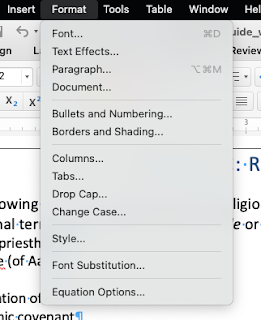


As a copyeditor, I am sometimes asked to apply styles to a document I'm editing. And, I have to admit that there are two things that Word for Mac 2019 does fairly well: R-to-L Hebrew (finally!) and the Styles pane.
But, character styles are a different matter. There is no good tutorial that I could find out there, which is why I'm writing this: to attempt to fill in the gaping hole.
The impetus for this comes from my most recent job, which requires character styles on all the Greek for typesetting purposes. Different presses handle this differently. For example, SBL Press asks you to set all Greek to SBL Greek and all Hebrew to SBL Hebrew. They then use macros to transform that in their typesetting process. The press I'm doing the current book for uses character styles. I've used character styles in Word for Mac before, but recently was forced to migrate to Word for Mac 2019 because the older version was only 32-bit. Things aren't as obvious as I would wish. So, let's begin…
Select the word/character you want to create a style for. In my case it was a Greek word, set in GraecaU, 11 point. Then, click on Format on the top and select Styles (see graphic below)
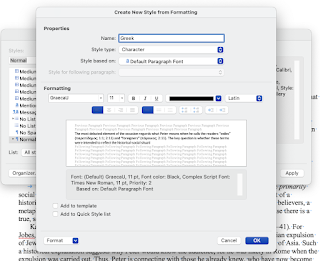
Click on New, and type in the name you want to call the style. I used Greek for obvious reasons. Change the Style type to Character, basing the style on the Default Paragraph Font. Note the "a" with an underline; that means it is a character style. You can see all the characteristics it inherits in the box. If you want to change the font size and style, you can do so, but I find it easiest to change them before I create the style, that way you can just accept it.
I click both Add to template and Add to Quick Style List, just to keep it handy. Then click OK and Apply. On the right-hand side of Word's Home ribbon, there's a Styles Pane button. Click it and the styles will appear on the right hand column of your document; adjust the size of your document so you can see the Style pane as your document easily.
Now, highlight the next word(s) you want to apply the style to, click on Greek, and, "Voilà!" it's in the correct font and the style will be there for the typesetter. See below, before:
And after:
And that's it! Of course, if you don't want to have the style pane open, or don't have room for it on your screen, you can create a keyboard shortcut for it, but that's another story. I have multiples of those for various fonts, formatting, etc. Maybe someday I'll go into that, but this has already eaten up too much of my time today—hopefully it will save you (and me in the future when I forget) a great deal of time!
Here's a list of all copyediting posts.
Tuesday, February 22, 2022
The cheapening of marriage
Neoliberal capitalism inhibits the Christian practice of marriage and family because the market has overrun its boundaries. We face a belligerent bottom line that invades all aspects or spheres of our existence. We are coached to see not just the bartering of bread and soap but the whole of our lives in the ways of the market. We too easily fall into neoliberal economistic language that reconceives family practices and relationships. We speak of children presenting “time demands.” Spouses should “invest” in one another to “promote” intimacy, or their marriage may become unproductive.— Naming Neoliberalism: Exposing the Spirit of Our Age, 102
Monday, February 21, 2022
Contract versus covenant
Neoliberal contractualism is hemmed about by qualifications; its form of marriage is enamored of contractual arrangements such as no-fault divorce and prenuptial agreements. Whereas covenantal marriage aims at a union of selves, contractualism aims only at a union of interests. It promises faithfulness only so long as one (or both) parties do not find a “better” option. It hedges its bets and is based on careful and ongoing calculation. For neoliberalism, with contractualism and competition at its roots, enduring trust is decidedly not a premium. And what is true here of neoliberal marriage is true of its wider economy: the “suzerains” that are neoliberal employers owe no fidelity to their workers or “vassals,” who are fungible and disposable.— Naming Neoliberalism: Exposing the Spirit of Our Age, 103
<idle musing>
Almost diametrically opposed ot the biblical view, isn't it? The Bible says we are made in the image of God and have inherent value. Neoliberalism says we are merely an "asset" to be exploited and then disposed of.
Let's call it what it is: Sin!
</idle musing>
Friday, February 18, 2022
What kind of god?
Note well that this covenant fidelity of Yahweh represents a particular kind of divinity. The Greek gods, after all, put no premium on fidelity to their people. Pagan divinity in general is not so much to be trusted as outwitted and manipulated. But fidelity is a key mark of the God revealed to Israel and the church—the God who chose, finally, to answer human betrayal with the cross rather than a flood of destruction. And so if we are to live in the light of this, the true divinity, we must strive to become the kind of people who practice at least enough covenant faithfulness to know what it looks like. Christians live lives of fidelity in order to become people who can learn to recognize the God of enduring faithfulness, the God of Israel and Jesus Christ.— Naming Neoliberalism: Exposing the Spirit of Our Age, 101
Thursday, February 17, 2022
This is evil!!
The Maryland court blocked the library ebooks law from going into effect, claiming that it violated copyright protection.
Now, that might be, and by itself wouldn't have riled me. But, the very next sentence in the Publishers Weekly Daily eletter says this: "Hachette Book Group parent company Lagardère saw record gains last year, with HBG up as well even discounting its purchase of Workman Publishing."
And they aren't the only publishing company setting records for profit and sales!
But, they won't let the libraries have ebooks at a fair price (the pricing to libraries is definitely ridiculous and gouging) or in a timely manner. Why? Because it might damage their record profits. It would be different if they weren't making tons of cash and paying their executives sinfully extravagent salaries and bonuses (all the while paying their rank and file workers scandalously low wages and exploiting them). But they aren't.
Copyright is to protect the rights to make a fair profit for authors and publishers. It is an attempt to balance the rights of producers and consumers. But, the balance of late is far too much in favor of the corporate producer (not most authors, mind you) at the expense of the consumer.
Just an
</idle musing>
Contract or Covenant? It matters
Contract is the fundamental basis of the neoliberal economy (and of a liberal economy more generally). A contract is a punctual agreement enacted between two parties, for a set period, and under specified conditions. Contracts, and contracting parties, are calculating and careful. Their trust and fidelity, such as they are, intend to serve the immediate interests of the contracting parties—and do not extend beyond the terms of the contract. In other words, the relationships they establish are limited and completely conditional.
Though Christians certainly participate in this contractual economy, it is not their ultimate economy. The church as first family is the oikos grounded in God’s encompassing economy. It works most fundamentally by way of covenant rather than contract. It is about establishing and maintaining deep, full, thoroughly faithful, long-term, and open-ended relationships.— Naming Neoliberalism: Exposing the Spirit of Our Age, 100–101
Wednesday, February 16, 2022
Scapegoating again
There's an article on Bicycling Magazine's website, entitled "Cars Kill. Bike Helmets Don’t Change That." It's really about more than that, though. It's about how we assign blame so we don't have to change anything. Read the whole thing for more, but here's a good takeaway paragraph:
As a pedestrian and bicyclist, I know that the odds are that if I get hit, I'm in serious trouble. I've already experienced that once and don't want it to happen again. But, why is it always the victim that is blamed?
Studies show that the simple act of finding someone to blame in an accident makes people less likely to see systemic problems or seek systemic changes. One [study] prompted subjects with news stories about a wide variety of accidents: financial mistakes, plane crashes, industrial disasters. When the story blamed human error, subjects were more intent on punishment and less likely to question the built environment or seek investigation of organizations behind the accident. No matter the accident, blame took the place of prevention.<idle musing>
As a pedestrian and bicyclist, I know that the odds are that if I get hit, I'm in serious trouble. I've already experienced that once and don't want it to happen again. But, why is it always the victim that is blamed?
And I don't mean just in auto-pedestrian and auto-bicyclist accidents. What about sexual misconduct cases? There's a lot of victim-blaming going on there, too.
Why?
Because it's a whole lot easier and cleaner to blame somebody than to face the fact that the system is broken.
But it is! Culture is broken. It's worshiping the wrong gods: Money, sex, and power.
It's the same gods that have always been worshiped, just wearing different clothes now.
Just an
</idle musing>
Yes, unconditional, but…
Compare again human parents and children. Parents can love unconditionally, never withdrawing their final and ongoing commitment to their children. But especially in relation to younger children, parents do know what is best mediately and in the long term, and not just immediately. Thus loving parents, not least unconditionally loving parents, do harbor moral expectations and make stipulations—and yes, on occasion, even commands—to their children. At their best and in all circumstances, what such parents hope for is the eventual and enduring flourishing, if not the immediate appeasement, of their children.
Similarly, God’s covenant love is unconditional. But it aims to sustain a substantial and long-term relationship, so it includes what might be considered “conditional” elements. As Levenson says, “It is unconditional in that the love comes into, and remains, in force even when nothing has been done to deserve it. . . . But the relationship is also conditional in that it involves expectations and stipulations, and suffers and turns sour if they are not met.” (Levinson, Love of God, 62)— Naming Neoliberalism: Exposing the Spirit of Our Age, 100
Tuesday, February 15, 2022
What's the foundation?
Accordingly, in the biblical world, covenant was not made just or primarily on the basis of blood. To be a son or daughter was first of all, in Hebrew thought, to be obedient, not to indicate biological descent. Israel’s election as the “children of God” entailed obedience (Deut l3:17–l4:2). If Israel disobeyed, God might spurn “his sons and daughters” (Deut 32:l9—20), sell them into slavery (Isa 50:l), and declare them no longer God’s people (Hos 1:9). It is likely in this spirit, a covenant spirit, that Jesus turned away from his consanguineous mother and siblings and declared instead, “Whoever does the will of God is my brother and sister and mother” (Mark 3:31-35). Jesus’s primary family, in this sense, is composed not of those who share his genetic makeup but of those who share his obedient spirit.
At the same time, such remarks must be kept in tension with an underlying unconditional quality about covenant. Though Israel (and later the church) repeatedly fails and betrays its Lord in what the prophets portray as adulterous liaisons with other gods, Yahweh shows a determination to never give up or turn God’s back on his people. The romance between God and his people is stormy and too often ruptures.— Naming Neoliberalism: Exposing the Spirit of Our Age, 98–99
Monday, February 14, 2022
That's a different take on hospitality
Meanwhile, married Christians bear children to witness to the church’s conviction that God has not given up and will not give up on God’s creation. Christians have children because they believe the world has a future. And they have children to witness to and practice hospitality, for no strangers can challenge us so much as the intimate strangers we call children.— Naming Neoliberalism: Exposing the Spirit of Our Age, 97
<idle musing>
While I can't say I disagree with what he says about children being strangers, I'm not sure I would have put it that way! But he is definitely correct that given the state of the world and its future, it takes faith to bring children into it.
</idle musing>
Friday, February 11, 2022
Freedom? Or bondage masquerading as freedom?
Finally, as regards positive freedom, a word about capacitation or enablement. In the thrall of sin and death, we are not free to love God, to love creation, to love others, or even to love ourselves rightly. We are dead in the condition of sin, and only God’g Word and God’s Spirit can raise us to life and fulsome agency. Resurrection, I have said, is exclusively God’s business, so it is only in the Spirit that we are freed for love in all its forms and directions. Through Word and Spirit, we are enabled and given the capacity to love.
Consider an alcoholic turned loose in a liquor store and given free rein to drink whatever and as much as he would like. He has full, but only negative, freedom, in that he is not forbidden any bottle in the store. But he is a slave to his impulses or compulsion. As Alcoholics Anonymous would have it, he needs a “higher power” for true freedom, the freedom not to drink but to live free of bondage and addiction.
Likewise, we are all addicted to sin. It is the Holy Spirit that can give us the capacity not to sin. Our final and fullest freedom, as Augustine would have it, is the freedom not even to be able to sin, but only to love. This is freedom for—freedom for love of God, of creation, of others, and truly of ourselves. Such freedom is what the apocalyptic gospel promises.— Naming Neoliberalism: Exposing the Spirit of Our Age, 85
Tuesday, February 08, 2022
Let those who have ears…
“Cursed is anyone who obstructs the legal rights of immigrants, orphans, or widows.” Deut 27:19 (CEB)
Let those who have ears to hear, hear (and in Hebrew, "hear" means more than just listen; it means to act on what you hear).
Monday, February 07, 2022

Tuesday, February 01, 2022
Why do I read?
I read a post today at the Scholarly Kitchen that triggered some thoughts, not directly related to that post.
Why do people read?
I'm sure there are as many reasons as there are people. But generally, I would say people read for information. Why read directions? Why read traffic signs? (Granted, that's not generally categorized as "reading" in the same way one reads a book or article.) Why read a newspaper/magazine (paper or online version)?
Mainly for information, to feel informed; whether one is or not is another question, depending on the source and the reader's ability to comprehend what is written.
But people also read for entertainment. Why read fiction? Generally to be entertained, unless, of course it is an assigned reading!
But, why else do people read?
Thinking about it, I read for all of the above, but more deeply, I read for character formation. I try to weigh carefully what I intake in the form of media in general, and reading in particular, with a thought to how it will form my character.
We don't realize it most of the time, but what we read (or watch) has a strong impact on who we are and who we are becoming. Even, and I would say especially, fiction. Our guard is down more when we read fiction, so we are more easily influenced without realizing it.
But, nonfiction influences who we are, too. Why do people feel so depressed after doom-scrolling their Twitter/Facebook/RSS/whatever feed? What they read is forming them, whether they realize it or not.
I periodically purge my RSS feed because I tend to subscribe too freely to things that pique my interest. Frequently, after a month or two, I find that what I'm reading on a particular site is having a negative affect on who I want to become, so I purge it. I think that's healthy. I don't want to become closed-minded, so I explore. But, I also want to become someone who reflects Jesus more clearly, so I need to prune some of those explorations.
And that is where discernment comes in. It's too easy to purge something because it makes you uncomfortable. It's also too easy to keep subscribing because it confirms what you want to believe (confirmation bias).
May God grant us wisdom in what we read!
Just an
</idle musing>
Friday, January 28, 2022
New blog!
Jim Eisenbrauns has started a blog! It's called The Almond Branch. The first post is a review of the first two chapters of the book that I'm reading right now and posting excerpts from (and he's the one who gave me the book).
Add it to your RSS feeder or subscribe via email. Having know Jim for nearly twenty years now, I know it will be worth your time.
Thursday, January 27, 2022
Bankrupt!
Capitalism has been premised on the assumption of infinite growth and ever-rising consumption. In a clearly finite and much-exhausted world, this assumption no longer makes sense. For many, it is clear that we should seek a less heedless, more modest, and sustainable way of life—one that does not simply exploit and plunder nature but recognizes that we are all a part of a web of life that includes the atmosphere, soil, plants, animals, and humans. Neoliberalism, only and always revving for more market rapaciousness and expansion, has nothing to offer in this regard.— Naming Neoliberalism: Exposing the Spirit of Our Age, 56
Wednesday, January 26, 2022
It's coming, as sure as sunrise, just ask Amos
If these conditions leave us pitted against coworkers, neoliberal capitalism will certainly allow for little amity between white-collar workers and employers: “Across the board, measures taken by finance-disciplined corporations to maximize profitability prevent workers and employers from profiting together. Thus, even when making outsized profits, corporations cannot risk sharing them with employees by raising wages. Doing so would only cut into company profit margins and thereby threaten the price of company stock.” (Tanner, Christianity and the New Spirit, 178–79, cited in Naming Neoliberalism: Exposing the Spirit of Our Age, 51)
<idle musing>
Of course the irony of this situation is that they don't hesitate to hand out multimillion dollar bonuses and raises to the people at the top—usually white males.
Take those bonuses and that ridiculous salary and divide it among the people who actually do the work. Read James 5 and all of Amos—especially Amos 5:24—and then act accordingly.
Every employee should receive the same benefit package that the CEO does; every American should receive the same healthcare package that a Congress person does. Until that time, any claims at equality are just theater.
Just an
</idle musing>
Tuesday, January 25, 2022
Are you a loser?
And what to do with the “losers”? They are deemed disposables (and remember, we are all ultimately disposable under neoliberalism). And so we see poor folk—especially poor folk of color—killed by police without consequence. We see postindustrial communities no longer deemed valuable by state governments and left without clean, safe drinking water, as in Flint, Michigan. We see poor youth abandoned without affordable and excellent education. We see refugees forced to flee their homes by war or social and economic collapse but rejected at the border or forced to languish in refugee camps. We see undocumented workers exploited but reviled for supposedly taking away jobs from “real” and “good” citizens.
And we see millions of people—again, disproportionately poor and of color—confronted by (increasingly militarized) police forces and flung into (increasingly privatized) prisons. Given historical and structural racism, poor people of color start the neoliberal race with the least advantage and so are likely to fall behind fastest and furthest. To cope with the armies of the most dramatically dispossessed, neoliberalism has developed a “criminal industrial complex.” The War on Drugs, for example, has been waged especially vigorously against poor people of color. Initiated by President Richard Nixon, the War on Drugs was rooted in the soil of racism. H. R. Haldeman, onetime assistant to Nixon,commented that the president “emphasized that you have to face the fact that the whole problem really is the blacks. The key is to devise a system that recognizes this while appearing not to.”(Duggan, Twilight of Equality?, 18)— Naming Neoliberalism: Exposing the Spirit of Our Age, 49–50
Friday, January 21, 2022
Call it what it is!
More darkly, this acting easily blurs into con artistry. For example, service workers are coached and trained to cunningly deploy their own pleasant affect to maximize sales (and tips). Any “real” feeling that remains is often distant and diluted. In on the game as we all are, we become suspicious of those treating us with respect and affection; they may only be conducting a scam, we may only or mainly be objects of manipulation and exploitation. So the already frayed social fabric suffers further tears.
More darkly yet, when entrepreneurialism becomes the essence (such as it is) of the self and is always in the service of selling itself, we come perilously close to something that may most honestly—and realistically—be called prostitution. What, after all, is prostitution except the successful presentation of an attractive body for sale? And what is the entrepreneurial self if not body and soul totally enlisted in an unending hustle, the next sale?— Naming Neoliberalism: Exposing the Spirit of Our Age, 47
Thursday, January 20, 2022
The real cause
Excessive inequality erodes democracy and strains to bursting the social fabric. It raises stressful questions about injustice and does violence to any notion of shared citizenship. It batters all sense of common belonging or that there might be any such thing as a common good. The competitiveness of the marketplace, unchecked, pits Americans against Americans and goes a long way toward explaining why the country is now so divided and riven. Unfortunately, division and hostility are often misidentified or misdirected against immigrants or those of other races. What goes unnamed is the neoliberal framework that entraps us all.— Naming Neoliberalism: Exposing the Spirit of Our Age, 43
Wednesday, January 19, 2022
This is not something to be proud of!
Overall, what we can now boast of is an economy that in its inequality compares to that of ancient Rome. It has been estimated that the top four hundred taxpayers in the United States exercise ten thousand times the material power of the average citizen in the bottom 90 percent. This differs little from the gap between Roman senators and the slaves and farm laborers who comprised most of the population.— Naming Neoliberalism: Exposing the Spirit of Our Age, 43
Tuesday, January 18, 2022
Really? How can you justify this?
Dwell for a moment on the take-home of American CEOs compared to that of rank-and-file employees. In 2018, the average chief executive of an S&P 500 company earned 287 times more than their median employee. Elon Musk made 40,668 times more money than the median Tesla employee. But we need not focus on the extreme of the extremes. Since so many employees are found in retail and food service, we might consider the pay ratios of executives to that of their median worker of Gap clothing (3,566 to l) or McDonald’s (2,124 to 1). Does a Gap executive, however brilliant or hardworking, really do 3,566 times the work of a median-level employee? What wonders must the McDonald’s CEO work to genuinely earn (i.e., deserve) 2,124 times his frontline cooks and cashiers? And has the CEOs’ reasonable value actually increased nearly tenfold since 1970, when the median ratio of executive compensation was 30 to 1.— Naming Neoliberalism: Exposing the Spirit of Our Age, 42
<idle musing>
Let's call it what it is: Sinful greed. Let's put that into a bit more perspective: The CEO of McDonalds makes as much in an hour as the line worker makes in a year—provided they are given 40 hours/week, which may or may not be the case. And the CEO has a full benefits package of retirement, insurance, and all the other perks. The line worker? Right! Fat chance.
James, the brother of Jesus has a word for them:
"Pay attention, you wealthy people! Weep and moan over the miseries coming upon you. Your riches have rotted. Moths have destroyed your clothes. Your gold and silver have rusted, and their rust will be evidence against you. It will eat your flesh like fire. Consider the treasure you have hoarded in the last days. Listen! Hear the cries of the wages of your field hands. These are the wages you stole from those who harvested your fields. The cries of the harvesters have reached the ears of the Lord of heavenly forces. You have lived a self-satisfying life on this earth, a life of luxury. You have stuffed your hearts in preparation for the day of slaughter. (James 5:1–5 CEB)</idle musing>
Monday, January 17, 2022
No longer social
On the Christian account, sinful self-interest is strong enough without being anointed and isolated as the only effective human motivator. Liberalism has shorn us of higher commitments as social animals. It has concentrated on the individual and left individuals to their own devices to determine what they are free for—to what end or project they should devote their lives. In Hauerwas’s pithy formulation, “We have made ‘freedom of the individual’ an end in itself and have ignored the fact that most of us do not have the slightest idea of what we should do with our freedom.” (Hauerwas, "The Church and Liberal Democracy," 79)— Naming Neoliberalism: Exposing the Spirit of Our Age, 18
Friday, January 14, 2022
The wrong half
After [Adam] Smith, we have grabbed and retained only bits of his teaching, the invisible hand being the most famous. But Smith actually had a great deal to say about the importance of morality constraining and supplementing the market. Many historians argue that The Wealth of Nations should be interpreted in the light of Smith’s earlier book, Theory of Moral Sentiments, which “can be read as a text in psychology or theology or ethics, or all of these” (Cox, Market as God, 158).— Naming Neoliberalism: Exposing the Spirit of Our Age, 17 n. 35
Thursday, January 13, 2022
The erosion of the common good
Through the magical ministrations of Adam Smith’s “invisible hand,” the market amalgamates the various individual self-interests into the mutual self—interest of all. The desire—even greed—of individuals singly, blended in the free market, results in the greatest good for all. If Christianity had formerly looked on limitless material acquisition with great suspicion, and always with a watchful eye to the welfare of the poor, liberalism said, “Let it be. Even if individuals enter the marketplace solely with their self-interest in mind, the market will combine and transform these interests so that as a whole, they will most effectively benefit all (or most).”— Naming Neoliberalism: Exposing the Spirit of Our Age, 17
<idle musing>:
And if ever there was a pernicious lie, that is it. Unrestrained greed will lift up the most unscrupulous and they will exploit the poor and weak to get whatever they can. Only unwillingly and under pressure will they grudgingly offer a sop to the worker and the poor. There's a reason that scripture warns against the desire for riches and wealth—it is deadly to the soul. In the words of 1 John, "Children, flee from idolatry!" And the idol in the US is wealth and the attendant power that goes with it.
</idle musing>
Wednesday, January 12, 2022
Not so innocent!
I rehearse the stories of enclosure, the game laws, and US slavery to indicate that liberalism and its concomitant capitalism did not arise naturally and benignly. Human intentionality and, more specifically, state oversight and (sometimes nakedly violent) force were crucial to capitalism’s inception and growth. I made that explicit in recounting enclosure and the game laws. It hardly needs to be added that government was essential to the institution of and policing on behalf of slavery: making it legal, implementing and enabling the slave market, brutally punishing runaway slaves and their allies, and declaring, from the highest court in the land, that African American slaves were only three-fifths human.— Naming Neoliberalism: Exposing the Spirit of Our Age, 9
Tuesday, January 11, 2022
The source
The massive theft that was slavery is the tainted wellspring of American capitalism. In the United States, capital—accrued for the wealthiest over generations—was built on the lacerated backs of Black people. To appreciate the magnitude of this, we must remember that cotton was the material center of the maturing Industrial Revolution. What oil and computerization are to our current economy, cotton was to the nineteenth-century industrial economy.https://www.fortresspress.com/store/product/9781506472652/Naming-Neoliberalism" target="_blank"> Naming Neoliberalism: Exposing the Spirit of Our Age, 7
Monday, January 10, 2022
What is real?
I recently received a book from Jim Eisenbraun (thanks, Jim!) entitled Naming Neoliberalism: Exposing the Spirit of Our Age, by Rodney Clapp. I started reading it over the weekend and will be posting excerpts from it here. It doesn't lend itself well to excerpting in many cases, but I'll do what I can to make them understandable without the context of the book.
Here's the first one, just before the title page of the book, to give you a taste of it:
We mean to suggest that the conflict between the neoliberal market and the Trinitarian God is over what reality is at ‘the fundamental level. If reality is inconstant, inscrutable, with no discernible connection to justice (other than.market rules), then a neoliberal order of class warfare, diminished substan- tial freedom, de-democratization, theaters of cruelty, accel- erated environmental destruction, slum proliferation, mass incarceration, and mass deportation, at the very least, makes some sense. However, if reality is fundamentally love, mercy, and steadfast kindness, the crises of neoliberalism to which we have just pointed make no sense, and should be decried as false and, indeed, evil.—Matthew T. Eggemeier and Peter Joseph Fritz, Send Lazarus, quoted in Naming Neoliberalism: Exposing the Spirit of Our Age, by Rodney Clapp
Wednesday, January 05, 2022
Dying with grace
We do not know how to die in grace, because we do not know how to grow old gracefully. Growing old must be a process of cleansing the self, a way of getting ready for ultimate confrontation. If life is a pilgrimage, death is an arrival, a celebration. The last word should be neither craving nor bitterness, but peace, gratitude. We have been given so much. Why is the outcome of our lives, the sum of our achievements, so little? Our embarrassment is like an abyss. Whatever we give away is so much less than what we receive. Perhaps this is the meaning of dying: to give one’s whole self away.—Abraham Joshua Heschel in Moral Grandeur and Spiritual Audacity: Essays, 377
<idle musing>
Well, that's the final snippet from this book, and a very appropriate one, too. It's been a long journey through the book from the time I picked it up at a thrift store until today, in fact about eleven months! I hope the few of you who stuck around for it enjoyed it. I highly recommend the book, and basically anything Heschel wrote. I find him a stimulating discussion partner.
I'm not sure what I'll be reading next. Or even if I'll keep posting to the blog with any kind of regularity. I'm planning on continuing the copyediting posts, but beyond that, I don't know. So much of what I'm reading right now doesn't lend itself to small snippets—without the context they make no sense. We'll see. Blogging has changed dramatically since I started in October, 2005, and now over 6000 posts later, I'm not sure if it's worth continuing. My readership has consistently shrunk over the last 5 years, which is understandable, as I'm rarely, if ever, posting anything other than small quotations from books on obscure topics : )
</idle musing>
Tuesday, January 04, 2022
Point of view
It is a distortion to characterize the life of man as moving toward death. Death is the end of the road, and while moving along the long road of days and nights, we are really moving toward living, acting, achieving. Death is the end of the road, but not its meaning, not a refutation of living. That every moment of life is a step toward death is a mechanical view. Every moment of life is a new arrival, a new beginning. Those who say that we die every day, that every moment deprives us of a portion of life, look at moments as time past. Looking at moments as time present, every moment is a new arrival, a new beginning.—Abraham Joshua Heschel in Moral Grandeur and Spiritual Audacity: Essays, 375
<idle musing>
A nice reminder at the beginning of a new year!
</idle musing>
Monday, January 03, 2022
You mean I have to love those people, too?
The basic dignity of man is not made up of his achievements, virtues, or special talents. It is inherent in his very being. The commandment “Love thy neighbor as thyself” (Leviticus 19:18) calls upon us to love not only the virtuous and the wise but also the vicious and the stupid man. The rabbis have, indeed, interpreted the commandment to imply that even a criminal remains our neighbor (Pesahim 7 5a).—Abraham Joshua Heschel in Moral Grandeur and Spiritual Audacity: Essays, 370
Friday, December 31, 2021
Where and what is the image of God?
The intention is not to identify “the image and likeness” with a particular quality or attribute of man, such as reason, speech, power, or skill. It does not refer to something which in later systems was called “the best in man," “the divine spark,” “the eternal spirit,” or “the immortal element" in man. It is the whole man and every man who was made in the image and likeness of God. It is both body and soul, sage and tool, saint and sinner, man in his joy and in his grief, in his righteousness and wickedness. The image is not in man; it is man.—Abraham Joshua Heschel in Moral Grandeur and Spiritual Audacity: Essays, 369
Thought for the year
But if someone has material possessions and sees a brother or sister in need but refuses to help—how can the love of God dwell in a person like that?
Little children, let’s not love with words or speech but with action and truth. This is how we will know that we belong to the truth and reassure our hearts in God’s presence. 1 John 3:17–19 CEB
<idle musing>
A good thought to start the year. Love isn't a feeling; it's a verb.
See you next year!
</idle musing>
Thursday, December 30, 2021
The starting point matters
Man is man not because of what he has in common with the earth but because of what he has in common with God. The Greek thinkers sought to understand man as a part of the universe: the prophets sought to understand man as a partner of God.—Abraham Joshua Heschel in Moral Grandeur and Spiritual Audacity: Essays, 369
Wednesday, December 29, 2021
But which god?
In many religions, man is regarded as an image of a god. Yet the meaning of such regard depends on the meaning of the god whom man resembles. If the god is regarded as a man magnified, if the gods are conceived of in the image of man, then such regard tells us little about the nature and destiny of man. Where God is one among many gods, where the word “divine” is used as mere hyperbolic expression, where the difference between God and man is but a difference in degree, then an expression such as “the divine image of man” is equal in meaning to the idea of the supreme in man. It is only in the light of what the biblical man thinks of God—namely, a Being who created heaven and earth, the God of justice and compassion, the master of nature and history who transcends nature and history—that the idea of man having been created in the image of God refers to the supreme mystery of man, of his nature and existence.—Abraham Joshua Heschel in Moral Grandeur and Spiritual Audacity: Essays, 368
Tuesday, December 28, 2021
Foreknown
The creation of man, however, is preceded by a forecast. “And God said: Let us make man in our image, after our likeness.” The act of man’s creation is preceded by an utterance of His intention; God’s knowledge of man precedes man’s coming into being. God knows him before He creates him. Man’s being is rooted in his being known about. It is the creation of man that opens a glimpse into the thought of God, into the meaning beyond the mystery.—Abraham Joshua Heschel in Moral Grandeur and Spiritual Audacity: Essays, 367
Monday, December 27, 2021
Presumptuous?
Do souls become dust? Does spirit turn to ashes? How can souls, capable of creating immortal words, immortal works of thought and art, be completely dissolved, vanish forever?
Others may counter: The belief that man may have a share in eternal life is not only beyond proof; it is even presumptuous. Who could seriously maintain that members of the human species, a class of mammals, will attain eternity? What image of humanity is presupposed by the belief in immortality?
Indeed, man's hope for eternal life presupposes that there is something about man that is worthy of eternity, that has some affinity to what is divine, that is made in the likeness of the divine.—Abraham Joshua Heschel in Moral Grandeur and Spiritual Audacity: Essays, 367
Thursday, December 23, 2021
What is death?
A valid question in a year where Covid has claimed nearly a million victims in the US alone. Abraham Joshua Heschel looks at death in the final essay in Moral Grandeur and Spiritual Audacity: Essays:
Death is grim, harsh, cruel, a source of infinite grief. Our first reaction is consternation. We are stunned and distraught. Slowly, our sense of dismay is followed by a sense of mystery. Suddenly a whole life has veiled itself in secrecy. Our speech stops, our understanding fails. In the presence of death there is only silence, and a sense of awe.Is death nothing but an obliteration, an absolute negation? The view of death is affected by our understanding of life. If life is sensed as a surprise, as a gift, defying explanation, then death ceases to be a radical, absolute negation of what life stands for. For both life and death are aspects of a greater mystery, the mystery of being, the mystery of creation. Over and above the preciousness of particular existence stands the marvel of its being related to the infinite mystery of being or creation.—Abraham Joshua Heschel in Moral Grandeur and Spiritual Audacity: Essays, 366
Wednesday, December 22, 2021
The wonder of it all!
There is no word in biblical Hebrew for doubt; there are many words for wonder. Just as in dealing with judgments our starting point is doubt, so in dealing with reality our starting point is wonder. The biblical man never questions the reality of the world around him. He never asks whether the rivers, mountains, and stars are only apparitions. His sense of the mind-surpassing grandeur of reality prevented the power of doubt from setting up its own independent dynasty. Doubt is an act in which the mind confronts its own ideas; wonder is an act in which the mind confronts the mystery of the universe. Radical skepticism is the outgrowth of conceit and subtle arrogance. Yet there was no conceit in the prophets and no arrogance in the psalmist.—Abraham Joshua Heschel in Moral Grandeur and Spiritual Audacity: Essays, 363–64
Tuesday, December 21, 2021
Worthy of adoration? Hardly!
Is the cosmos an object worthy of our adoration? The Bible's answer is: No! The whole world utters adoration; the whole world worships Him. Join all things in their song to Him. The world’s beauty and power are as naught compared to Him. The mystery is only the beginning.
Beyond the mystery is God.
The biblical man sees nature not in isolation but in relation to God. “At the beginning God created heaven and earth.” These few words set forth the contingency and absolute dependence of all of reality. What, then, is reality? To the Western man, it is a thing in itself; to the biblical man, it is a thing through God. Looking at a thing his eyes see not so much form, color, force, and motion as an act of God. It is a way of seeing which has fortunately not vanished from the world.—Abraham Joshua Heschel in Moral Grandeur and Spiritual Audacity: Essays, 361–62 (emphasis original)
Monday, December 20, 2021
Here and now
What is so wondrous about the world? What is there in reality that evokes supreme awe in the hearts of men? In his great vision Isaiah perceives the voice of the seraphim even before he hears the voice of the Lord. What is it that the seraphim reveal to Isaiah? “The whole earth is full of His glory” (6:3). It is proclaimed not as a messianic promise but as a present fact. Man may not sense it, but the seraphim announce it. It is not to Isaiah only that this fact is the essential part of his revelation. Ezekiel, too, when the heavens were opened by the river Chebar, hears the voice of a great rushing, while cherubim cry, “Blessed be the glory of the Lord from His place” (3:12).—Abraham Joshua Heschel in Moral Grandeur and Spiritual Audacity: Essays, 359
Saturday, December 18, 2021
It's coming…
1 Hey, powerful person!
Why do you brag about evil?
God’s faithful love lasts all day long.
2 Your tongue devises destruction:
it’s like a sharpened razor, causing deception.
3 You love evil more than good;
you love lying more than speaking what is right. Selah
4 You love all destructive words;
you love the deceiving tongue.
5 But God will take you down permanently;
he will snatch you up,
tear you out of your tent,
and uproot you from the land of the living! Selah
6 The righteous will see and be in awe;
they will laugh at those people:
7 “Look at them! They didn’t make God their refuge.
Instead, they trusted in their own great wealth.
They sought refuge in it—to their own destruction!” Ps 52 (CEB)
Why do you brag about evil?
God’s faithful love lasts all day long.
2 Your tongue devises destruction:
it’s like a sharpened razor, causing deception.
3 You love evil more than good;
you love lying more than speaking what is right. Selah
4 You love all destructive words;
you love the deceiving tongue.
5 But God will take you down permanently;
he will snatch you up,
tear you out of your tent,
and uproot you from the land of the living! Selah
6 The righteous will see and be in awe;
they will laugh at those people:
7 “Look at them! They didn’t make God their refuge.
Instead, they trusted in their own great wealth.
They sought refuge in it—to their own destruction!” Ps 52 (CEB)
Let the reader understand!
Friday, December 17, 2021
The world and what we see
What have Job, Agur, Ecclesiastes discovered in their search? They have discovered that the existence of the world is a most mysterious fact. Referring not to miracles, to startling phenomena, but to the natural order of things, they insist that the world of the known is a world unknown, of hiddenness, of mystery. Not the apparent but the hidden is the apparent; not the order but the mystery of the order that prevails in the universe is what man is called upon to behold. The prophet [Isaiah], like Job and Agur, alludes to a reality that discredits our wisdom, that shatters our knowledge.—Abraham Joshua Heschel in Moral Grandeur and Spiritual Audacity: Essays, 358
Thursday, December 16, 2021
Power, Loveliness, or Grandeur. Which will it be?
There are three aspects of nature that command man’s attention: power, loveliness, grandeur. Power he exploits, loveliness he enjoys, grandeur fills him with awe. It is according to how deeply man is drawn to one of these aspects that his particular way of knowledge is developed. Western knowledge of the last four centuries may be characterized by the famous principle of Bacon: Knowledge is power. The goal of that knowledge is neither to portray the beauty nor to convey the grandeur of the world, but to exploit its resources. Man, proud to be Homo faber, regards the world as a source of satisfaction of his needs. He is willing to define his essence as “a seeker after the greatest degree of comfort for the least necessary expenditure of energy.” His hero is the technician rather than the artist, the philosopher, or the prophet. Out of such a system of knowledge it is hard to find a way to the reality of God. Nature as power is a world that does not point beyond itself. It is when nature is sensed as mystery and grandeur that it calls upon us to look beyond it. Similarly, when nature is sensed as beauty, we become infatuated by her grace and look to her for answers to problems she is incapable of giving. It is when nature is sensed as mystery and grandeur that we discover that nature herself is the problem.
Significantly, the theme of biblical poetry is not the charm or beauty of nature; it is the sublime aspect of nature which is constantly referred to.—Abraham Joshua Heschel in Moral Grandeur and Spiritual Audacity: Essays, 355–56 (emphasis original)
Wednesday, December 15, 2021
Let's put first things first for a change
The dogmas are merely a catalogue, an indispensable index [of religion]. For religion is more than a creed or an ideology and cannot be understood when detached from actual living. It comes to light in moments in which one’s soul is shaken with unmitigated concern about the meaning of all meaning, about one’s ultimate commitment, which is integrated with one’s very existence; in moments in which all foregone conclusions, all life-stilling trivialities are suspended, in which the soul is starved for an inkling of eternal reality; in moments of discerning the indestructibly sudden within the perishably constant.
Thus the issue which must be discussed first is not belief, ritual, or the religious experience but the source of these phenomena: the total situation of man; not what or how he experiences the supernatural, but why he experiences and accepts it. What necessitates religion in my life and yours.—Abraham Joshua Heschel in Moral Grandeur and Spiritual Audacity: Essays, 354
Tuesday, December 14, 2021
To dream in league with God
At the beginning of all action is an inner vision in which things to be are experienced as real. Prayer, too, is frequently an inner vision, an intense dreaming for God—the reflection of the divine intentions in the soul of man. We dream of a time “when the world will be perfected under the Kingdom of God, and all the children of flesh will call upon Thy name, when Thou wilt turn unto Thyself all the wicked of the earth." We anticipate the fulfillment of the hope shared by both God and man. To pray is to dream in league with God, to envision His holy visions.—Abraham Joshua Heschel in Moral Grandeur and Spiritual Audacity: Essays, 353
<idle musing>
I've spent a good deal of time in this essay; I've probably posted two-thirds or more of it online. I hope it moved you as much as it has me. In my opinion, this essay shows Heschel at his best. He exemplifies the deep yearning of humanity for intimacy with God, yet he also reflects the hesitancy we feel to approach the throne of grace.
Because he wasn't a Christian, he didn't have the same assurances that Christians have, but I daresay he knew God better than most Christians do! We have the assurance that we can "boldly approach the throne of grace," as Hebrews puts it. Yet, we rarely do it. We're too enamored by the mere triffles of living in the twenty-first century post-modern, social media-saturated, materialistic (in the metaphysical as well as physical senses) world. We are practicing atheists.
May we repent and believe the good news of God's presence before it is too late!
</idle musing>
Monday, December 13, 2021
What is prayer? (part 2)
Prayer is spiritual ecstasy. It is as if all our vital thoughts in fierce ardor should burst the mind to stream toward God. A keen single force draws our yearning for the utmost out of the seclusion of the soul. We try to see our visions in His light, to feel our life as His affair. We begin by letting the thought of Him engage our minds, by realizing His name and entering into a reverie which leads through beauty and stillness, from feeling to thought, and from understanding to devotion. For the coins of prayer bear the image of God's dreams and wishes for fear-haunted man.—Abraham Joshua Heschel in Moral Grandeur and Spiritual Audacity: Essays, 353
Friday, December 10, 2021
What is prayer?
The main ends of prayer are to move God, to let Him participate in our lives, and to interest ourselves in Him. What is the meaning of praise if not to make His concern our own? Worship is an act of inner agreement with God. We can petition Him for things we need only when we are sure of His sympathy for us. To praise is to feel God’s concern; to petition is to let Him feel our concern. In prayer we establish a living contact with God, between our concern and His will, between despair and promise, want and abundance. We affirm our adherence by invoking His love.—Abraham Joshua Heschel in Moral Grandeur and Spiritual Audacity: Essays, 353
Thursday, December 09, 2021
The dignity of humanity
The privilege of praying is man’s greatest distinction. For what is there in man to induce reverence, to make his life sacred and his rights inalienable? The possession of knowledge, wealth, or skill does not compose the dignity of man. A person possessing none of these gifts may still lay claim to dignity. Our reverence for man is aroused by something in him beyond his own and our reach, something that no one can deprive him of. It is his right to pray, his ability to worship, to utter the cry that can reach God: “If they cry at all unto me, I will surely hear their cry.”—Abraham Joshua Heschel in Moral Grandeur and Spiritual Audacity: Essays, 352–53
Wednesday, December 08, 2021
The folly of life
What is pride worth if it does not add to the glory of God? We forfeit our dignity when we abandon loyalty to what is sacred; our existence dwindles to trifles. We barter life for oblivion and pay the price of toil and pain in the pursuit of aimlessness. Only concern for our inalienable share in the unknown holds our inner life together. It enables us to grasp the utopia of faith, to divine what is desirable to God, aspiring to be, not only a part of nature, but a partner of God. The sacred is a necessity in our lives, and prayer is born of this necessity. Through prayer we sanctify ourselves, our feelings, our ideas. Everyday things become sacred when prayed for to God.—Abraham Joshua Heschel in Moral Grandeur and Spiritual Audacity: Essays, 352
<idle musing>
In keeping with yesterday's comment about why we don't pray, Heschel addresses it today. And truly, we have bartered our lives away for mere bobbles and trifles. Believing the lie that material wealth is a satisfactory substitute for spiritual wealth. Yet, God still calls us to participate in a life full of meaning when lived with him. Indeed, "Everyday things become sacred when prayed for to God."
</idle musing>
Tuesday, December 07, 2021
Loneliness that leads to prayer
The thirst for companionship, which drives us so often into error and adventure, indicates the intense loneliness from which we suffer. We are alone even with our friends. The smattering of understanding which a human being has to offer is not enough to satisfy our need of sympathy. Human eyes can see the foam, but not the seething at the bottom. In the hour of greatest agony we are alone. It is such a sense of solitude which prompts the heart to seek the companionship of God. He alone can know the motives of our actions; He alone can be truly trusted. Prayer is confidence, unbosoming oneself to God. For man is incapable of being alone. His incurable, inconsolable loneliness forces him to look for things yet unattained, for people yet unknown. He often runs after a sop, but soon retires discontented from all false or feeble companionship. Prayer may follow such retirement.—Abraham Joshua Heschel in Moral Grandeur and Spiritual Audacity: Essays, 352
<idle musing>
He sure pegged modern society, didn't he? We're surrounded by social media, yet we have a flood of loneliness and depression. But we won't turn to God in prayer. Why? Pride? Ignorance? Sense of unworthiness?
Yet, if we cast aside all those, we find that God welcomes us with open arms. That's Good News!
</idle musing>
Monday, December 06, 2021
Prayer, again/still
[A story] told in Sefer Hasidim, concerns a young shepherd who was unable to read the Hebrew prayers. The only way in which he worshipped God was to say: “O Lord, I should like to pray, but I cannot read Hebrew. There is only one thing I can do for you——if you would give me your sheep, I would take care of them for nothing." One day a learned man passing by heard the shepherd pronounce his offer and shouted at him: “You are blasphemous!” He told the boy that he should read the daily Hebrew prayers instead of uttering irreverent words. When the shepherd told him that he could not read Hebrew, he took him to his house and began to teach him to read the prayerbook. One night the learned man had a dream in which he was told that there was great sadness in heaven because the young shepherd had ceased to say his usual prayer. He was commanded to advise the boy to return to his old way of praying.—Abraham Joshua Heschel in Moral Grandeur and Spiritual Audacity: Essays, 351
Saturday, December 04, 2021
Ouch!
Just read an interesting essay by William J. Abraham, discussing his four-volume work, Divine Agency and Divine Action (Oxford University Press, 2017–2021). This statement jumped out at me:
Theologians in the modern period have fussed at length about the justification of their commitments. Hence, the long sections on divine revelation and authority of scripture that detain them at the beginning. As a result, God can become sidelined. We are so preoccupied with knowing how we know God that we cease to know God for ourselves.YMMV on the rest of the essay; it is interesting, but something I have to admit I'm not terribly interested in right now...
Friday, December 03, 2021
The form matters not
Is it the outburst of eloquence which makes the Infinite listen to our feeble voice? Prayer is not a sermon delivered to God. Essential in prayer is the intention, not the technical skill. ln oratory, as in any other work of art, we endeavor to lend an adequate form to an idea; we apply all our care to adjusting the form to the content. But prayer is almost pure content; the form is unimportant. It makes no difference whether we stammer or are eloquent. We can concentrate entirely on our inner devotion.—Abraham Joshua Heschel in Moral Grandeur and Spiritual Audacity: Essays, 351
Thursday, December 02, 2021
In praise of liturgical prayers
The ability to express what is hidden in the heart is a rare gift and cannot be counted upon by all men. What, then, makes it possible for us to pray is our ability to affiliate our own minds with the pattern of fixed texts, to unlock our hearts to the words, and to surrender to their meanings. For words are not dead tools but living entities full of spiritual power. The power of words often surpasses the power of our minds. The word is often the giver, and man the recipient. Thus man submits to the words. They inspire his mind and awaken his heart. We do not turn the light of prayer on and off at will, as we control sober speculation; we are seized by the overwhelming spell of His name. It is amazement, not understanding; awe, not reasoning; a challenge, a sweep of emotion, the tide of a mood, an identification of our wills with the living will of God.—Abraham Joshua Heschel in Moral Grandeur and Spiritual Audacity: Essays, 350
Wednesday, December 01, 2021
Take the invitation
Prayer is an invitation to God to intervene in our lives, to let His will prevail in our affairs; it is the opening of a window to Him in our will, an effort to make Him the Lord of our soul. We submit our interests to His concern and seek to be allied with what is ultimately right. Our approach to the holy is not an intrusion but an answer. Between the dawn of childhood and the door of death, man encounters things and events out of which comes a whisper of truth, not much louder than stillness, but exhorting and persistent. Yet man listens to his fears and his whims, rather than to the soft petitions of God. The Lord of the universe is suing for the favor of man, but man fails to realize his own importance. It is the disentanglement of our heart from cant, bias, and ambition, the staying in of the bulk of stupid conceit, the cracking of hollow self-reliance, that enables us to respond to this request for our service.—Abraham Joshua Heschel in Moral Grandeur and Spiritual Audacity: Essays, 349
Tuesday, November 30, 2021
Strive for that one instant!
The focus of prayer is not the self. A man may spend hours meditating about himself, or be stirred by the deepest sympathy for his fellow man, and no prayer will come to pass. Prayer comes to pass in a complete turning of the heart toward God, toward His goodness and power. It is the momentary disregard of our personal concerns, the absence of self-centered thoughts, which constitute the act of prayer. Feeling becomes prayer in the moment in which we forget ourselves and become aware of God. When we analyze the consciousness of a supplicant, we discover that it is not concentrated upon his own interests but on something beyond the self. The thought of personal need is absent, and the thought of divine grace alone is present in his mind. Thus, in beseeching Him for bread, there is one instant, at least, in which our mind is directed neither to our hunger nor to food but to His mercy. This instant is prayer.—Abraham Joshua Heschel in Moral Grandeur and Spiritual Audacity: Essays, 348–49 (emphasis original)
Friday, November 26, 2021
Thoughts on the "metaverse"
So Facebook has renamed itself Meta and is dumping vast amounts of money into the metaverse. I'm reminded of the 1909 short story "The Machine Stops" by E. M. Forster. You can read a plot summary on the wiki here. Because it is out of copyright, you can read the complete short story here. It's a mere 25 pages and well worth your time.
Here's a portion of the last couple of pages, which is loaded with good theology as a mother and son are faced with the collapse of everything they know:
They wept for humanity, those two, not for themselves. They could not bear that this should be the end. Ere silence was completed their hearts were opened, and they knew what had been important on the earth. Man, the flower of all flesh, the noblest of all creatures visible, man who had once made god in his image, and had mirrored his strength on the constellations, beautiful naked man was dying, strangled in the garments that he had woven. Century after century had he toiled, and here was his reward. Truly the garment had seemed heavenly at first, shot with colours of culture, sewn with the threads of self-denial. And heavenly it had been so long as it was a garment and no more, man could shed it at will and live by the essence that is his soul, and the essence, equally divine, that is his body. The sin against the body—it was for that they wept in chief; the centuries of wrong against the muscles and the nerves, and those five portals by which we can alone apprehend—glozing it over with talk of evolution, until the body was white pap, the home of ideas as colourless, last sloshy stirrings of a spirit that had grasped the stars.Dystopian? Yes, but with a nice snippet of hope in there, too. Read the whole thing to find the hope I'm talking about.
Tuesday, November 23, 2021
It might start there, but…
For neither the lips nor the brain is the limit of the scene on which prayer takes place. Speech and devotion are functions auxiliary to a metaphysical process. Common to all men who pray is the certainty that prayer is an act which makes the heart audible to God. Who would pour his most precious hopes into a deaf abyss? Essential is the metaphysical rather than the psychical dimension of prayer. Prayer is not a thought that rambles alone in the world but an event that starts in man and ends in God. What goes on in our heart is a humble preliminary to an event in God.—Abraham Joshua Heschel in Moral Grandeur and Spiritual Audacity: Essays, 347
<idle musing>
Yes!
</idle musing>
Monday, November 22, 2021
It's more than the will…
But prayer goes beyond the scope of emotion; it is the approach of the human to the transcendent. Prayer makes man a relative to the sublime, initiating him into the mystery. The will, at times, is an outsider to the sanctuary of the soul. It ushers in great things, but does not always control them. The will to pray opens the gates, but what enters is not its product. The will is not a creative but an auxiliary power, the servant of the soul. Creative forces may be discharged, but not engendered, by the will. Thus, inclination to pray is not prayer. Deeper forces and qualities of the soul must be mobilized before prayer can be accomplished. To pray is to pull oneself together, to pour our perception, volition, memory, thought, hope, feeling, dreams, all that is moving in us, into one tone. Not the words we utter, the service of the lips, but the way in which it is performed, the devotion of the heart to what the words contain, the consciousness of speaking under His eyes, is the pith of prayer.—Abraham Joshua Heschel in Moral Grandeur and Spiritual Audacity: Essays, 347
<idle musing>
And that's why just saying "my thoughts and prayers are with you" falls short. That's the will to prayer, but not the actual substance. The actual substance is throwing the whole body, mind, and soul into it. And that can be hard at times. It's easier to go through the motions, but far less rewarding and satisfying, as tomorrow's excerpt will talk about.
</idle musing>
Sunday, November 21, 2021
Persian Inscriptions: Abbreviations
I thought I had bookmarked a site with a listing of Persian inscription abbreviations, but alas, no.
Anyway, here's the basic rule: "The standard siglum for Old Persian royal inscriptions is by initial letter of the king’s name, letter for the location, and lowercase letter for the order of its discovery; thus, DNa stands for Darius (I), Naqš-ī Rustam, first inscription." (Political Memory in and after the Persian Empire, vii). While this is good information, is doesn't help much, does it?
But, Livius.org has a nice listing, which is the one I thought I had bookmarked.
Table of contents for copyediting stuff.
Friday, November 19, 2021
Prayer without works is…
To most people, thinking is a thing that grows in the hothouse of logic, separated from the atmosphere of character and of everyday living. They consider it possible for a man to be unscrupulous and yet to write well about righteousness. Others may disagree with this view. However, all of us, mindful of the ancient distinction between lip service and the service of the heart, agree that prayer is not a hothouse plant of temples but a shoot that grows in the soil of life, springing from widespread roots hidden in all our needs and deeds. Vicious needs, wicked deeds, felt or committed today, are like rot cankering the roots of tomorrow's prayer. A hand used in crime is an ax laid to the roots of worship.» It is as Isaiah said: “And when ye spread forth your hands, I will hide mine eyes from you; Yea, when ye make many prayers, I will not hear; your hands are full of blood.” Life is fashioned by prayer, and prayer is the quintessence of life.—Abraham Joshua Heschel in Moral Grandeur and Spiritual Audacity: Essays, 346–47
Thursday, November 18, 2021
What's the purpose of prayer
Prayer is not thinking. To the thinker, God is an object; to the man who prays, He is the subject. Awaking in the presence of God, our aim is not to acquire objective knowledge but to deepen the mutual allegiance of man and God. What we want is not to know Him but to be known to Him; not to form judgments about Him but to be judged by Him; not to make the world an object of our mind but to let it come to His attention, to augment His, rather than our knowledge. We endeavor to disclose ourselves to the Sustainer of all, rather than to enclose the world in ourselves.—Abraham Joshua Heschel in Moral Grandeur and Spiritual Audacity: Essays, 346
<idle musing>
Sorry for the hiatus; I'm a trifle busy right now and don't have a lot of time for leisurely reading. But, I decided to carve out a few minutes every day for Heschel.
While I might quibble with some of what he says here, I think that on the whole, he is correct. Prayer isn't about us! It's about God. I read somewhere the other day that Mother Theresa was once asked how she prayed. She replied, "I listen." The questioner then asked what God said. She replied, "He listens." After a pause, she continued, "And if you don't understand what that means, I can't explain it." Yep.
</idle musing>
Thursday, November 11, 2021
The order of the elements in a bibliography
I don't know about anybody else—well, that's not quite true—but I never was very clear about what order stuff is supposed to appear in the bibliography. Does the edition precede the editor (I've seen it that way)? Does the edition precede the translator (I've seen it that way)? Where does the series name/number go?
Fribourg; Presses Universitaires; Göttingen: Vandenhoeck & Ruprecht, xxxx.
I asked a fellow copyeditor one time, and they replied that my question made their head swim! That was encouraging, because I thought I was alone in it.
In cases like that, I turn to the basics: CMS17 and SBLHS2. Being lazy, I perused all the examples—multiple times. I should have been rereading the text, because the answer was right in front of me, in SBLHS2 §6.1.1. Sequence of Information. Can't get much clearer than that, can it?
So, what is that sequence (remember, for bibliographies; footnotes play fast and loose with the page number location and only list all the authors/editors if they are 3 or fewer; otherwise, et al.)?
Author/Editor (last, first, Author2 [first last], Author3 [first last], etc.). "Title of article." Pages xx–xx in Title of book. Edited by Editor 1 (and Editor 2, etc.). Translated by Person. X ed. x vols. Series Name x/xx. City (State): Publisher, xxxx.If there is more than one publisher, then a semicolon separates them:
Fribourg; Presses Universitaires; Göttingen: Vandenhoeck & Ruprecht, xxxx.
Some are more complicated, but you get the idea. Perusing the examples with this as a foundation will hopefully keep you (and me) from getting too confused.
We're all libertarians now
Have you noticed lately how many people are claiming, "It's my body!" in answer to why they are or aren't doing something, be it vaccines or abortions?
Isn't it ironic that both left and right are claiming the same thing—but for different things?
The right claims "It's my body!" when they don't want to wear a mask or get a vaccine.
The left claims "It's my body!" when it comes to abortion rights.
But what if they are both wrong?
I know that's sounds like heresy in our culture, where individual rights are sacrosanct. But, think for a minute. What if the body politic has a say? What if we consider the common good for a minute?
When was the last time you heard someone talk about the common good?
Yep, we are all libertarians now...
Just an
</idle musing>
Tuesday, November 09, 2021
Managing bibliographies, part 1
After a bit of a hiatus, more on copyediting. In this post, I'm showing you a system that works for me. Others use other systems, but I found this to be the simplest and haven't found it necessary to modify in over five years now.
Bibliographies are the one area where the style guides diverge the most. For this post, I'm assuming SBLHS2, with the amendments from their blog as necessary.
For the example here, I am using a bibliography from a collection of essays, so the bibliography is only for one chapter. That both simplifies and complicates things, but the principles are the same.
I always start with the bibliography when I edit. It makes sense to get that checked and fixed first. Otherwise, if you edit the chapter first, any errors you find in the bibliography will need to be corrected on stuff you've already done. When you are paid by the page, which I usually am, that's costing you money—and causing more stress to hit the deadline.
Before I start, I create a separate file with the bibliography and name it Chapter# Working Bibliography, so in this example, the file is 20_Working_Bibliography.docx. For chapters below ten, I use a leading zero to keep them sorted properly, so 07_Working_Bibliography.docx, etc.
I check every bibliography entry for accuracy using WorldCat for books, and Google search for articles. When WorldCat results seem contradictory, I try to find the publisher's website. Whatever you do, don't rely on Amazon's listings; they are notoriously error-ridden, just ask any publisher!
For articles, a Google search will usually show you an academia.edu or some other web despository, which is really nice, because they usually have the original document. Barring that, another gold is a book reference. If the Google book reference disagrees with your entry, try a different book. In cases of disagreement, if I can't find the original, I go with the best two out of three or three out of four. If it is a mess everywhere, I put an author query on it for them to check.
The next problem is how to keep track of short forms and to prevent a full entry twice or only a short entry. And, most importantly, when an author has been referenced in the body text, so you don't use their first name twice. The following example is what works for me. Your mileage may vary! Note that for this bibliography, I had to create it from the footnotes, so their are no em-dashes for multiple entries of the same author. When I copy it into the chapter at the end, I fix that. But it is handy for creating a sorted combined bibliography (I'll talk about that in a future post—consistency in multiple author volumes is a big concern).

This is from chapter 20. The "20." at the beginning of an entry means it has been referenced once. The underlined portion means that it has been referenced by that short form later in the chapter. The asterisk means that they have been referenced by first name in the body text.
After editing the chapter, I always check to make sure everything in the bibliography has been referenced. Because there is the chapter number at the beginning of the entry, it is easy to scan down the page. I usually enter it as a search term to highlight it, making it easier to see.
If an entry doesn't have a number in front, I do a search on the chapter to confirm it is missing. If it is, I either mark it with a query, or if instructed by the publisher, delete it from the chapter bibliography. I always leave it in my working bibliography! Very few publishers allow uncited entries in the bibliography, but sometimes they will allow a "Related Works" or "Further Reading" section, which is why I keep the original intact. (It's also fun to see how much an author "pads" their bibliography—expecially if it is a revised dissertation. The highest percentage I've ever seen is 25 percent. Most come in around 2–3 percent.)
Here's the table of contents for all the copyediting stuff.
Tuesday, November 02, 2021
Musings on clicking through on a link
The other day, I chased a Tech Radar link on how much sleep you need. I know that they say your sleep needs change as you get older—and I've experienced that several different times in my life. So, I was wondering what the latest research was.
Anyway, that's not the point of this post; I might come back to that some other time. The point of this one is that the link didn't really say much of anything; it was more a glorified advertisement, with the whole thing building up to the products they were plugging at the end, and for which I'm sure they get a nice commission.
No surprises there; that's only too common these days. Gotta keep the lights (and servers) on somehow!
But how they did it was what I found interesting. First graphic: An older Asian couple sleeping in a bed. Second graphic: A thirty-something guy w/longish hair and the short, neatly trimmed beard that is stylish. Third graphic: A lesbian couple sleeping together. Fourth graphic: A thirty-something woman walking along a paved path with fall-colored leaves.
It was almost like they were keeping a checklist of things to cover. They know their main clientele will be somewhat "woke" middle-to-upper-middle class thirty-something, white people, so they want to cover the bases. I suspect the Asian couple was chosen instead of a POC couple to show they were against the anti-Asian attitudes that Covid caused to rise to the surface. The lesbian couple was to show that they are not homophobic. And we have to have the good-looking white guy and the woman walking outside to glue it together for their clientele.
Am I being overly cynical here? Maybe. But I doubt it. To paraphrase Jesus in John, "He didn't need anyone to tell him what goes on in a marketer's mind, for he knew." I've worked in marketing a long time. Rule one: Know your clientele. Rule two: Don't piss them off. Rule three: Show that you sympathize with their concerns (or at least pretend that you do!). Rule four: Get them to buy.
Just an
</idle musing>
Subscribe to:
Posts (Atom)
