Saturday, January 21, 2023

So-called benefactors

On the Anxious Bench the other day, but I just finished reading it now (I’ve taken it in chunks), reflection on the the mature Dr. Martin Luther King Jr.

This paragraph sums up what I’ve thought:

It was perhaps King’s commitment to the alleviation of poverty that got him killed. The night before his assassination, he was working with striking sanitation workers because it would expose the need for economic equality. King’s Poor People’s Campaign was meant to do precisely that work because after he moved his ministry from the South to the North, he was reminded that the fight against racism necessarily included a fight against poverty.
Yep. The one thing that the oligarchy has always feared is that the various groups of exploited people would see that actually they have more in common with each other than they do w/the oligarchs—the ones Jesus said call themselves “benefactors.” (As an interesting experiment, search that term in the books of the Maccabees for some context.)

A footnote in the book I’m editing sums up the benefactors pretty well:

Yale Daily News, November 10, 2021. A study by Philp Mousavizadeh found that the administration had expanded an incredible 44.7 percent since 2003, and that Yale had the highest manager-to-student ratio in the Ivy League and the fifth highest in the nation among four-year colleges. Thus the administration was larger than the faculty and cost $2.7 billion annually, with a 5 percent increase in only one year. An article by Isaac Yu, Yale Daily News, September 9, 2021, noted that over the same period, some key administrative units had grown 150 percent in staffing, as opposed to a 10.6 percent in faculty growth, and that Yale had gone from five vice presidents to thirty-one. The salaries of the president had increased 17.2 percent, of the General Counsel 6.2 percent, but of the faculty 3.6 percent.
I’m sorry to say that a recent survey found that Harvard has now surpassed Yale in the highest manager-to-student ratio…

Everybody needs to read ch. 1 of Heschel’s The Prophets at least once a year…

Just an
</idle musing>

Friday, January 20, 2023

The glories of our king

5 C. M.
The glories of our King.

COME, ye that love the Saviour’s name,
   And joy to make it known,
   The Sov’reign of your hearts proclaim,
   And bow before his throne.

2 Behold your Lord, your Master, crown’d
   With glories all divine:
   And tell the wond’ring nations round,
   How bright those glories shine.

3 When, in his earthly courts,
   We view The glories of our King,
   We long to love as angels do,
   And wish, like them, to sing.

4 And shall we long and wish in vain?
   Lord, teach our songs to rise:
   Thy love can animate the strain,
   And bid it reach the skies.
                Anne Steele
                Methodist Episcopal Hymnal (1870 edition)

Wednesday, January 18, 2023

Update on bike helmets

A friend sent me this article from Slate, entitled "The Cult of Bike Helmets."

It's a good read, providing a nice historical overview of how the helmet evolved and what it is designed to do and not to do. They also point out the "blame the victim" mentality of much media coverage of bicycle fatalities. Here's a nice little snippet, but read the whole thing, it isn't long.

I have been a bike commuter in every city I’ve lived in as an adult, including Minneapolis, Milwaukee, Chicago, Columbus, and New York City. I travel on two wheels for the exercise and fresh air, for environmental reasons, and for independent, efficient mobility.

In exchange, I feel unsafe, always, on my bicycle—and for sound reason. I’ve gotten doored in Times Square. I’m forced to weave in and out of bike lanes to avoid the vehicles that constantly park and loiter there. I hold my breath when a passing truck leaves only a few inches between my shivery flesh and its metal flanks.

I do what I can to protect myself. I use front and rear lights. I gravitate toward roads with designated bike lanes. I signal turns with my arms and ding my handlebar bells to attract the attention of inattentive drivers. And I never, ever leave home without my neon yellow helmet.

But as with many cyclists and lawmakers, I’ve increasingly found myself wondering: How much does my helmet help me, really? Are there costs to our single-minded devotion to it?

In the past 50 years, as helmet designs have become more sophisticated, adult cycling deaths in the United States have not declined—they’ve quadrupled. As I dug into the history of these humble foam-and-plastic shells, I learned that helmets have a far more complicated relationship to bike safety than many seem ready to admit.

The Song of Moses and the Lamb

2 C. M.
The song of Moses and the Lamb.

AWAKE, and sing the song
   Of Moses and the Lamb;—
   Wake, every heart and every tongue,
   To praise the Saviour’s Name.

2 Sing of his dying love;
   Sing of his rising power;
   Sing how he intercedes above
   For those whose sins he bore.

3 Ye pilgrims, on the road
   To Zion’s city, sing;
   Rejoice ye in the Lamb of God,—
   In Christ, the’ eternal King.

4 Soon shall we hear him say,—
   Ye blessed children, come;
   Soon will he call us hence away,
   To our eternal home.

5 There shall each raptured tongue
   His endless praise proclaim;
   And sweeter voices tune the song
   Of Moses and the Lamb.
                  William Hammond
                  Methodist Episcopal Hymnal (1870 edition)

Tuesday, January 17, 2023

Tozer for Tuesday

If we ever lose the wonder out of our hearts, just to hear these words, “Christ, foreknown before the foundation of the world but manifest in time for you,” if those words ever cease to move your heart, then your heart is hard.—A.W. Tozer, Living as a Christian, 57

The highway of holiness

448 L M.
The highway of holiness.

JESUS, my all, to heaven is gone,—
   He, whom I fix my hopes upon;
   His track I see, and I ’ll pursue
   The narrow way, till him I view.

2 The way the holy prophets went,—
   The road that leads from banishment,——
   The King’s highway of holiness,
   I’ll go, for all his paths are peace.

3 This is the way I long have sought,
   And mourn’d because I found it not;
   My grief a burden long has been,
   Because I was not saved from sin.

4 The more I strove against its power,
   I felt its weight and guilt the more;
   Till late I heard my Saviour say,—
   Come hither, soul, I am the way.

5 Lo! glad I come; and thou, blest Lamb,
   Shalt take me to thee, as I am;
   Nothing but sin have I to give,—
   Nothing but love shall I receive.

6 Then will I tell to sinners round,
   What a dear Saviour I have found;
   I’ll point to thy redeeming blood,
   And say,—Behold the way to God.
                John Cennick
                Methodist Episcopal Hymnal (1870 edition)

<idle musing>
I wasn't familiar w/John Cennick. He was a friend and coworker of both Wesley and Whitefield, later becoming a Moravian and ministering in Ireland. You can read more at The Hymnary.
</idle musing>

Monday, January 16, 2023

Surveys of previous work

Sometimes, ok, frequently, when I'm reading surveys of previous work in a book, and it goes on for page after page, I think they should have read 2 Maccabees 2:32:
32 From this point then we will begin the narrative, not adding further to what was already said. After all, it would be absurd to prolong the preface but then cut short the history. (CEB)
Look, I get it, if it's a revised dissertation, you need to prove to the committee that you read everything written on your subject from the Jemdet Nasr period until today. Or, at least have read enough previous literature reviews from other dissertations that read literature reviews from other dissertations, ad infinitum.

As an aside, copyeditors know. I can usually find out the chain by chasing errors in citations back to the offending book or article. You might fool the dissertation committee or series editor, but the copyeditor will know. I've chased errors in citations back 20 years or more in some cases. And let's not even start with the padded bibliographies! I had one semirevised dissertation that was over 30 percent padded! OK, back to the matter at hand.

I've noticed a trend over the last 15 years or so: the literature reviews are getting longer; the morsels of insight are getting more tentative; the use of scare quotes is getting more prevalent. And, sadly, the synthesis of all this information, data, if you will, is disappearing—in many cases, totally disappeared.

So, while data is expanding and becoming overwhelming, the information, which is the synthesis of it all, has ceased to exist. We're drowning in data, but can't find the proverbial needle of real information/insight in the haystack of data.

I don't have a solution to it, because the way the system is set up, it encourages this type of baloney slicing, as they call it in STEM. You take your results, and slice them into tiny segments to coax out as many articles as you can.

Publish or perish! Tenure, where it still exists, depends on it! Or, if you are in that ever-growing segment of adjuncts, the possibility of a real job depends on it. And since, as an adjunct, you don't have a whole lot of time, you baloney-slice because of necessity.

All of this to go back to 2 Maccabees advice, don't prolong the preface to cut short the history…

Just an
</idle musing>

Sunday, January 15, 2023

The hope of redemption

509 C. M.
Cordial obedience

COME, Lord, and claim me for thine own;
   Saviour, thy right assert;
   Come, gracious Lord, set up thy throne,
   And reign within my heart.

2 The day of thy great power I feel,
   And pant for liberty;
   I loathe myself, deny my will,
   And give up all for thee.

3 I hate my sins,—no longer mine,
   For I renounce them too;
   My weakness with thy strength I join
   Thy strength shall all subdue.

4 So shall I bless thy pleasing sway,
   And, sitting at thy feet,
   Thy laws with all my heart obey,—
   With all my soul submit.
                Charles Wesley
                Methodist Episcopal Hymnal (1870 edition)

Friday, January 13, 2023

In the presence of the Lord

45    5th P. M. 4 lines 7s.
The Lord our righteousness.

IN thy presence we appear;
   Lord! we love to worship here,
   When, within the veil, we meet
   Thee upon thy mercy-seat.

2 While thy glorious Name is sung,
   Touch our lips, and loose our tongue;
   Then our joyful souls shall bless
   Thee, the Lord our righteousness.

3 While to thee our prayers ascend,
   Let thine ear in love attend;
   Hear, for Jesus intercedes;
   Hear us, for thy Spirit pleads.

4 While thy Word is heard with awe,
   And we tremble at thy law,
   Let thy Gospel’s wondrous love
   Every doubt and fear remove.

5 While thy ministers proclaim
   Peace and pardon through thy name,
   In their voices let us own
   Jesus, speaking from the throne.

6 From thy house when we return,
   Let our hearts within us burn;
   That at evening we may say,—
   We have walk’d with God to day.
                 James Montgomery
                 Methodist Episcopal Hymnal (1870 edition)

<idle musing>
Take a look at the guy's biography. In some ways it reads like Paul's! "Montgomery was imprisoned briefly when he printed a song that celebrated the fall of the Bastille and again when he described a riot in Sheffield that reflected unfavorably on a military commander. He also protested against slavery, the lot of boy chimney sweeps, and lotteries."

We could use more hymn writers with a biography like that!
</idle musing>

Thursday, January 12, 2023

The order of authors in a reference list

This one is a bit tricky, and I had to confirm it in CMS17. What's the order of entries in an author-date reference list when there is more than one author?

That one is easy, you order put it after the single-author entry and order by date.

But what happens when there are multiple entries with multiple authors with the same leading author?

That one took a bit of digging, and it's not spelled out clearly in the text, but check the examples in CMS17 §15.16. The examples show that they are alphabetized by the Last name of the next author and then date, in the case of multiple entries. If the second author is identical, but the third authors differ, then alphabetize by that author and order by date. And so on.

Table of contents on copyediting stuff

The assembly of God's people

43 8th P. M. 87,87,417.
Heavenly joy anticipated.

IN thy name, O Lord, assembling,
   We, thy people, now draw near:
   Teach us to rejoice with trembling;
   Speak, and let thy servants hear:
   Hear with meekness,——
   Hear thy word with godly fear.

2 While our days on earth are lengthen’d,
   May we give them, Lord, to thee:
   Cheer’d by hope, and daily strengthen’d,
   May we run, nor weary be;
   Till thy glory
   Without cloud in heaven we see.

3 There, in worship purer, sweeter,
   All thy people shall adore;
   Sharing then in rapture greater
   Than they could conceive before:
   Full enjoyment,—
   Full and pure, for evermore
                  Thomas Kelly
                  Methodist Episcopal Hymnal (1870 edition)

Wednesday, January 11, 2023

The fulness of God

42 C. M.
The fulness of God

BEING of beings, God of love,
   To thee our hearts we raise;
   Thy all-sustaining power we prove,
   And gladly sing thy praise.

2 Thine, wholly thine, we pant to be;
   Our sacrifice receive:
   Made, and preserved, and saved by thee,
   To thee ourselves we give.

3 Heavenward our every wish aspires,
   For all thy mercy’s store;
   The sole return thy love requires,
   Is that we ask for more.

4 For more we ask;
   We open then our hearts t’ embrace thy will;
   Turn, and revive us, Lord, again;
   With all thy fulness fill.

5 Come, Holy Ghost, the Saviour's love
   Shed in our hearts abroad;
   So shall we ever live, and move,
   And be, with Christ in God.
                  Charles Wesley
                  Methodist Episcopal Hymnal (1870 edition)

Tuesday, January 10, 2023

Tozer Tuesday

God did not rush in to apply first aid when man sinned. Sometimes in our instinct for a direct statement, we forget and allow the impression that when man sinned, God looked around for a remedy. This is not the case. Before man sinned, the remedy had already been provided. Before paradise was lost, paradise had already been regained. Because Christ was crucified before the foundation of the world and in the mind and purpose of God, Christ had already died before He was born. In the purpose of God, Christ had already died before Adam was created. In the purpose and plan of God, the world had already been redeemed before the world was ever brought into being. Paradise lost did not drive God to some distracted action and bring about redemption, but paradise lost was foreseen before the world was and before paradise existed. God had already preordained and foreknown the Lamb that was without spot or blemish, and this purpose in eternity lay in the mind of God.—A.W. Tozer, Living as a Christian, 55–56

Monday, January 09, 2023

A perfect longing

500 C. M.
A perfect heart the Redeemer’s throne.

O FOR a heart to praise my God,
   A heart from sin set free;—
   A heart that always feels thy blood,
   So freely spilt for me;—

2 A heart resigned, submissive, meek,
   My great Redeemer’s throne;
   Where only Christ is heard to speak,——
   Where Jesus reigns alone.

3 O for a lowly, oontrite heart,
   Believing, true, and clean;
   Which neither life nor death can part
   From Him that dwells within:——

4 A heart in every thought renew‘d,
   And full of love divine;
   Perfect, and right, and pure, and good,
   A copy, Lord, of thine.

5 Thy nature, gracious Lord, impart;
   Come quickly from above;
   Write thy new name upon my heart,—
   Thy new, best name of Love.
                    Charles Wesley
                    The Methodist Episcopal Hymnal (1870 edition)

Friday, January 06, 2023

Greater than the parts…

The prisoner statues of Pepi I and Pepi II clearly demonstrate this complexity. Their destruction should not be understood as an isolated ritual. Rather it occurred in a broader context and the results of the destruction, namely, the prisoner statue fragments, continued to operate within the ritualization of the pyramid complex. The destructive action was only one layer of this. The scattered prisoner statue fragments eternalized the annihilation of the kings’ enemies so that it would perpetually occur, and they served as permanent offerings to the king. This then reinforced other ritual activity that occurred within the complex, all of which served to benefit the king and aid his transition into the afterlife.

The prisoner statues were only one feature of the late Old Kingdom pyramid complex. Consequently, any attempt to reconstruct the ritual life of these monuments cannot be based only or even primarily on them, but rather it would need to take into account the rest of the architecture and decoration.—Ancient Egyptian Prisoner Statues: Fragments of the Late Old Kingdom, 173

Wednesday, January 04, 2023

Location, location, location

The scholarly focus becomes what people do in ritual and how they do it; what objects do they use and how are these ritualized. Ritualization is a culturally specific phenomenon; rituals are not universal, and one needs to study them contextually in order to recognize and interpret them. By concentrating on the ritualized actions and artifacts within their original context, one can begin to reconstruct their meanings and significance even when one cannot reconstruct the entire ritual itself.—Ancient Egyptian Prisoner Statues: Fragments of the Late Old Kingdom, 166

Tuesday, January 03, 2023

Tozer Tuesday

As a young preacher in West Virginia, I preached against tobacco. I still hate it as much as I did then, but I have sense enough to know that it is only a pimple on the body of morality. So I do not preach against tobacco, although I hate it. But in those days, I attacked anything that did not look good, and tobacco was one. I used to tell them they were dirty if they used it and could not be Christians. Do you know the response to that kind of preaching? White-faced anger.—A.W. Tozer, Living as a Christian, 45

Monday, January 02, 2023

On drinking and cycling

Bicycling magazine has a post up today about the effects of alchohol on the body. Here's a nice little snippet, but if you drink, even moderately, you might want to read the whole article. The statistics, some of which I was not aware of, are definitely in favor of totally abstaining.
If the health impacts of drinking seem abstract to many fit and healthy-feeling cyclists, most athletes have some awareness that ethanol impairs multiple aspects of performance, especially recovery. Probably most widely known is alcohol’s dehydrating effect, which happens because booze inhibits the antidiuretic hormone that tells the body to hold on to fluid, causing too much to be released through urine. Alcohol also impairs the uptake of glycogen in your muscles, inhibiting the refueling effect of any postride carbs you eat and possibly affecting your performance for up to a couple of days, says sports dietitian Bob Seebohar, R.D.

Most people also know that drinking disrupts sleep, and Kevin Sprouse, director of medicine and sports science for EF Pro Cycling, enlightened me on the details. Specifically, alcohol shortens deep sleep cycles and disrupts REM sleep. Deep sleep is when the body releases human growth hormone, repairs tissues, and recovers physically; REM sleep is generally when cognitive recovery happens. When drinking sabotages these cycles, the result is compromised reaction time and mental focus and the ability to, say, navigate a pack or push through a tough workout the next day. EF riders wear Whoop fitness trackers, and performance staff have seen deviations in their sleep quality—as well as in metrics such as resting heart rate and heart rate variability—after as little as a single drink. Research supports their observations on sleep quality, too.

Well, something had to be done!

Execration figurines are examples of heka, or magic. All images in ancient Egypt were extremely powerful. The image of the bound captive alone had magical power; the depiction of the desired effect or event guaranteed its reality. By depicting the enemies of the king, and thus the enemies of Egypt, bound and helpless, as the prisoner statues do, the Egyptians ensured that all evil forces, in all realms of the cosmos, would remain powerless and contained. The execration figurines take this further; the proscription formula that usually covers or is associated with them explicitly connects named threats, both foreign and domestic, with the generic captive form. Moreover, the active, ritualized manipulation of these figurines sets them apart from passive images of bound captives. While the exact content of the rituals remains unclear, they do seem to have changed over time and been somewhat variable, with elements not always appearing or being executed in different combinations. These elements could include breaking, binding, incineration, striking, and burial, all of which served to further damn and destroy the targeted individuals, places, and things that were mentioned on the figurines themselves.—Ancient Egyptian Prisoner Statues: Fragments of the Late Old Kingdom, 161

<idle musing>
Now, before you snicker and say, "Oh, those silly Egyptians!," think about the little rituals you do every day to make the day go your way.

How Christian are those? How "logical" are they?

Right. That's what I suspected.
</idle musing>

Friday, December 30, 2022

Magical thinking

One of the king’s primary responsibilities was to defeat and contain these threatening beings, thus maintaining the stability of the world. This was of utmost importance in Egyptian ideology, and the king was often depicted in the act of annihilating rebels or symbols of evil, who usually took the form of foreigners. For example, in smiting scenes, the pharaoh strides forward with a weapon raised overhead in order to execute the one or more foreign enemies who are in his grasp (fig. 1.5). In other scenes, the king takes the form of a sphinx or griffin and tramples foreign enemies (fig. 1.6). This imagery, like all imagery in ancient Egypt, had a magical capacity: by depicting the king defeating his enemies, the Egyptians guaranteed that the king would continually do so. The image created the reality. In this way, such imagery was both apotropaic and effective.—Ancient Egyptian Prisoner Statues: Fragments of the Late Old Kingdom, 8–9

<idle musing>
In the old days, we used to call this sympathetic magic, but that term has fallen out of favor in the last thirty or so years. I don't recall what they call it now, but it's still the same: Like begets like.

Makes sense, doesn't it? As one of my seminary professors used to say, when you reason from the given to the divine, you end up with magic—the attempt to control your circumstances by manipulating them symbolically, i.e., magic.

Unfortunately, some of that thinking has invaded Christian thought, theology, and behavior. Now, I'm not trying to minimize or deny the effectiveness of acting out some things, such as the writing of offenses on a piece of paper and then burning the paper—we are embodied beings and actions help—but, to think the action in and of itself is effective? Well, no. Emphatically, no. It only becomes effective through the power of God in the Holy Spirit, working in and through you and your circumstances.

And as for the practice that I've seen of placing a Bible on someone as if the book is magical? That's just plain wrong. The Bible is just a block of wood, thinly sliced—unless the Holy Spirit quickens it. Nothing more; nothing less. And there is nothing magical about reciting scripture over someone either.

"Guard your thoughts" means more than just watch out for mean or sinful thoughts; it also means guard your thoughts (and practices) against sub-Christian ideas. You can't manipulate God, and that's what is happening in the above scenarios. Pharaoh was trying to manipulate the gods into striking his enemies. It didn't work! The Old Kingdom fell.

What's interesting is that this practice of destroying prisoner statues was prevalent at the end of the Old Kingdom, as it was getting weaker. Think about that for a minute.

Magic tends to run rampant when we feel like the world around us is out of control. But, if you really believe that God is in control (or as some prefer, in charge), then why should you need to perform magical actions?

Could it be that, as J. B. Phillips's 1952 book put it, Your God Is Too Small?

Consider that in you New Year's Resolutions…

Just an
</idle musing>

Divine hope

513 C. M.
The garner of God.

COME, thou omniscient Son of man,
   Display thy sifting power;
   Come, with thy Spirit’s winn’wing fan
   And throughly purge thy floor.

2 The chaff of sin, the’ accursed thing,
   Far from our souls be driven;
   The wheat into thy garner bring,
   And lay us up for heaven.

3 Whate’er offends thy glorious eyes,
   Far from our hearts remove; -
   As dust before the whirlwind flies,
   Disperse it by thy love.

4 Then let us all thy fulness know,
   From every sin set free;
   Saved to the utmost, saved below,
   And perfected in thee.
          Charles Wesley, from the Methodist Episcopal Hymnal (1870 ed.)

Thursday, December 29, 2022

For the love of…

Sir. 31:5    Whoever loves gold won’t be declared just,
      and whoever pursues profits
      will be led astray by them.
6 Many have been ruined because of gold,
           and their destruction has met them head-on.
7 It’s a stumbling block for those
      who are possessed by it,
           and it will take
           every senseless person captive. (CEB)

<idle musing>
We Protestants could do worse than reading the deuterocanonical books once in a while. There are some real gems in there…
</idle musing>

To what end salvation?

I return my reader to one of the key questions of this book: What is the goal of salvation? For too long, scholars and laymen alike have myopically viewed justification and salvation as ends in themselves, whether for the benefit of the individual or of the incorporative body of Christ. The goal of salvation is believers’ conformity to the Son of God—their participation in his rule over creation as God’s eschatological family and as renewed humanity—but only and always with the purpose of extending God’s hand of mercy, love, and care to his wider creation. This was humanity’s job in the beginning; it will be believers’ responsibility and honor in the future; it is God’s purpose in calling his people in the present.—Conformed to the Image of His Son, 266

<idle musing>
Indeed! We underestimate the purposes of God and are unaware of his ability to bring it about.

That's the final paragraph of the book. I hope you enjoyed the brief snippets I posted; they really don't do the book justice. It is definitely worth the time invested in reading it. But, be aware that it is loaded with untranslated Greek—both LXX and NT—so if your Greek is rusty/nonexistent, you will miss some of the nuances. But, it is still worth the time invested.
</idle musing>

A hymn for the new year

1128 C. M.
For a blessing on the truth.

O GOD, by whom the seed is given,
   By whom the harvest blest;
   Whose word, like manna shower’d from heaven,
   Is planted in our breast ;—

2 Preserve it from the passing feet,
   And plund’rers of the air;
   The sultry sun’s intenser heat,
   And weeds of worldly care.

3 Though buried deep, or thinly strown,
   Do thou thy grace supply:
   The hope in earthly furrows sown
   Shall ripen in the sky.
                  Reginald Heber (1783–1826)
                  from the Methodist Episcopal Hymnal (1870 edition)

Wednesday, December 28, 2022

Participation in Christ

God’s children will receive this glory in full when their own redemption and adoption is complete, but they also are currently glorified, even if in part. This is the reason believers are predestined, called, and justified: that, as God’s eschatological family, his children might be used by God to bring redemption to the world around them, in part by action and in part by prayer (Rom 8:26–27). This participation is the now of believers’ glorification, the present purpose for which they were called (Rom 8:28, 30). Believers are not yet glorified entirely or completely, but they nonetheless participate in the Son's glory in the present as those whose new identity is established in the Messiah, the Son of God.—Conformed to the Image of His Son, 250 (emphasis original)

Sanctified Knowledge

1011 1st P.M 6 lines 8s.
Sanctified knowledge.

COME, Father, Son, and Holy Ghost
   To whom we for our children cry
   The good desired, and wanted most,
   Out of thy richest grace supply;
   The sacred discipline be given,
   To train and bring them up for heaven.

2 Error and ignorance remove;
   Their blindness, both of heart and mind:
   Give them the Wisdom from above,—
   Spotless, and peaceable, and kind:
   In knowledge pure their minds renew,
   And store with thoughts divinely true.

3 Learning’s redundant part and vain
   Be here cut off, and cast aside:
   But let them, Lord, the substance gain;
   In every solid truth abide;
   Swiftly acquire, and ne’er forego
   The knowledge fit for man to know.

4 Unite the pair so long disjoin’d,
   Knowledge and vital piety:
   Learning and holiness combined,
   And truth and love, let all men see
   In those whom up to thee we give,
   Thine, wholly thine, to die and live.
                  —Charles Wesley, Methodist Episcopal Hymnal (1870 edition)

Tuesday, December 27, 2022

Tozer for a Tuesday

[Speaking of those who force an interpretation and call it "rightly dividing the word of truth," he says} Rightly dividing the Word of Truth turns out to be anemic and usually bleeds to death in the hands of the man who holds it. Then he carries a dead text around with him and rams it down everybody’s throat. The carnal urge to “rightly divide” arises from intellectual pride. And that is What we call trying too hard.—A.W. Tozer, Living as a Christian, 33

<idle musing>
We all know people like that, don't we? : (

Lord, deliver me from being one of them!
</idle musing>

Monday, December 26, 2022

Participation in Christ

God’s children are tasked with the role of participating in God’s restoration process in creation through the practice of prayer. In this way they participate with the Son's rule over creation as those whose new identity is in Christ. Just as the Son intercedes on behalf of the saints in his glory in Romans 8:34, so also the saints demonstrate their sonship, and thus their participation in the Sons glory, in the present. And they do so not in domination but in a Christ—modeled dominion (e.g., Phil 2:6–11) that leads to redemption. But because of their weakness, they can only fulfill this role with the help and intercession of the Spirit.—Conformed to the Image of His Son, 245

Saturday, December 24, 2022

Hymn for a Christmas Eve

493                                     L. M.
There remaineth a rest for the people of God.

COME, O thou greater than our heart,
   And make thy faithful mercies known;
   The mind which was in thee impart:
   Thy constant mind in us be shown.

2 O let us by thy cross abide,
   Thee, only thee, resolved to know,
   The Lamb for sinners crucified,
   A world to save from endless wo.

3 Take us into thy people’s rest,
   And we from our own works shall cease;
   With thy meek Spirit arm our breast,
   And keep our minds in perfect peace.

4 Jesus, for this we calmly wait;
   O let our eyes behold thee near!
   Hasten to make our heaven complete;
   Appear, our glorious God, appear!
            Charles Wesley, Methodist Episcopal Hymnal (1870)

Thought for the day

3 Rich people inflict injury,
   but then act as if they’re the ones
   who have been wronged;
     the poor suffer injury,
     but they’re the ones
     who must apologize.
4 If you are useful to the rich,
   they will work with you,
     but if you are in need,
   they will abandon you.
5 If you own anything,
   they will live with you;
     they will exhaust what you have,
     and they won’t suffer.
6 If they need you, they will deceive you
     and smile at you and give you hope;
     they will speak nicely to you and say,
     “What do you need?”
7 They will embarrass you
   with their fine foods,
     until they have cleaned you out
     two or three times over.
     In the end they will mock you,
     and after these things,
     they will see you and abandon you
     and shake their heads at you.

Sir. 13:8    Take care that you don’t go astray,
     and don’t be humiliated
     by your own foolishness.
9 When powerful people invite you,
   show yourself reluctant,
     and they will invite you all the more.
10 Don’t be forward,
   or you might be rejected;
     and don’t stand far off,
     or you might be forgotten.
11 Don’t think that you can speak
   with them as an equal,
     and don’t trust in their
   lengthy conversations,
     because they will test you
     with a lot of talking;
     and when they are smiling, they are really examining you.
12 Those who won’t guard your secrets
   are cruel,
     and they won’t spare you
     from mistreatment
     and imprisonment.
13 Be on guard and pay attention,
     because you are tiptoeing
     around your own downfall.—Sir 13:3–13 (CEB)

<idle musing>
I try to read through the Deuterocanonical books every year, usually in December. I'm a bit behind schedule this year, only being in Sirach now.

Every year I notice something new. This year I was struck by the similarity of Wisdom to sections of Romans and Hebrews. I'll have to pursue that a bit…
</idle musing>

Friday, December 23, 2022

Just because

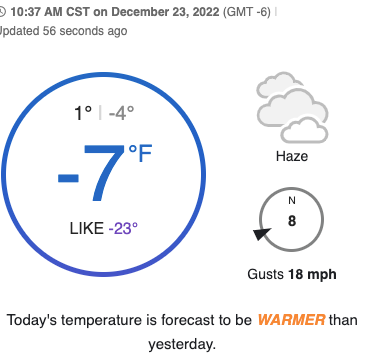
The weather right now:

That's warmer than yesterday??!! I didn't look yesterday when I was out shoveling (we got about 6 inches of snow), but it definitely was cold! I was outside for about 2.5 hours shoveling and the wind did feel cold. And when I looked at the temperature at about 8:00 last night, it was -12ºF. So I guess the wind chill would be lower than -27ºF.

Merry Christmas!

Hymn to God's holiness

100 L. M.
Holiness

HOLY as thou, O Lord, is none
   Thy holiness is all thine own;
   A drop of that unbounded sea
   Is ours,—a drop derived from thee

2 And when thy purity we share,
   Thine only glory we declare;
   And, humbled into nothing, own,
   Holy and pure is God alone.

3 Sole, self-existing God and Lord,
   By all thy heavenly hosts adored,
   Let all on earth bow down to thee,
   And own thy peerless majesty:

4 Thy power unparallel’d confess,
   Establish’d on the Rock of peace
   The Rock that never shall remove
   The Rock of pure, almighty love
              —Charles Wesley, Methodist Episcopal Hymnal (1870)

For whom do we groan?

I propose that nothing in the text warrants reading τὸ γὰρ τί προσευξώμεθα καθὸ δεῖ οὐκ οἴδαμεν [We don’t know what we should pray] in Romans 8:26 as a reference to the prayers believers should make only on their own behalf. Instead, what believers ought to pray for in Romans 8:26 and what the Spirit intercedes for in Romans 8:27 is not only for the believers’ own good but is also for the good of the creation, which currently groans, hence Paul’s transition from creation to believers in Romans 8:22–23.—Conformed to the Image of His Son, 244 (emphasis original)

Thursday, December 22, 2022

Coworkers!

I suggest that, though God’s children have not yet fully received their adoption as sons and thus are not yet in full possession of the inheritance, they are nevertheless called with the purpose of cooperating with God to bring restoration to his creation in the present. Discussions regarding humanity’s responsibility toward the nonhuman creation are increasingly popular, particularly within discussions surrounding the intersection of ecological concerns and theology. Byrne even goes so far as to suggest that “the future of the world (salvation) does to some extent lie in human hands.” He continues by stating, “Hope for the future in this sense takes human action into account. It remains hope in God but it is also hope in the prevailing power of God’s grace working through, not around or above human cooperation.”—Conformed to the Image of His Son, 242 (emphasis original in/quotation)

Wednesday, December 21, 2022

He shall glorify…

OK, I've been listening to Handel's Messiah, what can I say! Anyway, here's today's excerpt from Conformed to the Image of His Son:

Glorification, according to my working definition, occurs in two stages. On the basis of believers’ union with Christ, glorification is a present reality, at least in part. They are free from the powers of sin and death and have received the Holy Spirit, the firstfruits of their adoption. When believers’ bodies are resurrected to share in the glory of Christ, as in Philippians 3:21, then they will do so fully.—Conformed to the Image of His Son, 237

Tuesday, December 20, 2022

Tozer Tuesday

As soon as we accept the doctrine or the idea that the Bible is a book of theological toys to be played with by tender saintlings, we have missed the purpose of the Scripture and face the danger of slipping into false doctrine before very long. For the Bible was given to us not to satisfy our curiosity but to sanctify our personality.—A.W. Tozer, Living as a Christian, 33

Monday, December 19, 2022

An Advent hymn

118 C. M.
Design and object of His advent.

HARK, the glad sound! the Saviour comes,——
   The Saviour, promised long;
   Let every heart prepare a throne,
   And every voice a song.

2 He comes, the pris’ner to release.
   In Satan’s bondage held;
   The gates of brass before him burst,
   The iron fetters yield.

3 He comes, from thickest films of vice
   To clear the mental ray,
   And on the eyes oppress’d with night
   To pour celestial day.

4 He comes, the broken heart to bind,
   The wounded soul to cure,
   And, with the treasures of his grace,
   To’ enrich the humble poor.

5 Our glad hosannas, Prince of peace,
   Thy welcome shall proclaim,
   And heaven’s eternal arches ring
   With thy beloved name.
                    by Philip Doddridge
                    from the 1870 Hymns for the Methodist Episcopal Church

Sunday, December 18, 2022

Numismatic abbreviations

The last two books I've edited have had numismatic references, and therefore abbreviations. I'm not a numismatics guy—far from it! So, I had to dig around for a good site for abbreviations. The one I've had the best success with so far is this one called Wild Winds.

I also found a link to the Mionnet supplement volumes on google books here. There are nine of them!

This is mainly for my reference, but others might find it useful. If you have better sites, please add them in the comments.

See all the copyediting stuff here.

Friday, December 16, 2022

But what does the text say?

Contrary to Schreiner, Witherington, Moo, and others who maintain this guaranteed future reality, there is no indication within the context of Romans 8:30 that Paul writes from this future standpoint. Assurance alone is not a strong rationale for assuming Paul is writing about believers’ guarantee of glorification from a future perspective. I suggest that scholars take this view because their presupposed definition of δόξα [doxa] requires it: God’s people have clearly not yet been brought fully into the divine glory; therefore, the only explanation of the aorist is that, because it is so assured in the future, it can be spoken of as if it were a reality already in the present. This anticipatory interpretation, however, is unsupported.—Conformed to the Image of His Son, 236

Thursday, December 15, 2022

The goal

My emphasis here is on the ultimate goal of the calling, which Paul makes clear is not believers’ justification, contrary to much of Protestant post-Reformation theology. The goal is a redeemed people through whom God brings redemption to the rest of the cosmos. The embedded structure of Romans 8:28–30 makes this clear.—Conformed to the Image of His Son, 230–31 (emphasis original)

<idle musing>
A helpful reminder, isn't it? Post-Reformation theology gets hung up on the penultimate goal, forgetting what the reason for salvation is in the first place. God's ultimate goal hasn't changed: He gave humanity the imago Dei to be his stewards on earth; the method has changed because of sin and rebellion, but the goal remains the same.
</idle musing>

Wednesday, December 14, 2022

Speech does not equal writing

The assumption that writing exists solely to represent speech is also gravely mistaken. As Coulmas has observed, “Writing is for readers who have little need for minute phonetic information because they know the language that is written and, therefore do not depend on such information for identifying meaningful units in the text.” Moreover, as Coulmas notes that the origins and development of writing are independent of spoken language: “writing did not evolve as a means to record speech but as a system of communication” (2003: 15). The purpose of writing is to communicate meaning, not sound.—William Schniedewind, in Advances in Biblical Hebrew Linguistics, 113

<idle musing>
I need to be reminded of that every now and then…
</idle musing>

Tuesday, December 13, 2022

But we see Jesus…

In short, what I have argued here in Romans 8:29-30 is that Paul sees that those conformed to the image of the Son are those who, though once participants in the Adamic submission to the powers of sin and death, now participate in the reign of the new Adam over creation. Mankind’s position on earth as God’s vicegerents to his creation is now restored, though now through the image of the Son of God, who reigns as God’s preeminent vicegerent. The depiction of humanity being crowned with glory and honor and established with dominion over creation in Psalm 8 is now again a reality, through both the Firstborn Son of God and those who participate in his exalted status, that is, his glory. Byrne notes that this is the “full arrival at the goal of God’s intent for human beings” in Romans 8:29. Those conformed to the image of God’s Son participate in the Firstborn Son’s sovereign position over creation as adopted members of God’s eschatological family and, as such, as a reglorified humanity.—Conformed to the Image of His Son, 226–27

Tozer Tuesday

Double dose today!

I do not believe that evangelical truth necessarily must accept any one theory of inspiration as long as we believe that the holy men of God spoke as they were moved by the Holy Ghost. “For verily I say unto you, till heaven and earth pass, one jot or one tittle shall in no wise pass from the law, till all be fulfilled” (Matt. 5:18 [KJV]). This, I believe, fulfills the requirements for belief concerning inspiration of Scripture.—A.W. Tozer, Living as a Christian, 29

And

It is usually the case in the Word of God that there are a multitude of applications, so that if one man says it means this, and another man says it means that, and three others say it means some other thing, they are not contradicting each other; they may easily be complementing each other’s interpretation. I have no objection to various interpretations provided they do not say, “Accept my interpretation or I rule you out.” That mindset is too narrow and legalistic.—A.W. Tozer, Living as a Christian, 30

<idle musing>
Isn't that a refreshing viewpoint? You could call it a generous orthodoxy. Quite the change from the heresy hunting and boundary-drawing activities of some today!

May those of his tribe increase while the heresy hunters decrease. The church (and world) would be a better place!

Just an
</idle musing>

Monday, December 12, 2022

Who's leading the show?

Rom 8:30 should first (not only) be read through a disciplined lens of biblical theology, in which we strive to let the text inform our system rather than (in an unhealthy way) our system inform the text. To be sure, it is not only impossible but undesirable to read any given text without a systematic framework. Yet our mindset must be one of self-consciously letting the text tinker with the framework rather than the framework with the text.—Dane Ortlund, Inaugurated Glorification: Revisiting Romans 8:30 JETS 57 (2014): 128 (emphasis original); cited in Conformed to the Image of His Son, 225

<idle musing>
But how often is it the other way around? Far too often we go to scripture seeking a proof text for our chosen position, rather than going there with an open mind. Yes, we all have frameworks (presuppositions), but they must be open to modification if we intend to grow spiritually (as well as intellectually and emotionally).

Back in the day, we used to call that inductive versus deductive reading. Not sure what they call it now, but the principle remains the same: Let the text dictate what you find, not the other way around.

To share a story: Many years ago, another person and I used to get together to sight-read in the Greek New Testament. One day, the person I was reading with said something to the effect that they were truly amazed because I let the text dictate how I translated and interpreted it. I asked them what they meant. They replied that they had been taught to go to the text with a firm idea and then find it there—and this person was seminary-trained! Yikes!

As the title of the post asked, "Who's leading the show?" I hope and pray you let God, through the Holy Spirit, direct what you find in any given text, not what your presuppositions/framework/theology dictates has to be there or can't be there.
</idle musing>

Saturday, December 10, 2022

Self-righteousness, the ultimate false hope

443 S. M.
Self-righteousness destroyed

A GOODLY, formal saint,
   I long appeared in sight;
   By self and Satan taught to paint
   My tomb, my nature, white.
   The Pharisee within still undisturb’d remain’d;
   The strong man, arm’d with guilt of sin,
   Safe in his palace reign’d.

2 But, 0, the jealous God
   In my behalf came down;
   Jesus as himself the stronger show’d,
   And claim’d me for his own.
   My spirit he alarm’d,
   And brought into distress;
   He shook and bound the strong man,
   arm’d in his self-righteousness.

3 Faded my virtuous show,——
   My form without the power;
   The sin-convincing Spirit blew,
   And blasted every flower:
   My mouth was stopp’d, and shame
   Cover'd my guilty face;
   I fell on the atoning Lamb,
   And I was saved by grace.
                                  (1870 Methodist Episcopal hymnal)

Friday, December 09, 2022

What do you do with that εἰκόν [eikon] in Romans 8:29

How then should one understand Paul’s use of εἰκόν [eikon] in Romans 8:29? It should be noted first that, as Philip Hughes rightly suggests, τῆς εἰκόνος [tes eikonos] and τοῦ υἱοῦ [tou huiou] in Romans 8:29 should be taken as mutually explicative, so that the verse reads “be conformed to the image (that is) [God’s] Son” (see 1 Cor 15:49). The image is neither external to the Son nor an attribute of the Son that can theoretically be removed or replaced; the image is the Son himself, the perfect representation of Sonship.—Conformed to the Image of His Son, 193

<idle musing>
For those of you paying close attention, you'll see over a hundred page jump here from the last one. That's because she has been laying a lot of foundational and literature review work (it's a revised dissertation after all!) that, while important to the study, doesn't lend itself very well to extracting a paragraph here and there. I recommend you look at the book if you are really interested. A word of warning though: If you aren't quite proficient in Greek, you will have a terrible time of it! She quotes large sections of the LXX without translating it.
</idle musing>

Thursday, December 08, 2022

Jesus, I am resting

1 Jesus, I am resting, resting
   In the joy of what Thou art,
   I am finding out the greatness
   Of Thy loving heart.
   Thou hast bid me gaze upon Thee,
   And Thy beauty fills my soul,
   For by thy transforming power
   Thou hast made me whole.

Refrain:
   Jesus, I am resting, resting
   In the joy of what Thou art,
   I am finding out the greatness
   Of Thy loving heart.

2 Oh, how great Thy loving-kindness,
   Vaster, broader than the sea;
   Oh, how marvellous Thy goodness
   Lavished all on me
   Yes, I rest in Thee, Beloved,
   Know what wealth of grace is Thine,
   Know Thy certainty of promise
   And have made it mine. [Refrain]

3 Simply trusting Thee, Lord Jesus,
   I behold Thee as Thou art,
   And Thy love, so pure, so changeless,
   Satisfies my heart,
   Satisfies its deepest longing,
   And supplies its every need,
   Compasseth me round with blessings:
   Thine is love indeed. [Refrain]

4 Ever lift Thy face upon me
   As I work and wait for Thee;
   Resting 'neath Thy smile, Lord Jesus,
   Earth's dark shadows flee.
   Brightness of Thy Father's glory
   Sunshine of Thy Father's face,
   Keep me ever trusting, resting,
   Fill me with Thy grace. [Refrain]
    By Jean Sophia Pigott, hymnary.org

<idle musing>

As an aside, read the author bio at hymnary.org. Seems Hudson Taylor found this hymn to be of great comfort. Personally, I can see why. It summarizes very well the power of looking to Jesus.

I'm fairly certain I learned this hymn from the Methodist Hymnal, but it isn't in the United Methodist one I have (1964 edition, w/O for a Thousand Tongues to Sing as #1). And I searched the index of the 1935 Methodist Episcopal Hymnal (Holy, Holy, Holy as #1) at hymnar.org, which was the hymnal I grew up with until about 1969, and it doesn't seem to be there either. So, I honestly don't know where I picked it up. Nevertheless, God brings it to mind frequently when I'm feeling stressed. Just like Hudson Taylor, I find comfort in its words; I hope you do too.
</idle musing>

Genesis—yes, but which part?

The point of Romans 1:23 is not the fall into sin of the primal pair from Genesis 3, particularly through idolatry, which thus affected either Gentiles specifically or humanity more generally, but humanity’s (אדם ['adam]) “exchange of the glory of the immortal God” in terms of its failure to fulfill its created purpose or identity as creatures made in the image of God, having dominion over creation as vicegerents of the Creator God—hence Paul’s obvious allusion to Genesis 1:26–28 and not Genesis 3:6. Dane Ortlund rightly argues that Paul’s reference here is not to God’s own glory, which then implies an “exchange of worship,” but that “it is probably human glory (the divine image) that is in view.” Humanity’s rejection of its created purpose throughout history took the form of idolatry—a form found in both Gentile and Jewish history—and resulted in a humanity that existed in their actions and desires as shadows of their created selves (Rom 1:24-32). Though the fall narrative of Genesis 2–3 is not implicit in Romans 1:23, Genesis 1:26-28 certainly is. Moreover, though the name “Adam” is not mentioned in Romans 1, the created purpose or identity of corporate humanity (“adam”; אדם) in Genesis 1:26-28 is undoubtedly of central importance in Romans 1:23.—Conformed to the Image of His Son, 93–94

<idle musing>
Interesting idea, which I really like and think is probably correct. I don't follow Romans' scholarship very closely, so I don't know how common this view is, but let's let her run with it. It ties in nicely with Second Isaiah's idea of a recommissioned humanity via the Servant.
</idle musing>

Wednesday, December 07, 2022

My faith looks up to thee

1 My faith looks up to Thee,
   Thou Lamb of Calvary,
   Saviour divine;
   Now hear me while I pray,
   Take all my sins away,
   O let me from this day
   Be wholly Thine.

2 May Thy rich grace impart
   Strength to my fainting heart,
   My zeal inspire;
   As Thou hast died for me,
   O may my love to Thee
   Pure, warm, and changeless be,
   A living fire.

3 While life's dark maze I tread,
   And griefs around me spread,
   Be Thou my guide;
   Bid darkness turn to day
   Wipe sorrow's tears away,
   Nor let me ever stray
   From Thee aside.

4 When ends life's transient dream,
   When death's cold, sullen stream
   Shall o'er me roll,
   Blest Saviour, then, in love,
   Fear and distrust remove;
   O bear me safe above,
   A ransomed soul
Words by Ray Palmer, The Book of Hymns (Methodist Hymnal, 1964), 143

Tuesday, December 06, 2022

Tozer for Tuesday

Not only does a Christian believe in the invisible world but he also counts on it. He acts, plans and lives as one who counts on the reality of the invisible. On the opposite side, the man of the earth does not believe in another world, or if he believes in it, he nods dutifully toward the belief in another world, but he does not let it change his plans any. He acts just the same as if there were no other world. He lays his plans precisely the same as if there were no invisible world, and he continues to live as if heaven is a myth and does not exist.

But the Christian counts on the other world, so that the invisible presence of God in His eternal kingdom, and the spirits made perfect in the holy church of the first-born, and the Holy Ghost and the invisible world actually influence his life. The invisible actually shapes his plans, determines his habits, comforts, consoles and supports him..—A.W. Tozer, —Living as a Christian, 21

<idle musing>
How many who call themselves Christian can fit into Tozer's category of the "man of the earth"? Too many I fear : (
</idle musing>

Unfortunate reversal

Behind the line of argument here [Rom 1:23] would seem to be the biblical tradition, stemming from Gen 1:26–28, where human beings, created in the image and likeness of God, are given dominion over the rest of creation (fish, birds, animals, reptiles), a motif given more poetic expression in Psalm 8 (esp. vv 5–8). Idolatry represents the summit of “futility” (v 21) in that it has human beings submitting themselves in worship to the creatures over which they were meant to rule. This perverts the whole raison-d'étre of the non—human created world, subjecting it to “futility” (8:30).—Brendan Byrne, Romans, Sacra Pagina (Collegeville, MN: Liturgical Press, 2007), 38; quoted in Conformed to the Image of His Son, 93

Monday, December 05, 2022

What amazing words of grace!

294 C. M.
Sufficiency and freeness.

WHAT amazing words of grace
   Are in the gospel found!
   Suited to every sinner’s case,
   Who knows the joyful sound.

2 Poor, sinful, thirsty, fainting souls,
   Are freely welcome here;
   Salvation, like a river, rolls,
   Abundant, free, and clear.

3 Come, then, with all your wants and wounds;
   Your every burden bring:
   Here love, unchanging love, abounds,——
   A deep, celestial spring.

4 Whoever will—O gracious word!—
   May of this stream partake;
   Come, thirsty souls, and bless the Lord,
   And drink, for Jesus’ sake.

5 Millions of sinners, vile as you,
   Have here found life and peace;
   Come, then, and prove its virtues too,
   And drink, adore, and bless.
                                          Methodist Episcopal Hymnal 1870 edition

How does the LXX use δοξάζω?

Two points of significance are notable here. First, in each of the examples for δοξάζω above [Daniel, Esther, 1 maccabees, Isaiah, and Sirach], the aorist active idicative third-person singular form is used—the same form used 1n Romans 8:30 for God's glorification of humanity. Second, in nearly every instance of humanity's glorification in the LXX (the exceptions being Ex 34:29-30, 35; Sir 50:15), δοξάζω refers primarily to a status or position of honor, authority, being radiant or brought into the presence of God.—Conformed to the Image of His Son, 50

<idle musing>
Remember that! It will be important later in the book.
</idle musing>

Friday, December 02, 2022

It's tautological

Put another way, according to the presentation of the identity of God by the translators of the LXX, the identity of God is irreducible to his presence. God is presented as a God who reigns because he is omnipotent and, as an omnipotent God who ranks above all idols and other gods, he therefore reigns as king.—Conformed to the Image of His Son, 45–46

Thursday, December 01, 2022

'Tis metaphorical, you see

All God-talk, all theology, even ours, is metaphorical, describing God in terms that properly belong to the human sphere. It cannot be otherwise, as human words, like human thought, belong this side of creation, and cannot begin to describe its other side, God as he is in his own interior life. Such knowledge as we have of God is not of God as he is, but as he shows himself towards human beings.… When we say that God saves, redeems, pities us, is our Father, our shepherd, our King, we are using metaphors or images drawn from human life and experience. In other words, we are using anthropomorphisms, ascribing to God human actions and human feelings.—J. C. L. Gibson, Language and Imagery in the Old Testament (Peabody, MA: Hendrickson, 1998), 22; cited in Conformed to the Image of His Son, 28

<idle musing>
Starting a new book today, Conformed to the Image of His Son. I picked it up at AAR/SBL a few years ago, and it languished on my bookshelf until recently.

Today's snippet might seem to contradict the previous post from Tozer about God being near, but not really. We use anthropomorphisms, but they accurately reflect God to a degree. The danger is to forget they are metaphorical, trying to describe what is beyond human comprehension.
</idle musing>

Tozer for a Tuesday (ok, it's Thursday; I forgot!)

So the believer accepts and believes in a real world of which God is the King, an eternal kingdom, an eternal world, a spiritual and invisible world co-existing with and touching and accessible to this world. Heaven is not so far away that we must take a jet and continue through light years of travel to get to heaven. The average Christian thinks of heaven as being so far away, and only by accommodation do we sing about heaven being near and “glory coming down our souls to greet.”—A.W. Tozer, —Living as a Christian, 17

<idle musing>
Sadly, he is correct. Too many Christians see God as "out there"—a great chasm separating us from him. That's not the biblical witness! God is close at hand, nearer than you realize; in fact, living inside you in the form of the Holy Spirit.

If we would internalize that understanding, it would transform how we live, wouldn't it? Lord, make it so!
</idle musing>

Wednesday, November 30, 2022

Freedom; it's not what you think

One can hardly imagine a greater contrast to what Luther meant by “the freedom of a Christian”: living in paradoxical bondage to selfless, loving service of your neighbors, tirelessly tending to their needs whatever they might be, as a result of gratitude for the unmerited gift of God’s saving grace. Freedom as understood by Luther, as well as by the other Protestant and Catholic reformers of the sixteenth century, was based on a radically different understanding of what human beings are, what the point of human life is, and how one ought to live. No wonder it seems so alien today to most Westerners.—Rebel in the Ranks, 262

<idle musing>
And that's also what Jesus, the apostles, and Paul all meant by the freedom of a Christian. It's the freedom to serve. The freedom of not fearing your neighbors or enemies, but instead loving them and serving them.

There's always been a shortage of that kind of freedom, but I suspect it's at an unusually low point right now in our society.

I saw a new word yesterday, "angertainment," the use of anger to entertain people. It seems a sad but apt descriptive word for our society.

Again, a good meditation for advent, leading up to the Deliverer's birth.

Just an
</idle musing>

Tuesday, November 29, 2022

The Goods life?

To judge by most people’s actions today, they believe the goods life is the good life, and they devote themselves to this whether or not they also believe in God or engage in worship or prayer. In public culture and society as a whole, in both the United States and Europe, the consumption of goods and pursuit of enjoyment has essentially replaced religion. Whether you happen to be religious has no effect at all on the dominant culture. This would have horrified—if perhaps not surprised—Luther and Calvin and other sixteenth-century Protestant reformers.—Rebel in the Ranks, 255

<idle musing>
I like that, the "goods life." He is correct, we've exchanged a good life in Christ for a goods life of consumerism—and it doesn't fulfill. We need to consume more to attempt to fill that hole in our souls, which of course feeds the cycle of consume and throw away, leading to an ever warmer and more unstable climate.

Seems an appropriate meditation this advent season for why we need a savior.

Just an
</idle musing>

Monday, November 28, 2022

A different look at Adam Smith

I read an interesting review article over the weekend about Adam Smith on the New York Review of Books (via Libby from my local library). I haven't read any Adam Smith for almost 50 years (back in high school), but maybe I should take another look. Here's a brief little snippet that I found interesting:
Once we enter society and start trading with one another, Smith thought, material goods take on a social meaning. Now we are as concerned with how those goods make us appear to others as we are with the goods themselves. Once we enter an economy with others, which is the only economy there is, we cease to think and act in a strictly economic sense. When “everyone began to look at everyone else and to wish to be looked at himself,” wrote Rousseau, “public esteem acquired a price.” Smith’s theory is an attempt to make sense of that price.
Seems there's a lot more going on than I remembered (and than most people talk about when they discuss Adam Smith). The above quotation should make the Chicago school of economists recalculate. They assume a Robinson Crusoe (article's words) approach: No societal pressure, therefore a person will make a logical decision. When's the last time someone did that!!? Right, Robinson Crusoe, but even he was influenced by his cultural background (I know, he's a literary figure, but the point stands).

If you can access the article via Libby, I recommend it; otherwise, try interlibrary loan (an independent scholar's best friend!).

By the way, the book reviewed is Being Me Being You: Adam Smith and Empathy, by Samuel Fleischacker, University of Chicago Press, 216 pp., $105.00; $35.00 (paper). The paperback is actually affordable!

Sunday, November 27, 2022

Advent

Advent Sunday! Christmas has pretty much taken over the Advent season; it used to be a preparation time for the coming of the "Long-Expected Jesus." Now, it's rare to hear an advent song; you mostly hear Christmas carols. Don't get me wrong; I love Christmas carols! But I would love to hear more Advent songs. Here's one that is probably the best known: O Come, O Come, Immanuel (various spellings of Immanuel; I prefer Emanuel myself). I didn't know the back story on this until I read about it on The Anxious Bench the other day. Fascinating! Anyway, here's the hymn, and please, do yourself a favor and look through a hymnal at some of the other Advent hymns an reacquaint yourself with the build up to the arrival of Messiah!

1 O come, O come, Immanuel,
   and ransom captive Israel
   that mourns in lonely exile here
   until the Son of God appear.

Refrain:
Rejoice! Rejoice! Immanuel
shall come to you, O Israel.

2 O come, O Wisdom from on high,
   who ordered all things mightily;
   to us the path of knowledge show
   and teach us in its ways to go. Refrain

3 O come, O come, great Lord of might,
   who to your tribes on Sinai's height
   in ancient times did give the law
   in cloud and majesty and awe. Refrain

4 O come, O Branch of Jesse's stem,
   unto your own and rescue them!
   From depths of hell your people save,
   and give them victory o'er the grave. Refrain

5 O come, O Key of David, come
   and open wide our heavenly home.
   Make safe for us the heavenward road
   and bar the way to death's abode. Refrain

6 O come, O Bright and Morning Star,
   and bring us comfort from afar!
   Dispel the shadows of the night
   and turn our darkness into light. Refrain

7 O come, O King of nations, bind
   in one the hearts of all mankind.
   Bid all our sad divisions cease
   and be yourself our King of Peace. Refrain

Saturday, November 26, 2022

I could use more of this attitude. Could you?

556 S. M.
The spirit of prayer

THE praying spirit breathe!
   The watching power impart;
   From all entanglements beneath,
   Call off my peaceful heart;
   My feeble mind sustain,
   By worldly thoughts oppress’d;
   Appear, and bid me turn again
   To my eternal rest.

2 Swift to my rescue come;
   Thine own this moment seize;
   Gather my wand’ring spirit home,
   And keep in perfect peace:
   Suffer’d no more to rove
   O’er all the earth abroad,
   Arrest the pris’ner of thy love,
   And shut me up in God.
                                      —Charles Wesley

Thursday, November 24, 2022

Clement of Alexandria and hymns

It's funny the things you see when you page through a book as opposed to just doing a search on the internet. I was leafing through The Book of Hymns, The 1966 edition of the Methodist hymnal, and ran across two hymns by Clement of Alexandria. They must be some of the oldest hymns around outside the Bible; he lived from ca. AD 160–220, so he was born roughly 130 years after Christ's ministry, death, and resurrection (and ascension!); to put that in modern comparisons, compared to the Revolutionary war, he would have been born around 1900, or compared to the Civil War/War between the States, he would have been born in 1990.

Anyway, this particular hymn, number 86 in The Book of Hymns, appears in over 200 hymnals according to Hymnary.org. The lyrics below were taken from there; the Methodist hymnal uses an older translation and is missing verse 2 (Why? It's a great verse!). Enjoy!

1 Shepherd of tender youth,
   guiding in love and truth
   through devious ways,
   Christ, our triumphant King,
   we come your name to sing
   and here our children bring
   to join your praise.

2 You are our holy Lord,
   Christ, the incarnate Word,
   healer of strife.
   You did yourself abase
   that from sin's deep disgrace
   you might now save our race,
   and give us life.

3 You are the great High Priest,
   you have prepared the feast
   of holy love;
   and in our mortal pain
   none calls on you in vain;
   our plea do not disdain;
   help from above.

4 O ever be our guide,
   our shepherd and our pride,
   our staff and song.
   Jesus, O Christ of God,
   by your enduring Word
   lead us where you have trod;
   make our faith strong.

5 So now and till we die
   sound we your praises high
   and joyful sing:
   infants and all the throng
   who to your Church belong,
   unite to swell the song
   to Christ, our King!

Hymnary.org

Wednesday, November 23, 2022

Now Thank We All Our God (duplicate!)

A bit too unbelieving, with a God who is "out there" as opposed to living within via the Holy Spirit, but still good sentiments for a Wednesday before Thanksgiving Day:

1. Now thank we all our God,
   with heart and hands and voices,
   who wondrous things has done,
   in whom this world rejoices;
   who from our mothers' arms
   has blessed us on our way
   with countless gifts of love,
   and still is ours today.

2. O may this bounteous God
   through all our life be near us,
   with ever joyful hearts
   and blessed peace to cheer us;
   and keep us still in grace,
   and guide us when perplexed;
   and free us from all ills,
   in this world and the next.

3. All praise and thanks to God
   the Father now be given;
   the Son, and him who reigns
   with them in highest heaven;
   the one eternal God,
   whom earth and heaven adore;
   for thus it was, is now,
   and shall be evermore.

United Methodist Hymnal (1989) # 102, via Hymnary.org

I just realized that I had posted this earlier. Sorry about that! Still good sentiments, and I could always say with Peter that it is not tiresome to me and good for you to be reminded of these things!.

Tuesday, November 22, 2022

Musings on Hebrews 3–4

484 C.M.

The believer’s rest.

LORD, I believe a rest remains
   To all thy people known;
   A rest where pure enjoyment reigns,
   And thou art loved alone.

2 A rest where all our soul’s desire
   Is fix’d on things above;
   Where fear, and sin, and grief expire,
   Cast out by perfect love.

3 O that I now the rest might know,
   Believe, and enter in;
   Now, Saviour, now the power bestow,
   And let me cease from sin.

4 Remove this hardness from my heart;
   This unbelief remove;
   To me the rest of faith impart,—-
   The Sabbath of thy love.

Tozer for a Tuesday

I've decided to bring back Tozer for a Tuesday; it's been a few years, but I think I need to read him again. Here's today's snippet, from Living as a Christian.
If he or she is honest, the average Christian will sing, “See how I grovel here below, fond of these earthly toys,” rather than sing, “The waves of glory roll, my shouts I can’t control.” How can we become the ones who sing in honesty “My shouts I can’t control”?

The Christians Peter writes about saw the invisible, believed in it and rejoiced with “joy unspeakable and full of glory.” I do not know how to tell you how to get it; I only know how they got it. They got it by believing in what they could not see, and that is the only way that you and I will ever have joy unspeakable and a shout that we cannot control.—A. W. Tozer, Living as a Christian, 17

Monday, November 21, 2022

The church's one foundation

1 The Church's one foundation
   Is Jesus Christ her Lord;
   She is His new creation
   By water and the Word:
   From heaven He came and sought her
   To be His holy bride;
   With His own blood He bought her,
   And for her life He died.

2 Elect from every nation,
   Yet one o'er all the earth,
   Her charter of salvation
   One Lord, one faith, one birth.
   One Holy Name she blesses,
   Partakes one Holy Food,
   And to one hope she presses
   With every grace endured.

3 Though with a scornful wonder
   Men see her sore opprest,
   By schisms rent asunder,
   By heresies distrest,
   Yet saints their watch are keeping,
   Their cry goes up, "How long?"
   And soon the night of weeping
   Shall be the morn of song.

4 'Mid toil, and tribulation,
   And tumult of her war,
   She waits the consummation
   Of peace for evermore;
   Till with the vision glorious
   Her longing eyes are blest,
   And the great Church victorious
   Shall be the Church at rest.

5 Yet she on earth hath union
   With God, the Three in One,
   And mystic sweet communion
   With those whose rest is won:
   O happy ones and holy!
   Lord, give us grace that we,
   Like them, the meek and lowly,
   On high may dwell with Thee.

Methodist Hymn and Tune Book (1917)

Amen! Good preaching!

I don't know if you follow Roger Olson's blog or not. If you don't you definitely need to take a look at today's post, on economic theory and Christian ethics. Here's a short snippet, but you definitely need to read the whole thing (and the preceding post as well for context and indentifying the theorists):
Nozick’s theory of justice as entitlement has no way of guarding against price gouging even in a catastrophe. Nor has it any way to ameliorate the growing gap between rich and poor in a capitalist society. In fact, I will go so far as to say his theory of justice is unjust and evil. Nozick may not have been a Social Darwinist, but this I will say about it: If I were a Social Darwinist I would find Nozick’s theory of justice as entitlement an ally and I would use it to promote my Social Darwinist beliefs. As a Christian ethicist, I unequivocally condemn Nozick’s theory of justice as entitlement even if Nozick himself inconsistently with his own theory offered qualifications that make it appear as if his theory has “place” for compassion. In his theory, charity is left to individuals and organizations and government has no obligation to help the poor, the indigent, the vulnerable, the weak, or the helpless.
<idle musing>
Amen and amen! Good preaching!
</idle musing>

Sunday, November 20, 2022

Now thank we all our God

1 Now thank we all our God
   with heart and hands and voices,
   who wondrous things has done,
   in whom his world rejoices;
   who from our mothers' arms
   has blessed us on our way
   with countless gifts of love
   and still is ours today.

2 Oh, may this bounteous God
   through all our life be near us,
   with ever-joyful hearts
   and blessed peace to cheer us
   and keep us in his grace
   and guide us when perplexed
   and free us from all ills
   in this world and the next.
  

3 All praise and thanks to God
   the Father now be given,
   the Son, and him who reigns,
   with them in highest heaven,
   the one eternal God,
   whom earth and heav'n adore;
   for thus it was, is now,
   and shall be evermore.

Hymnary.org

Thursday, November 17, 2022

Fairest Lord Jesus

1 Fairest Lord Jesus,
   ruler of all nature,
   O thou of God and man the Son,
   Thee will I cherish,
   Thee will I honor,
   thou, my soul's glory, joy, and crown.

2 Fair are the meadows,
   fairer still the woodlands,
   robed in the blooming garb of spring:
   Jesus is fairer,
   Jesus is purer
   who makes the woeful heart to sing.

3 Fair is the sunshine,
   fairer still the moonlight,
   and all the twinkling starry host:
   Jesus shines brighter,
   Jesus shines purer
   than all the angels heaven can boast.

4 Beautiful Savior!
   Lord of all the nations!
   Son of God and Son of Man!
   Glory and honor,
   praise, adoration,
   now and forevermore be thine.

United Methodist Hymnal, 1989 (taken from hymnary.org)

When I was in first grade, we lived in Columbia, MO while my dad was finishing up his doctoral work. We went to a large Methodist church, well it was large by 1960s standards anyway! (As an aside, the pastor there later went on to become a bishop.) One of the highlights for me was that I was able to sing in the primary youth choir, made up of first, second, and third graders. This was one of the songs that we would sing and it became one of my favorite hymns. I've also heard it called Beautiful Savior instead of Fairest Lord Jesus, like the first line of the fourth stanza.

Wednesday, November 16, 2022

A hymn for Wednesday

864 C. M.
I shall be satisfied when I awake in thy likness.

JESUS, the all—restoring Word,
   My fallen spirit’s hope,
   After thy lovely likeness, Lord,
   Ah! when shall I wake up?

2 Thou, O my God, thou only art
   The Life, the Truth, the Way;
   Quicken my soul, instruct my heart,
   My sinking footsteps stay.

3 Of all thou hast in earth below,
   In heaven above, to give,
   Give me thy only love to know,——
   In thee to walk and live.

4 Fill me with all the life of love;
   In mystic union join
   Me to thyself, and let me prove
   The fellowship divine.

5 Open the intercourse between.
   My 1onging soul and thee,
   Never to be broke off again
   To all eternity. (Charles Wesley)

Tuesday, November 15, 2022

Citing a YouTube video

This was a first for me. I needed to know how to cite a YouTube video!

According to Chicago Manual of Style, it gets cited as follows:

Hays, Richard B. “Did All the Gospel Writers Believe Jesus Was Divine?” Streamed live on Dec 4, 2014. YouTube video, 52:41. https://youtu.be/XHE6rWTcQW0.
To get the short YouTube url, you need to click on the Share button and then copy that.

Simple, isn't it? But note that this is in their FAQ, not in the actual CMS17 itself.

Use this url to access the CMS site for questions: https://www.chicagomanualofstyle.org/tools_citationguide/citation-guide-1.html. I use it all the time to find the paragraph numbers and then consult the physical book. You need a subscription to access the online version of the manual.

See all the copyediting stuff here.

Monday, November 14, 2022

Vain attempt

“People who present themselves as the embodiment of order become the embodiment of nothingness and ‘emptiness.’” John Goldingay, The Message of Isaiah 40–55: A Literary-Theological Commentary (London: T&T Clark, 2005), 57

Sunday, November 13, 2022

A hymn for the second Sunday in November

Yes, I'm on a hymn kick right now. Here's one that came to mind as I was brewing a pot of tea this morning:
1 God of grace and God of glory,
   on the people pour thy power;
   crown thine ancient church's story,
   bring her bud to glorious flower.
   Grant us wisdom, grant us courage,
   for the facing of this hour,
   for the facing of this hour.

2 Lo! the hosts of evil round us
   scorn thy Christ, assail his ways!
   Fears and doubts too long have bound us;
   free our hearts to work and praise.
   Grant us wisdom, grant us courage,
   for the living of these days,
   for the living of these days.

3 Cure thy children's warring madness,
   bend our pride to thy control;
   shame our wanton, selfish gladness,
   rich in things and poor in soul.
   Grant us wisdom, grant us courage,
   lest we miss thy kingdom's goal,
   lest we miss thy kingdom's goal.

4 Save us from weak resignation
   to the evils we deplore;
   let the search for thy salvation
   be our glory evermore.
   Grant us wisdom, grant us courage,
   serving thee whom we adore,
   serving thee whom we adore.

The United Methodist Hymnal #577

You can find more info, including author and alternate wording at hymnary.org.

This hymn seems appropriate for the strife-ridden culture consuming the US right now. May all who name the name of Christ, whether right or left, allow God to "cure [his] children's warring madness, bend our pride to thy control; shame our wanton, selfish gladness, rich in things and poor in soul" and "Grant us wisdom, grant us courage, lest we miss thy kingdom's goal."

Saturday, November 12, 2022

Tempest in a teapot

Aparently there has been a big dust up on Twitter about translators not being named on the cover of a book. Jim West has a post on it and I posted a comment. Because Jim moderates his comments (wise choice), it may or may not be posted, so I provide it here:
As Jim Eisenbraun pointed out to you on Twitter, it is normal for publisher not to display the translator on the cover. And, I'd like to point out that K.C. is an editor at W&S, so he might have had some input on that.

The cover is for selling the book. The title page is where the important stuff is. Worldcat, the librarians tool, usually only displays the translator in the (now hidden) details screen.

The only exception is where the translator is in some way a "big name" and having his/her name on the cover will help sell the book. Because that's what covers are for—to catch people's eyes so that they will buy the book. Period. Actually, exclamation point. Covers are a selling point—which is why the old-style stamped cloth cover is not around much anymore. It's usually on over-priced books that only need to sell 100 copies to libraries to make money. Popular-priced books need a cover to attract the nonlibrarians. If having the translator on the cover helps sell the book, then it will probably appear there. If not, too bad, so sad.

Sorry if I sound cynical, but with the proliferation of illegal sharing sites and people just not buying books, selling the few that a publisher does is what the cover is all about. (And note, too, that libraries are cutting way back on buying books.)

Sorry if you don't like my comment, but it's the truth. Not dissing translators in any way, shape, or form. They do difficult and necessary work, but if the book doesn't sell, their work will be in vain. And publisher will go away, which some of you may think is a good thing, but when I look at some self-pub stuff, with egregious factual, grammatical, and other obvious errors, I suspect the wild, wild west of self-pubs might not be the utopia that some seem to think it is.

Tell me I'm wrong…

Just an
</idle musing>

Friday, November 11, 2022

Hymn for a Friday

I woke up with this hymn on my mind:
1 All glory, laud, and honor
  to you, Redeemer, King,
  to whom the lips of children
  made sweet hosannas ring.
  You are the King of Israel
  and David's royal Son,
  now in the Lord's name coming,
  the King and Blessed One.

2 The company of angels
  is praising you on high;
  and we with all creation
  in chorus make reply.
  The people of the Hebrews
  with palms before you went;
  our praise and prayer and anthems
  before you we present.

3 To you before your passion
  they sang their hymns of praise;
  to you, now high exalted,
  our melody we raise.
  As you received their praises,
  accept the prayers we bring,
  for you delight in goodness,
  O good and gracious King!

This is an old hymn, written around 800 (in Latin, of course). You can read about the author and the translator at Hymnary.org. I might note that I remember it in the Methodist hymnal version, which is a bit different (you can use hymnary.org to compare and see).