Thursday, December 10, 2015

A Christian response (guest post)

This is a guest post by Daniel Bradley. He originally posted it on Facebook in response to my posting a link to the excerpt on Tuesday.

One of the most difficult aspects of Christianity—one with which Christians in every era have struggled (including myself)—is its wholesale rejection of violence in any and every form. Within the teachings of Jesus lies such an ethic of nonviolence and non-retaliation that it runs counter to the very grain of human nature and logic. It is an ethic that does not render evil for evil; it turns the other cheek. It’s an ethic that loves enemies until death and tells Peter to put away his sword. And, well, that simply doesn’t square with our natural instincts for self-protection/preservation.

But here is where the beauty of the Christian faith shines: Once a person says, “I am crucified with Christ,” and names Jesus as “Lord,” the paradigm completely changes. What may be permissible in the eyes of the State may be wrong for the Christian. Take the Second Amendment for example. Within the scope of Jesus’ teaching, we can find no place for answering violence with violence. Many have attempted to dilute this by means of appealing to self-defence (claiming that self-defence is not violence), but that’s just the problem. Jesus never defended himself; when he was reviled, he didn’t revile back. Nor did he prevent the martyrdom of the Apostles. On the contrary, Jesus stated that he was sending them out as sheep among wolves. He basically promised them they would die! Stephen didn’t take up a sword when being stoned, and neither did Paul and the other of the earliest followers take up arms to defend themselves or one another. This is one of the gut punches of the Gospel: laying down the sword, and really laying it down for the sake of Christ. Can I truly say I am loving my enemy when I’m putting a bullet in his head??

Yes, I honestly grapple with the scenario of an intruder breaking into my home to kill me and my family, and with the question of what would I do. To some there’s no question at all – they would shoot to protect themselves and their families. Yet, the real question to ask is, “What would following Christ look like in that moment?” Of course, my natural instincts say, “Fire away! Load with lead and aim for the head!” But that’s not what Jesus did when he died, and that’s not what the early Christians did when being fed to the lions in the Circus Maximus or burned as human candles in Nero’s Pleasure Garden. We must all face the fact that someone is going to suffer because of *our* convictions, no matter where we stand on the issues. People make their choices, and others will feel the impact of those choices in some form or degree – whether we are pacifists or we happen to side with those who opt for war or their gun “rights.” As Christians, however, we should want to side with Jesus no matter what the cost, and teach our families what it means to be one of his disciples. This means not holding one’s life precious to oneself, but rather entrusting our existence to the one who gave his life for us, and following after his pattern. Far from being a cakewalk, this is a very courageous, daring, and yes, dangerous way to live. But it *is* the way of Christ. In short, as we discuss these matters, we have to carefully articulate what “You shall not kill” and “Do not repay evil for evil,” and other such statements of nonviolence mean. Sadly, American culture (and even Americanized Christianity) is in such a state that these questions and considerations have difficulty even being articulated, because we have lost the ethical framework in which they can be accommodated. Christian ethics are quickly tossed out to sea and drowned in the bloody waters of fearmongering and war propaganda with a firm, religio-political strangle hold.

Finally, let me say that many professing believers speak concerning this issue more as Americans than they do as Christians, and like James Spinti said, that’s the idolatry—dare *I* say apostasy-- of it all. Christians are foreigners in a foreign land, a culture within a culture, and we must act, speak, and think like it. Just to the extent that Christians allow their attitudes and actions to be contoured by anything or anyone other than Jesus, it represents a misalignment with the Christian faith. In short, just because it is in the American Bill of Rights doesn’t mean it is Christ/ian. “Religious liberty,” an Americanized version of “freedom,” and the wielding of our American “rights” have, in my estimation, done great harm to the Christian faith in America, to where it is no longer intelligible to itself. Instead of being a prophetic voice in our culture, Christians have capitulated to the spirit of the age and have relied on politics and the “arm of flesh” to carry/legislate their moral agendas. American Christians nowadays, especially right-wing, conservative Evangelicals, are guilty of a kind of nationalistic, civil religion which blends God and country, and basically (and blindly) underwrites the American war agenda so long as our leaders tip their hats to Israel. Allegiance to Jesus has become equated with certain political parties and convictions, to the point that if some were asked “What denomination are you?” they would answer, “Republican.” All this to say, it is not Jesus. It represents a departure from His teachings, and is nothing short of idolatry. The second we appeal to Caesar to justify our convictions is the second we reject Christ’s kingship.

Wednesday, December 09, 2015

Raising the veil

If the city council announced an adult book and video store had applied for a business license close to the church and high school, would the elder gather the congregation for a prayer meeting? Would the elder merely pray that the owner of the porn shop would have a change of heart? Would the proposed store be a political or a spiritual problem?

Gun violence is nonpartisan. Guns kill Republicans, Democrats, and Independents every day. The victims are Jews, Christians, Muslims, Sikhs, Buddhists, atheists, agnostics, whites, blacks, Latino, Asian, men, women, boys, girls, young, old, gay, straight, rich, poor, rural, and urban. No category of person escapes. Gun violence is no more a political issue than drunken driving, selling crack cocaine, or arson.—America and Its Guns: A Theological Expose, page 14

<idle musing>
What more can we say? The fact that this is our response shows what our true god is...
</idle musing>

Tuesday, December 08, 2015

Let's talk about the spiritual

There are political dimensions whenever guns are discussed, but what happens in society because of guns makes them a profound spiritual concern that must be dealt with by people of faith. In spite of the metaphysical rhetoric to the contrary, guns actually do kill. That is their purpose. Although one cannot dismiss the political implications of guns, the spiritual implications, in my mind, far outweigh the purely political.—America and Its Guns: A Theological Expose, page 12

<idle musing>
Indeed! It is a spiritual problem when we send 12,569 people to their graves because of gun violence (figure is from here). Think about that for a minute. That means gun violence destroys 10 towns the size of Grand Marais every year! Ten towns!

And we're getting uptight about admitting refugees because they might be terrorists? What kind of irony is that? Oh my! A terrorist might kill some people! Yes. That's true. And I'm not trying to minimize that potential or the fact that real people might die. But—and this is huge—we allow over 12,000 people to die every year and don't blink an eye. Twelve thousand! Every year! And this year we're way ahead of that. Last year there were 281 mass shootings. This year we already have 355 (last I checked, but that was 3 days ago, so we are now probably at 360 or more). We have over 300 million, yes million guns in the U.S. If guns could make you safe, then we should be the safest nation in the world. But, apparently not, because we need more guns. And now you want to allow conceal and carry on college campuses? Insane!

And Christians are leading the charge in many cases! All in the name of Jesus, who said love your enemies, pray for those who persecute you. Vengeance is mine saith the LORD! What is going on here?

OK. Enough ranting...
</idle musing>

Monday, December 07, 2015

This looks interesting

Ohhh!! Book lust! Just ran across this in a book I'm editing:

Sievers' Law and the History of Semivowel Syllabicity in Indo-European and Ancient Greek
P. J. Barber
Oxford Classical Monographs
Hardcover
Published: 28 January 2014
464 Pages
ISBN: 9780199680504

This book is an investigation of how semivowels were realised in Indo-European and in early Greek. More specifically, it examines the extent to which Indo-European *i and *y were independent phonemes, in what respects their alternation was predictable, and how this situation changed as Indo-European developed into Greek.

Here's the link: https://global.oup.com/academic/product/sievers-law-and-the-history-of-semivowel-syllabicity-in-indo-european-and-ancient-greek-9780199680504?cc=us&lang=en&#

But the price...OUCH! $185.00! Oxford, why do you do this? Interlibrary loan! Closest place is Duluth, at least according to WorldCat. I wonder if that library does ILL? Update: Nope. According to MNLink, it doesn't exist for ILL : ( Guess I'll have to talk to the librarians...

The agony of being 5 hours from the nearest research library. But the setting more than makes up for it! After all, with ILL (if I'm willing to wait for a week) I get the best of both worlds.

The right to bear arms? Or the right to die by arms?

Though I own guns, I do not believe they should be exempt from safety requirements, wise regulation, and restrictions. Guns are made to kill. America has an abominable record of balancing an individual’s right to have a gun with the public’s inalienable right to life, liberty, and the pursuit of happiness. Public safety in the company of three hundred million guns should not be a wish or the pipe dream it is today. Children in the United States are twelve times more likely to die from firearms injury than children in twenty-five other industrialized nations combined. Gun murder rates in the United States per one-hundred thousand people are more than seventeen times higher than those in Australia; thirty-five times higher than in Germany; thirty-seven times higher than in Spain; and 355 times higher than in Japan. If the United States respected both the constitutional right to keep and bear arms and the right of its citizens to live on safe streets, these figures would drop precipitously. We should be embarrassed to be first in the developed world for gun deaths—America and Its Guns: A Theological Expose, page 5

<idle musing>
Remember the antiwar song by Country Joe and the Fish? "Hey moms, be the first on your block to get your boy home in a wooden box." That's basically what we're doing by allowing the Gun Empire to set the rules. This book will reveal how they do it...you really should buy this book and read it, or check it out of the library. Somehow, get your hands on this book and read it.
</idle musing>

Saturday, December 05, 2015

The source of the problem

Gun violence is not so much a political or social problem as it is a spiritual problem, and God’s people must be in the lead of the moral and ethical struggle for the soul of America—America and Its Guns: A Theological Expose, page xvii (emphasis original)

<idle musing>
But he doesn't stop there as too many do. He goes on to expose the idolatry at the root of it. Stay tuned!
<idle musing>

Friday, December 04, 2015

Wake up!

If our nation finally decides to save thousands of lives every year by reducing gun violence, it will be because a sleeping spiritual giant is waking up and realizes God is calling it to name and unmask the idols of power and deadly force that are perpetuating murder and violence in our communities. These idols are the principalities and powers, which are nourished by death. The good news is it does not have to be this way. There are things we can do. It is not the will of God that between eighty-two and eighty-four people die every day by guns. Many of these lives will be saved the moment the faith community wakes up, learns about the Gun Empire, and decides to do something about the violence that is all too routine in America—America and Its Guns: A Theological Expose, page xvii

<idle musing>
I find it sadly ironic that the day I begin reading this book there is another mass shooting. Twenty people dead. Boom. Just like that, their lives are snuffed out. There have been more mass-shootings in the U.S. this year than there have been days! And people say this is a political issue? Sorry! This is a spiritual issue.

"It is not the will of God that between eighty-two and eighty-four people die every day by guns." Amen! The gun empire is indeed an idol, based on fear. If perfect love casts out all fear, then why do we allow this idol to continue to dominate us?
</idle musing>

Thursday, December 03, 2015

It's the ideology

U.S. exceptionalism, in turn, requires not only a strong military force, but a military ideology that gives privilege to military adventurism and military personnel, and that assures limitless funding for such adventurism that is deeply engrained in machismo posture. The presence of the military ideology in advertising and sports means that military posturing is pervasive, so that the national anthem must be sung everywhere always, a kind of pervasiveness that shocks us when we see it performed in “lesser” societies of an authoritarian ilk. Thus military exhibits of flags, anthems, marching, and saluting of the kind that endorsed National Socialism in Germany become commonplace among us—America and Its Guns: A Theological Expose, page xii

<idle musing>
I'll bet you don't even notice it, do you? It's so commonplace that it's like the fish who doesn't know it's wet. Flags everywhere—especially since 9/11/2001.
</idle musing>

Wednesday, December 02, 2015

Now that's a scary thought

"The report says that on Black Friday, November 25, 2011, more handguns were sold in the United States than on any previous single day in U.S. history. That datum might produce staggering dismay, for it indicates a level of fear and anxiety, posturing power, and readiness for violence that defies reason. Sadly, however, that dismaying report does not in fact even evoke surprise among us, so inured are we to guns and to the culture that sustains their legitimacy and popularity."—America and Its Guns: A Theological Expose, page xi of the foreword by Walter Brueggemann

<idle musing>
I wonder if this Black Friday beat all previous ones—actually, I'd be surprised if it didn't leave all the other ones in the dust. The fact that I don't feel outrage about it confirms that Brueggemann is correct. And that is a frightening thought, even more frightening than the prospect of more weapons in an already flooded market!
</idle musing>

Tuesday, December 01, 2015

Summary

When returned to the context of human activity in general, so-called ritual acts must be seen first in terms of what they share with all activity, then in terms of how they set themselves off from other practices. Ritualization is fundamentally a way of doing things to trigger the perception that these practices are distinct and the associations that they engender are special. A great deal of strategy is employed simply in the degree to which some activities are ritualized and therein differentiated from other acts. While formalization and periodization appear to be common techniques for ritualization, they are not intrinsic to 'ritual' per se; some ritualized practices distinguish themselves by their deliberate informality, although usually in contrast to a known tradition or style of ritualization. Hence, ritual acts must be understood within a semantic framework whereby the significance of an action is dependent upon its place and relationship within a context of all other ways of acting: what it echoes, what it inverts, what it alludes to, what it denies.— Ritual Theory, Ritual Practice, page 220

<idle musing>
That's the final snippet from this book. I hope you learned something from it. I found it very interesting, but then...well, we won't go there : )

Not sure what I'll be extracting from next. I got a whole bunch of great books at AAR/SBL that I can't wait to dig into. We'll see what happens. I'm also in the middle of editing two books, plus working for Eisenbrauns part-time, so I don't have a lot of free reading time right now. And the books I'm editing don't lend themselves to extracts very well—Syriac grammar anyone?

Maybe this one:

America and Its Guns
A Theological Expose
BY James E. Atwood
FOREWORD BY Walter Brueggemann

Monday, November 30, 2015

What do you think of first?

I was reading in Psalms this morning, specifically Psalm 51, and it occurred to me: What is the first thing you think of when someone mentions David and Bathsheba?

Do you think of the adultery? Or do you think of the death of Uriah the Hittite, her husband?

I'll warrant that 90% of American Christians think of the adultery first. In fact, I'd bet that a goodly percentage don't even know the murder of Uriah! But back to Psalm 51. There's no mention of the adultery in the psalm, aside from the superscription, and even there it just says, "after he had been with Bathsheba" (CEB). But there is mention of violence:

Deliver me from violence, God, God of my salvation, so that my tongue can sing of your righteousness. Ps. 51:14 CEB
I think the fact that we don't think of the death of Uriah says a lot about the casual acceptance of death and violence in our culture. Just an
</idle musing>

But are we really one?

Ritualization both implies and demonstrates a relatively unified corporate body, often leading participants to assume that there is more consensus than there actually is. It leads all to mistake the minimal consent of its participants for an underlying consensus or lack of conflict, even when some conflict is objectified and reembodied. Most of all, ritualization leads participants to mistake the group's reformulation of itself as a straightforward communication and performance of its most traditional values.— Ritual Theory, Ritual Practice, page 210

<idle musing>
Yep. Social commentators fall prey to this all the time. Think of the way Muslims are stereotyped. And conservative Christians too, for that matter.
</idle musing>

Saturday, November 28, 2015

Refried brains

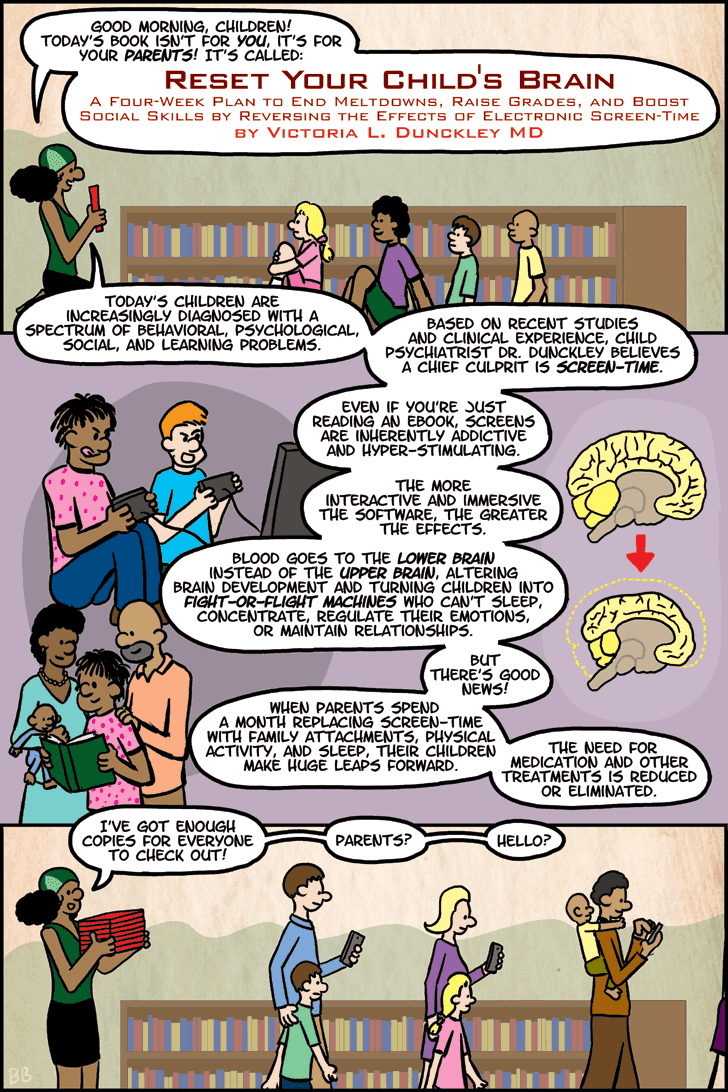
Remember those old public service announcement from the late 20th century? You know, the ones with the hot frying pan and they would say, "This is your brain." Then they would drop an egg into it and say, "This is your brain on drugs." Well, here's a modern version:
By the way, Unshelved is a great daily cartoon!

Musings on exercise rooms

As you know, I recently returned from the annual AAR/SBL meetings, this year in Atlanta (you can read about my trip there and back again). Over the years, I've noticed a distinct trend in the use of exercise equipment in the conference hotels.

When I first started attending the conference back in 2003, if you didn't get to the exercise room by 6:00 AM, you likely wouldn't get the machine you wanted. In my case, it is the recumbent bicycle. More than likely you would have to take the upright bicycle or an elliptical machine. I started getting up a bit earlier and getting to the room at 5:55. If you waited until 6:15, you likely would stand in line for about 10–15 minutes to get a machine.

Over the years, that has changed. The change was gradual, the lines disappeared with people arriving later. It became less essential to arrive before 6:00, indeed 6:15 became early enough to get whatever machine you wished. The number of pieces of equipment also changed. Where before you would see 1 recumbent bicycle, 2 upright bicycles, 3–4 ellipticals, and 3–4 treadmills, now it is 1 recumbent, 1 upright (or none), 1–2 ellipticals, and 2–3 treadmills.

This year was the most dramatic, perhaps because I haven't attended for 2 years. Every day I arrived in the exercise room between 5:45-6:10 (depending on when my first appointment was). On most days, no one else arrived in the room until 6:15. On no day did more than 2 other people enter the room before I left (usually at 6:40) and on some days, I was the only person in the room.

Meanwhile, the nation has a growing problem with weight. Hmmm...

But, exercise is only half the issue. The other half is diet. At one of the hotels I stayed at, they offered "grab and go" lunches. Basically, a sack lunch. I took one. Here's what it had: 1 white bun with ham and cheese, 1 bag of potato chips, 1 Rice Krispie™ bar, 1 packet of real mayonnaise, and 1 packet of yellow mustard. Basically, the healthiest thing in there was the mustard packet! No fiber, no fruit, no vegetable (potato chips are not a vegetable!). Needless to say, it isn't healthy; even aside from the ham, cheese, and real mayo being animal products, the white bun and Rice Krispie™ bar would cause a pre-diabetic / diabetic's sugar levels to go nuts. But this was passed off with no apparent thought as a normal lunch. Add to that the probability that whoever ate it would grab a can of sugar-laden beverage, be it carbonated or not, and you've exceeded the recommended sugar intake for the day by about 3 times! And that's just one small lunch!

Any wonder we're a nation of obesity?

Wednesday, November 25, 2015

And the road home from Atlanta is paved with...delays!

For those of you just tuning in, the record of my trip to Altanta is here. I arrived in Atlanta safely, late last Thursday, after a 13 hour day, what with traffic and all. We set up the booth for AAR/SBL on Friday and the conference opened on Saturday. Yesterday, Tuesday, the exhibit closed at noon.

Once a large conference closes, mayhem ensues. Everybody wants to get torn down, packed up, and outta there as quickly as possible. Usually it's because they have a flight to catch. Well, of the four of us, one lives in Atlanta, and the other three of us drove, so the flight deadline wasn't looming. But, I had to get the van out of valet parking before 3:00 or pay for another day, so we wanted to get done. Because everything sold so well (thank you!), the teardown went well. In fact, we were waiting for them to bring our stuff out of the storage so we could pack up. Huh? Well, when you set up, you have to put all the empty boxes and crates on a skid and they store it someplace, fire regulations and all that. So, one of the first things they do is bring up the storage skids—usually!

That wasn't happening, so I went looking (along with other vendors!). I found the foreman, who was frustrated. Apparently the freight elevator had ceased working! Not a good thing. But, they had managed to get it fixed and our skid was soon to be delivered. Sure enough, 5–10 minutes later it showed up.

We still had to skid everything up, even though I drove. The loading dock is down one floor, so they move the skid down there and then it goes on the van. No problems there—until the guy decided he wanted to just load the skid on the van instead of unstacking and restacking. Oops! Too tall. Tear off a few layers and on it goes. Pack the stuff we took off around the skid and I'm ready to go.

I asked the guys standing there about the fastest way to the Interstate. Mistake! They gave me bad directions! I lost 20 minutes trying to get unlost from following them! Oh well...off we go into the wild construction zones of I-75 and I-65! I had hoped to get to Louisville before stopping. Originally, I had hoped that would be around 9:30—10:00. As the traffic moved slowly through the construction zones around Chattanooga, I started hoping for 10:30. It looked like I might make it as I pulled onto I-65 in Nashville. That is, until about 20–30 miles south of Elizabethtown (E-town to those of us who know). There was a 16 mile section where the lanes split; I chose the one with the exits, figuring that if there was an accident, the exits would make it easier for them to clear the road. Bad choice! About 5 miles into it, traffic came to a dead stop. For 27 minutes! And there was no cell phone coverage, so I couldn't even look at what was happening on Google maps. I still don't know what it was, because once traffic started moving, the lane was clear. I hit Louisville around 11:00 and stopped a bit into Indiana.

Today I took off around 8:00 or so and hit the offices in Winona Lake before noon. No problems! I hope the flight out tomorrow is as uneventful!

Sunday, November 22, 2015

The Christian and violence

Great post by Preston Sprinkle—actually it's a paper he recently presented at ETS—entitled "A Case for Christocentric Nonviolence" (he doesn't like the word "pacifist"). Here's a small snippet, but do read the whole thing
If Jesus does not walk out of a grave and sit at the right hand of the Father, then we have no business loving our enemies. Unless Christ defeats evil by submitting to violence—by dying rather then killing—and rises from the dead to tell the tale, I will most certainly destroy my enemy before he destroys me. Without the death and resurrection of Jesus, all forms of nonviolence, I believe, are uncompelling.

To be clear, I believe in Christian—or more explicitly, Christocentric—nonviolence. Christocentric nonviolence says that we should fight against evil, we should wage war against injustice, and we should defend the orphan, the widow, the marginalized, and oppressed. And we should do so aggressively. But we should do so nonviolently.

In other words, Christocentric nonviolence does not dispute whether Christians should fight against evil. It only disputes the means by which we do fight. (emphasis original)

<idle musing>
Amen and amen!
</idle musing>

Thursday, November 19, 2015

And he made it!

I just rolled in from Indiana with a van load of goodies! Tomorrow we set up. My luggage was indeed waiting for me when I got to the airport in Fort Wayne, so all is good there.

Now I'm heading over to the exhibit hall to see what I can see...more later! But it sure was a long drive!

The road to Atlanta is paved with . . . delays!

Well, I finally got into Warsaw, coming via South Bend airport. But my luggage went to Fort Wayne! I'll have to pick it up tomorrow on my way through to Atlanta.

For those of you just joining us, I am on my way to the annual AAR/SBL meeting in Atlanta. I'm going via Warsaw, IN, because I'm picking up a van full of Eisenbrauns books for the show. I started this morning (well, actually yesterday now) at 7:00 AM from Grand Marais, MN. I drove to Duluth through rain, and as I got near the Duluth airport, the fog got extremely thick. Not good, I thought. My flight might get delayed.

Well, it was delayed, but not because of fog in Duluth, but because of wind in Chicago. The plane I was supposed to board was still grounded at O'Hare! It finally arrived around 2:00 and it looked like we might get a fast track for me to catch my connecting flight to Fort Wayne. Nope. We sat on the tarmac for an hour before they sent us back to the terminal. Then it looked like we might not get out at all. Just about the time I was weighing my options—drive home and try again Thursday, drive to Indiana, or just stay in Duluth—they said that Chicago had cleared them to come on down. So, we loaded up the plane and headed south. This was about 5:00. We got into O'Hare around 6:30 and deplaned. I headed to the customer service counter, hoping to catch the last flight into Fort Wayne, but it was already full...so much for that! Maybe I'd be spending the night in Chicago.

They asked if I had an alternate destination. I said, South Bend. It's about an hour from Warsaw, about the same as Fort Wayne. There was a flight leaving in 20 minutes and there was one seat left. I took it and headed to the gate. I got to the gate just in time for them to announce that there was a mechanical problem on the plane and they were switching planes. We should be leaving around 7:30. And then around 8:00. And then around 8:15. We finally left at about 9:00, which is actually 10:00 South Bend time. We landed in South Bend at 11:00.

Dan (the business manager at Eisenbrauns) had driven up to get me. As I was landing, I got a text message from the airline saying that my baggage had missed my flight and I needed to talk to a customer service rep. Fine, except there was no one there. They were unloading the cargo, running a short staff in the evening. He finally made it to the customer service counter around 11:45. Sure enough, my baggage was on another flight—it was waiting for me in Fort Wayne!

So, we headed toward Warsaw. We got in around 1:00, but Dan needed to show me how to run all the point-of-sale computers. And then we loaded it all into the truck and here I am, almost 2:00 AM and I'm hitting the road for Atlanta in the morning, with a detour through Fort Wayne, where hopefully my baggage awaits me! And then on to Atlanta!

Isn't travel fun? : )

Wednesday, November 18, 2015

But it doesn't count

Wuthnow has explored what he calls the "ritual aspects" of left-hand turn signals and the mass viewing of the television series "Holocaust." Given the analysis advanced in this chapter, however, the first case is not one of ritualized activities, merely regularized (rule-bound) behavior that functions as a signal of intentions in the context of driving. Why? The answer is cultural. In this culture, such legally articulated modes of regularized behavior are insufficient to count as 'ritual' for most people. In the second case, the network and general media undoubtedly used a variety of strategies to heighten the sense that people were viewing a unique and profound event, that the television was a medium of communal participation with other viewers for witnessing an important simulation of reality, and to dramatize the solemnity of the broadcast in contrast to the usual television fare. Indeed, there was sufficient evocation of ritual ways of acting that many people probably reacted with some of the conventions of consent used in ritual—"If it is this unique and important I should watch and accept," and the like. Nonetheless, in this culture, viewing the series was not likely to be judged ritual for those involved due to cultural distinctions among ways of acting, distinctions vital to any analysis of social action.— Ritual Theory, Ritual Practice, page 205

<idle musing>
That's refreshing to hear. So many people count just about everything that is regularized as ritual that it has been emptied of its meaning. I agree with her that the cultural distinctions have to be maintained in order for an understanding of what ritual is and what it does.
</idle musing>

Musings on ten years of blogging

I've been blogging for over 10 years now; I started in October, 2005. In those days, blogs were still considered controversial for academics and I wasn't sure how well my blogging would be received by Eisenbrauns' customers. Because of that, I just put it up under my initials, jps. It's been that way for 10 years now and blogs are now passé, but I've still been musing along, putting up excerpts from stuff I'm reading, commenting on the book industry, reflecting on gardening, bicycling, sharing the joys and frustrations of being a cabin caretaker on the North Shore.

All that to say, I looked over the sidebar of my blog today for the first time in ages. I'm amazed at how many of the blogs on my blogroll have fallen silent. I'm sure there are many new ones, and I've added some of them to my newsreader periodically. But I've been less than diligent about keeping the blogroll current. I think part of it is that I keep hoping some of the old standbys will start blogging again. Maybe they will, but probably not. I suppose I should update the blogroll this winter, once AAR/SBL is over.

While I was looking at the sidebar, I noticed the pattern of my posting. I'll bet you can't guess which month(s) were the busiest for me, between the cabins, Eisenbrauns, and editing. Here's the graphic for those of you who read this in an RSS newsreader

Tuesday, November 17, 2015

How it does what it does

[R]itualization involves the differentiation and privileging of particular activities. Theoretically, these activities may differentiate themselves by a variety of features; in practice, some general tendencies are obvious. For example, these activities may use a delineated and structured space to which access is restricted; a special periodicity for the occurrence and internal orchestration of the activities; restricted codes of communication to heighten the formality of movement and speech; distinct and specialized personnel; objects, texts, and dress designated for use in these activities alone; verbal and gestural combinations that evoke or purport to be the ways things have always been done; preparations that demand particular physical or mental states; and the involvement of a particular constituency not necessarily assembled for any other activities. These are not universal features, however. At best, ritualization can be defined only as a 'way of acting' that makes distinctions like the foregoing ones by means of culturally and situationally relevant categories and nuances. When such culturally specific strategies are generalized into a universal phenomenon, much of the logic by which these ritual strategies do what they do is lost. This becomes particularly clear in recalling that the situational and strategic nature of ritualization affects even the degree to which such ritualized acts differentiate themselves at all from other forms of activity. In other words, an essential strategy of ritualization is how it clarifies or blurs the boundaries that identify it as a specific way of acting.— Ritual Theory, Ritual Practice, pages 204–5

<idle musing>
As she keeps saying throughout the book, when you try to analyze ritual, you destroy its power. When it becomes an object of intellectual inquiry, it ceases to be effective—for you, not for the ones participating in it!

I must say, now that I'm almost through with the book, that this is a dense book and difficult to get through. It might be that I'm not familiar enough with the field, or it might be just plain difficult! But, I didn't always follow her arguments and frequently felt she was being convoluted; maybe that's the nature of ritual—to be difficult to describe clearly...I dunno, just an
</idle musing>

Monday, November 16, 2015

A bit of Tozer for a Monday

Life has settled down a bit, so I'm getting some time to read again, consequently, I think I'll start posting some Tozer. Let's start with some excerpts from The Dangers of a Shallow Faith.
So, my Christian friend, if you are settling back, snuggling into your foam rubber chair and resting in your faith in John 3:16 and the fact that you have accepted Jesus Christ, you had better watch yourself. Take heed, lest you also be found wanting. Take heed of your own heart, lest when all is said and done, you have become tied in with the world.—The Dangers of a Shallow Faith, page 15
Speaking of Tozer, I just saw that there is a new compilation that just got published: Delighting in God. Here's the blurb on the web site:
Delighting in God is the message A.W. Tozer intended to be the follow-up to The Knowledge of the Holy. He demonstrates how the attributes of God—those things God has revealed about himself—are a way to understand the Christian life of worship and service. Because we were created in the image of God, to understand who we are, we need to understand who God is and allow His character and nature to be reflected through us.
Sounds good; I'll have to get a copy!

Not necessarily

Any ideology is always in dialogue with, and thus shaped and constrained by, the voices it is suppressing, manipulating, echoing. In other words, ideologies exist only in concrete historical forms and in specific relations to other ideologies. Similarly, people do not simply acquire beliefs or attitudes imposed on them by others. If the manipulation of bias is a matter of unarticulated dispositions (e.g., "Stand up straight!"), then these dispositions must be embodied and reproduced in many activities that actively support them without much contradiction.— Ritual Theory, Ritual Practice, page 191

<idle musing>
In other words, it's complicated! That's why those people who say, "Do it this way, and you'll have perfect kids!" are wrong. It's complicated! There are so many factors interacting in so many ways that you are never in control of the results. Praise God for that! He is in control, and I find that reassuring.
</idle musing>

Thursday, November 12, 2015

Broken record

Despite the evidence for the ambiguous, unstable, and inconsistent nature of belief systems, recent literature persists in the view that ritual has an important social function with regard to inculcating belief.— Ritual Theory, Ritual Practice, page 186

<idle musing>
Yep. Just like I said yesterday. And this was written in 1992!
</idle musing>

Wednesday, November 11, 2015

The limits of ritual, or how I launch into a rant

These studies give evidence for the ambiguity and instability of beliefs and symbols as well as the inability of ritual to control by virtue of any consensus based on shared beliefs. They also suggest that ritualized activities specifically do not promote belief or conviction. On the contrary, ritualized practices afford a great diversity of interpretation in exchange for little more than consent to the form of the activities.— Ritual Theory, Ritual Practice, page 186 (emphasis original)

<idle musing>
When was this book written? Hmmm...1992! Over 20 years ago. And I'm still reading books written this year that claim that ritualized activities form a community around shared beliefs! What's with that? I even edited a book earlier this year that had that claim as a centerpiece of the argument!

Get a grip folks! It doesn't work that way! </rant>
</idle musing>

Tuesday, November 10, 2015

Illogical? Yep!

Hinduism for Hindus is not a coherent belief system but, first and foremost, a collection of practices. It is the collection of practices as such that needs to be explored further in order to understand their sense of religious action. Converse's conclusion about formal beliefs in comparison to particular practices also recalls the story of one exasperated foreign missionary in China. He could successfully convince the Chinese that they were foolish to bow to statues, he asserted, only to have them giggle shyly and admit that they would continue to do it anyway.— Ritual Theory, Ritual Practice, page 185–86

<idle musing>
Of course. Why not? After all, we don't act from our logic most of the time anyway. We'd like to think that we are logical beings, you know, homo sapiens and all that stuff, but the actual truth is we are emotional beings. And we want to cover our bases, too. After all, that statue just might have some power, and I don't want to anger it! And what harm will it do to bow just a little bit to it? It's cheap insurance...so goes the justification anyway. But it's all just trying to justify to our minds what we wanted to do anyway.

We need the transforming power of the Holy Spirit, working from the inside out. That's the only way we will get deliverance!
</idle musing>

Monday, November 09, 2015

Don't expect consistency or coherence

In addition to the evidence for the fundamental ambiguity of symbols, there is also evidence that religious beliefs are relatively unstable and unsystematic for most people. Instead of well-formulated beliefs, most religions are little more than "collections of notions." Philip Converse demonstrated this point quite graphically in a study of belief systems among elites in contrast to such systems among the mass public. With regard to political beliefs, he found that systems of ideas, beliefs, or ideological attitudes do not filter down much beyond the class of professionals who deal with them on a regular basis. Among the public at large, beliefs and opinions become increasingly incoherent with each other as the level of sophistication and education decreases. That is to say, beliefs or attitudes are increasingly less constrained by logic on the one hand while becoming more affected by local group interests on the other. The dissociation of logically related ideas proceeds down the social ranks to such an extent that it is impossible to find any significant public participation in the belief systems found among elites. In addition, nonsystematic clusters of ideas, so much more prevalent than wide-ranging systems of beliefs, show great instability over even short periods of time. Converse concluded that the factors affecting the juxtaposition of beliefs were most likely to be social (group affiliations), then psychological (expressive of individual idiosyncratic orientations); the logical coherence of beliefs was the least likely factor to affect which beliefs were juxtaposed.— Ritual Theory, Ritual Practice, page 184–85

<idle musing>
Yep. I agree 100% with that. Don't expect consistency or coherence in people's belief system. I am repeatedly amazed that people don't recognize the logical contradictions in things they claim to believe. When I bring it up, they say they just hadn't thought about it. Which reminds me of a post that I read this morning on Christians and philosophy. Here's a good little snippet:

Maybe we do not find many people interested in anything philosophical because of the growing anti-intellectual sentiment around us. Maybe cultural pressure from bite-size pieces of information delivered rapid-fire via digital media has conditioned our minds in such a way that we cannot think deeply. My concern is not so much with the culture-wide absence of philosophical conversation, but how a lack of thinking has grown among Christians and kept so many followers of Christ underdeveloped. It seems like many who call themselves evangelicals living in twenty-first century America typically find little or no interest in philosophy, theology, or engaging the intellect.

Mark Noll made this observation over twenty years ago when he declared, “The scandal of the evangelical mind is that there is not much of an evangelical mind.” (emphasis original)

"Lack of thinking has ... kept so many followers of Christ underdeveloped." Quite the accusation! But, I think he's correct. Now, what do I do to counteract that? Give me wisdom, Lord! I'd like to think that this blog (now over 10 years old!) is part of my attempt to counteract the lack of thinking. So, a question for both of you who read it: Does it stimulate thinking on your end?
</idle musing>

Friday, November 06, 2015

We hide it

In brief, it is my general thesis here that ritualization, as a strategic mode of action effective within certain social orders, does not, in any useful understanding of the words, 'control' individuals or society. Yet ritualization is very much concerned with power. Closely involved with the objectification and legitimation of an ordering of power as an assumption of the way things really are, ritualization is a strategic arena for the embodiment of power relations. Hence, the relationship of ritualization and social control may be better approached in terms of how ritual activities constitute a specific embodiment and exercise of power.— Ritual Theory, Ritual Practice, page 170

<idle musing>
I like that nuancing. If it were blatant, we might/would see it. Peter Leithart has a post today about what he calls our "double consciousness" in these types of things. Here's the relevant paragraph, but the whole thing is worth a read:

The double consciousness is most evident in the fact that we won’t admit that we have a double consciousness...He [Mitchell, What Do Pictures Want?] offers a simple illustration: “when students scoff at the idea of a magical relation between a picture and what it represents, ask them to take a photograph of their mother and cut out the eyes” (9). And he offers the image of the destruction of the World Trade towers as a more complex example. The images we saw were layered, since the event itself was meant to be a message more than a strategic military action. And the images of the event are living symbols that are part of the ongoing aftermath of the event they depict. Pictures of the billowing fire and smoke against the deep blue Manhattan sky live because they crystallize a form of life that is feared and despised.

With pictures as with so much else, we really haven’t escaped our pre-modern past. We have never been modern.

Ain't that the truth!
</idle musing>

Thursday, November 05, 2015

What happened to my Character viewer?

I upgraded to OS X El Capitan the other day. Ever since, I haven't been able to get the Character Viewer (they renamed it Emoji & Symbols) to show. At first it just wouldn't show if I was in Word; I was still able to get it to show when I was in TextEdit, so I was copying and pasting between TextEdit and Word (what a pain!). Now it won't appear anywhere! I use ʿ and ʾ all the time, plus I need the paragraph marker (not the pilcrow [¶], but this one §). I'm using the HTML entity on that last one because I can't find it on the keyboard. The ʿ and ʾ I have in my Syriac keyboard cheatsheet, so I'm just copying and pasting. But I can't use the HTML entity in a Word doc!

Frustrating! What is the keyboard command for the § sign? Or better yet, Apple! Fix the Character Viewer!

Update: the § is Option 5. But I still need the Character Viewer for some other characters!

Two weeks

Actually, 13 days. Thirteen days until I leave the glorious promised land of the North Shore for the delightful experience of wallowing in a sea of books at the annual carnival that is AAR/SBL.

Two weeks from yesterday I fly out of Duluth, heading for Winona Lake, IN. Once there, I'll pick up the cargo van loaded with books and goodies and drive it to Atlanta. I'll leave Winona Lake on Thursday morning and arrive in Atlanta early evening, I hope, anyway! Friday will be set-up most of the day. We have a smaller booth this year, so either it will go faster because there's less space. Or, it will take longer because we're trying to shoehorn all those great books into a smaller space!

Either way, I'm hoping to find time to head over to the ASOR book exhibit in the afternoon. It would be nice to see the ETS book exhibit as well, but I doubt I'll have time for that. No worries, I'll have 4 days to wander around the AAR/SBL one...

Stay tuned for this year's special offers! Forty years of business calls for special offers, doesn't it?

How past is the past?

A textually constituted tradition must continually and simultaneously create both the gap and the authority structures that can bridge it. Goody suggests that priestly control of literacy and sacred texts promotes the codification and standardization of 'orthodox' ritual practices in textual form, which in turn establishes a basis for a type of interpretive and exegetical discourse. Such discourse works to constitutes a class of experts and vice versa. These experts maintain both the pastness of the past and their access to it through the elaborate medium of a discipline of interpretation with its methods, skills, first principles, institutions, and credentials.— Ritual Theory, Ritual Practice, page 137

<idle musing>
A kind of warped hermeneutical spiral, eh? And self-reinforcing at that. I suspect that only the Holy Spirit can deliver us from it. What do you think?

Deliver us from confirmation bias, Lord!
</idle musing>

Tuesday, November 03, 2015

An inverted Midas curse

Once we accept that we must “do” theological scholarship coram deo, as an inescapable fact, our entire paradigm shifts. We encounter a call to the very subject matter that is a personal other. This leads us to continual reflection and self-criticism: do I know in whose presence I am standing? Do I know to whom I am responsible with my historical reconstructions, my didactic, homiletic, and poimenic theories, my dogmatic and philosophical systems? Theology is the answer. If we look at modern neo-liberal or postmodern theology, the question may be raised whether this claim is valid. Following Gerhard Ebeling, I would like to make a case for Job 42:7 and propose: “Prayer is the hermeneutical key to understanding God. We understand the being and the attributes of God from a position of prayer.” “If it is true that we can only decide in prayer who God is and understand our relationship to him, then it follows that the nature of God cannot be the object of neutral analysis and objectified conclusion.”44 “Thus we may refer to prayer as the syntax of faith.”45 Non-relational speech, even when it makes correct statements in weighty and aesthetically pleasing language, is the proton pseudos. Like an inverted Midas curse, it transforms all valuable theological gold into worthless stuff, all speech about God into “the kind of God-babble that is deplored in the heavens.”46 We all must reflect repeatedly47 on whether our theology has lost its source and its destination and mutated into “God-babble,” for which we too may face God’s wrath—because we did not speak to him like his servant Job.—Job's Journey, pages 100-101 (emphasis original)

Footnotes:
44. G. Ebeling, Dogmatik des christlichen Glaubens 1 (4th ed.; Tübingen: Mohr, 2012), 204. [“Das Phänomen des Gebets wird somit zum hermeneutischen Schlüssel der Gotteslehre. Von da aus öffnet sich das Verständnis für das Gott zugesprochene Sein und für die Gott zugesprochenen Attribute.” “Wenn es zutrifft, dass am Gebet herauskommt, was es um das Gottesverhältnis ist, dann ergibt sich daraus, dass Gott wesenhaft nicht zum Gegenstand neutraler Einstellung werden kann, dass er nicht objektivierbar ist.”]
45. See Ebeling, Dogmatik, 210. [“Deshalb könnte man das Gebet die Syntax des Glaubens nennen.”]
46. H. Timm, Sage und Schreibe: Inszenierungen religiöser Lesekultur (Innen & Außen 2; Kampen: Kok Pharos, 1995) 61 [“das im Himmel unterträgliche Gottesgeschwätz”]. 47. On theological reflection, see H. Timm, Wahr-Zeichen: Angebote zur Erneuerung religiöser Symbolkultur (Stuttgart 1993) 155–59.

<idle musing>
This book went to press yesterday; should be in stock by the end of next week. You need to buy this book and read it! Well, at least if the parts I've read are any indication. But these three excerpts that I've posted (and the stuff in between that I didn't) are worth the price of the book!

This line is definitely worth thinking about: "Like an inverted Midas curse, it transforms all valuable theological gold into worthless stuff, all speech about God into 'the kind of God-babble that is deplored in the heavens.'” Good stuff!

May our speech (and thought!) be more than "God-babble!"
</idle musing>

Monday, November 02, 2015

Where does the power lie?

Some features appear to be basic to systems of ritual specialists with or without literacy. Most obvious, of course, is how their authority rests on the intrinsic importance of ritual as a means of mediating the relations between humans and nonhuman powers. Yet correct performance of the ritual tends to be critical to its efficacy. An emphasis on the correctness of performance promotes and maintains expertise, but it is not uncommon that other groups, such as the general audience or another lineage of experts, have the right to pass judgment on the performance's correctness. Moreover, the power to do the ritual correctly resides in the specialist's officially recognized or appointed status (office), not in the personhood or personality of the specialist. In this way, the institutionalized office can control, constrain, and pass judgment on a specialist. The separation of the person and the office not only stabilizes the specialist's power and legitimizes it through the social sanctions by which the office is given and recognized; it also controls that power by requiring its conformity to establish models. Indeed, various studies have suggested that the emergence of a priesthood—religious specialists by virtue of holding an office—provides a stabilization and control of religious power not possible with shamanic or mediumistic mediators.— Ritual Theory, Ritual Practice, page 134

Friday, October 30, 2015

Augustine had it right!

As a young student, I shook my head when reading how St. Augustine would interject prayers into his exegetical writings. Is this not bad scholarship? Based on my understanding of the book of Job today I would say: No! This is the very foundation that allows true interaction with the text and the reality contained in it.—Job's Journey, page 99 n. 41

<idle musing>
I've got to read this book! Isn't that a wonderful sentiment? Reminds me of something I read (and posted) back in 2013:

[T]rue theology ought to end in prayer. If theology is the study of God, the knowledge of God, and if God is God, then the end of our study ought to be worship. If it is not, if it has been only a study about a subject and our thoughts on that subject, that is idolatry; I have made God a thing. It does not matter how accurate my thought is; if it does not bring me to Him as a living Person, I have only found a substitute for Him, a knowledge of something other than God. When one comes to know the true God, the only response is, in the language of the Old Testament, fearful worship.— Lectures in Old Testament Theology, pages 15-16
Good stuff, indeed!
</idle musing>

Thursday, October 29, 2015

Why is Job praised by God?

Thus I come to the conclusion, based on an analysis of the Masoretic Text and supported by the ancient versions, that God does not praise a specific statement made by Job (neither the patient sufferer of the beginning, the passionate rebel of the middle section, nor the individual who rebukes himself in the end). God does not justify a specific teaching about himself but rather the direction of Job’s speech, his internal stance, his knowledge of the place to which and from which his thoughts proceed. God praises Job’s speech as a speech to God. In contrast, the friends are not scolded for what they have said, but for their attitude toward God. It is their distant stance toward God that incurs God’s wrath: Job’s friends are studious and earnest theologians. They use their full cognitive competence and produce an impressive system of thought. Yet their mistake lies in the foundation of their theology: “You have not spoken well to me, not toward me, not in personal relation to me. Instead, you only spoke of me. In this, all theology is perverted, becomes sinful, and incurs God’s wrath.” Job may speak against God and perhaps even make mistakes, but he speaks to God and thus receives God’s praise. We can describe the paradigmatic form of Job’s speech with a phrase coined by Martin Luther: “contra deum in deum,” to speak against God to God. The friends’ error lies in their objectified speech; they never speak to God! Instead of prayerfully speaking to God and wrestling with God, they practice theology as speech about God. Instead of praying for Job or with Job, they theorize about God. In this manner, they completely miss God, even if they do make theologically correct statements.—Job's Journey, pages 98–99 (emphasis original)

<idle musing>
Isn't that great? He defends the reading in the preceding two pages, based on the MT, LXX, and Vulgate, but you'll have to wait for the book to be published to find out : )

As for me, I can't wait to read it! Jim shared that snippet with me and I can't help sharing it with you. Here are all the details:

Job's Journey

Job's Journey
Stations of Suffering
Critical Studies in the Hebrew Bible - CSHB 7
by Manfred Oeming and Konrad Schmid
Eisenbrauns, Forthcoming, Nov. 2015
Pp. xiv + 110, English
Paper, 6 x 9
ISBN: 9781575063997
List Price: $29.95
Your Price: $26.96
www.eisenbrauns.com/item/OEMJOBSJO

</idle musing>

The same but different

Theories that have defined ritual activity as first and foremost the reenactment of historical or mythical precedents, such as those formulated by Eliade, risk a certain blindness to a group's constant reinterpretation of what constitutes these precedents and the community's relationship to them. As I indicated earlier, the evocation of tradition differs significantly in the early Christian eucharistic meal, the Roman rite codified by the Council of Trent, and the post-Vatican II folk mass of liturgical renewal. These liturgies display not only different formulations of the significance of Christ's last supper but also different understandings of the relationship existing between the ritual and the original event. Similarly, in each case a different type of community is constituted around different values and forms of authority—and all within a relatively stable liturgical tradition that presents itself as quite fixed.— Ritual Theory, Ritual Practice, pages 123–24

<idle musing>
There's a saying in anthropology that two people doing the same thing aren't necessarily doing the same thing! This illustrates that truth. The actions might look the same, but they aren't being done for the same reason or with the same understanding of what is happening.

I love reading Eliade; I find him stimulating—even though I think he is wrong about 80% of the time! I think part of the reason he's wrong so often is because he offers a "flat" reading of the rituals, which is what Bell is getting at here. The community is formed by the rituals, sure. But, just as importantly, the community forms the rituals. It goes both ways, and that is something Eliade never considered. For that matter, do we?
</idle musing>

Wednesday, October 28, 2015

End of another season

Well, we closed the cabins for the season (our third with Max & Sherri, fourth overall) on Monday. The last guests left Monday morning and we began the chores of shutting down for the year.

The most important (and usually urgent) task is draining the water lines. This year it has been warmer, so it wasn't as urgent as some years, but you never know what the weather may hold. Blowing the lines out is a bit of a complicated process. First you have to install bypasses at all the water heaters, then drain them. Water heaters don't drain very fast—about 1/2 hour per tank—so you need multiple hoses.

While the tanks are draining, you can begin blowing the lines out. Dave had created a nice system whereby he plugged an air compressor into the line (after shutting off the water main! You don't want to inject air into the city water line!), opened and shut a few valves, and voila! You can open the faucets and blow the water out. Of course, you need to remove the aerators or they plug up with all the junk the air breaks loose in the lines from 60 years of use.

Did I mention it's very messy? The compressed air shoot water out at you and around you. I've taken to wearing a rain jacket and carrying a few hand towels to block the water. It seems the sinks are shaped to direct the water right up at your face!

Dave learned from experience that just blowing the lines wasn't enough. There was always a low-lying spot in the mains where the water would pool. Add -20ºF temperatures in the winter, and you have broken mains. Not a good way to start the spring! So, he added a 30 gallon holding tank for RV antifreeze. Turn a few more valves, and go back through the cabins, turning on each faucet again until pink stuff shows up.

Here's where I learned a few tricks, too. If you aren't careful, the pink stuff will puddle in the bottom of the tubs or sinks. Add 5 months of sitting there, and in the spring you have a pink stain. Believe me, with 50+ years of use, the tubs don't have much protection over the enamel anymore. They soak up that pink like a sponge. Guess whose job it is to get it out in the spring? Yep, mine.

Here's where the towels come in handy. Let enough pink come through so you know the pipes won't freeze, but not too much or you'll have a pink sink/tub. Take a towel to that little puddle ASAP before it can soak in. Works like a charm. You still have to use cleanser in the spring, but not a bucket of it!

Oh, did I mention that each toilet needs to be drained, too? The bowl has to be empty or you'll be replacing toilets. Not on my list of favorite (or cheap!) things to do. So, you need to bail out the majority of it with a cup, then siphon out the last bit. Dave used a drill-powered pump—you know, one of those little portable things. But I found that to be too unwieldy, so I just us a turkey baster and suction it out. Don't worry, it doesn't get used for anything else : )

Then it's the laundry. All the blankets, shower curtains, bath mats, and mattress covers need to be washed and stored. In the case of the mattress covers, they go back on the beds right away and we put the bedspreads over the top. The bedspreads get washed in the spring so that all the dust from the winter doesn't matter.

And then all the lawn chairs and lawn furniture needs to be stored. And the grill needs to be put away. And the gas turned off. And the electricity gets turned off in each cabin. And the signs get put away. And all the soap bottles need to be brought in or they will freeze and separate. That's a funny looking sight, but it sure makes the soap (actually detergent) unusable. Learned from experience: The windows need to be screwed shut or the winter storms will blow them open. This happens gradually, as the rattle of the wind slowly loosens the latches. Eventually, the window blows open and you get a pile of snow everywhere. Or, as happened the first year, the window blows open and knocks a lamp on the floor, which then shatters and scatters everywhere, mixed with snow, of course! Not a pretty sight. So, we learned to screw the windows shut.

Well, today is Wednesday, and all I have left is washing the mattress covers. Not bad for 2 days work. But it's raining today, and I don't want to track dirt, leaves, and grass into the cabins, so they probably won't get done until tomorrow...there's always tomorrow : )

Problem? Simple, redefine it and conjure it away...

What does ritualization see? It is a way of acting that sees itself as responding to a place, event, force, problem, or tradition. It tends to see itself as the natural or appropriate thing to do in the circumstances. Ritualization does not see how it actively creates place, force, event, and tradition, how it redefines or generates the circumstances to which it is responding. It does not see how its own actions reorder and reinterpret the circumstances so as to afford the sense of a fit among the main spheres of experience—body, community, and cosmos.

Ritualization sees its end, the rectification of a problematic. It does not see what it does in the process of realizing this end, its transformation of the problematic itself. And yet what ritualization does is actually quite simple: it temporally structures a space-time environment through a series of physical movements (using schemes described earlier), thereby producing an arena which, by its molding of the actors, both validates and extends the schemes they are internalizing. Indeed, in seeing itself as responding to an environment, ritualization interprets its own schemes as impressed upon the actors from a more authoritative source, usually from well beyond the immediate human community itself. Hence, through an orchestration in time of loosely and effectively homologized oppositions in which some gradually come to dominate others, the social body reproduces itself in the image of the symbolically schematized environment that has been simultaneously established.— Ritual Theory, Ritual Practice, pages 109–10

<idle musing>
That's a bit complicated, isn't it? But I think she's spot-on with it. It all boils down to control. We respond to a problem of some kind by redefining it and then dealing with it in a way that has worked in the past...

That's why walking in the Spirit is so difficult for us; we're not in control. And that's why legalism appeals to us so much. We're in control; even if we fall short, at least we have something to hang on to that's shows us where we stand.

At least, that's my take, but maybe it's just an
</idle musing>

Tuesday, October 27, 2015

But what are you doing?

Ritual practices are produced with an intent to order, rectify, or transform a particular situation. Ritualized agents would see these purposes. They would not see what they actually do in ritually ordering, rectifying, or transforming the situation. Foucault implies a similar principle when he notes that people know what they do and they know why they do what they do, but they do not know what what they are doing does. For Althusser, this constitutes the intrinsic "blindness" of practice. For our purposes, it is a strategic 'misrecognition' of the relationship of one's ends and means.— Ritual Theory, Ritual Practice, page 108

Friday, October 23, 2015

Why all those verb forms in Greek?

From a book I'm editing: Why are there seven verb-forms in the indicative mood and only three in the nonindicative moods? The answer is simple: the forms in the indica¬tive mark both aspect and tense (the future forms may mark only tense and not aspect); outside of the indicative they mark only aspect. Since there are only three aspects, there are only three verb-forms outside of the indicative.

An explosion

Last Saturday put an end to the garden for the year, except for the kale, broccoli, cabbage, carrots, and kohlrabi. They're a bit more cold hardy than others. But the tomatoes, peppers, squash, beans, etc. all bit the dust as the temperature plunged to 21ºF. Even the stuff in the hoop house got bit.

So this week has been garden cleanup. The tomatoes have all been brought inside to the basement to ripen slowly. Last year I ate the last one the week before Christmas. Sure, they don't taste as good as fresh from the vine, but they're still better than those red things in the store that they call tomatoes.

Quite a few of the tomatoes were almost to the point of being ripe, so last night I canned 7 quarts of stewed tomatoes. For those of you who don't know, part of the process of canning is processing the quart jars in a pot of boiling water for about an hour. The instructions say 50 minutes, but I usually prefer to err on the side of caution and give them an hour. Then you pull the jars out and let them seal. Debbie loves to hear the "pop" when they seal.

As I said, I was canning 7 quarts of tomatoes last night. After they went into the boiling water bath, I went into the other room to do some editing. About 50 minutes into the processing, there was a huge Boom! Debbie yelled at me to come quickly because the pot was boiling over.

That's an understatement! I've been canning now for the better part of 40 years, and I've never seen anything like it before. One of the rings holding the lid on had let loose. The jar was intact, but the boiling tomatoes inside had acted like a cannon, shooting the lid and ring into the lid of the pot. The lid had actually moved over about an inch, and tomato was all over the top of the stove and down the front of it, onto the floor, and all over the rug!

Sometimes a jar will have a weak spot in it and break, but then you just get tomatoes (and glass) in the canning water. Sure it's a pain to clean up, but it isn't a mess like this! It took us the better part of 1/2 hour, working together, to clean it up.

The jar is still intact. But I threw that ring away! In feeling it after the fact, I could tell that the threads weren't as deep as normal. What a way to discover that, though! Gardening, hazardous to your health!

Endless iterations

People do not take a social problem to ritual for a solution. People generate a ritualized environment that acts to shift the very status and nature of the problem into terms that are endlessly retranslated in strings of deferred schemes. The multiplication and orchestration of such schemes do not produce a resolution; rather, they afford a translation of immediate concerns into the dominant terms of the ritual. The orchestration of schemes implies a resolution without ever defining one.— Ritual Theory, Ritual Practice, page 106

Wednesday, October 21, 2015

Esoteric knowledge

In sum, ritualization not only involves the setting up of oppositions, but through the privileging built into such an exercise it generates hierarchical schemes to produce a loose sense of totality and systematicity. In this way, ritual dynamics afford an experience of 'order' as well as the 'fit' between this taxonomic order and the real world of experience.— Ritual Theory, Ritual Practice, page 104

<idle musing>
OK, looking at the page views, it's obvious that this book isn't appealing to people! But I find this stuff fascinating. It helps explain why we do what we do—and why we don't even realize that we are doing it! But, you see, that's the "magic" of ritualization! We hide it from ourselves. We convince ourselves that we are doing something. So, again, as always, it is about control. By ritualizing something, we create the illusion that we are actually influencing the outcome. Can you say sin? Can you say pride? Can you say rebellion against God?

And that is why I find books like this fascinating and important. But, I don't expect the page views to increase just because I find it fascinating and important! Let me assure you, I don't blog for page views! If I did, I certainly wouldn't have chosen to blog about obscure things like this! And Hebrew and Greek grammar. Instead, I would be using words that scream for hits; you know the ones I mean. Every time I use them, the page views climb, but the interaction is usually mean-spirited. I don't need or want that. So, I'll be content with obscure stuff that only a few people care about. I've been doing this for nearly 10 years now; I'm not about to change : )

Just an
</idle musing>

Now those are real books!

One of the Eisenbrauns employees (Michael) forwarded this to me. This is real bookmaking. Wouldn't it be fun to work there?

Tuesday, October 20, 2015

Subconsciously effective

The strategies of ritualization are particularly rooted in the body, specifically, the interaction of the social body within a symbolically constituted spatial and temporal environment. Essential to ritualization is the circular production of a ritualized body which in turn produces ritualized practices. Ritualization is embedded within the dynamics of the body defined within a symbolically structured environment. An important corollary to this is the fact that ritualization is a particularly 'mute' form of activity. It is designed to do what it does without bringing what it is doing across the threshold of discourse or systematic thinking.— Ritual Theory, Ritual Practice, page 93

<idle musing>
In other words, it sneaks through the backdoor to be effective...Interesting thought, isn't it? And I think she's correct. What about you?
</idle musing>

Monday, October 19, 2015

But it's informal...

If ritual is interpreted in terms of practice, it becomes clear that formality, fixity, and repetition are not intrinsic qualities of ritual so much as they are a frequent, but not universal strategy for producing ritualized acts. That is to say, formalizing a gathering, following a fixed agenda and repeating that activity at periodic intervals, and so on, reveal potential strategies of ritualization because these ways of acting are the means by which one group of activities is set off as distinct and privileged vis-a-vis other activities. Yet in a different situation, informality might be stressed to dominate other ways of acting. For example, the formal activities of gathering for a Catholic mass distinguish this 'meal' from daily eating activities, but the informality of a mass celebrated in a private home with a folk guitar and kitchen utensils is meant to set up another contrast (the spontaneous authentic celebration versus the formal and inauthentic mass) which the informal service expects to dominate. It is only necessary that the cultural context include some consensus concerning the opposition and relative values of personal sincerity and intimate participation vis-a-vis routinized and impersonal participation.— Ritual Theory, Ritual Practice, page 92

<idle musing>
An excellent insight! An informal gathering can be just as much a ritual as a formal one—and to think otherwise is just deceiving ourselves...which we seem to be only too good at!
</idle musing>

Friday, October 16, 2015

It works!

Viewed as practice, ritualization involves the very drawing, in and through the activity itself, of a privileged distinction between ways of acting, specifically between those acts being performed and those being contrasted, mimed, or implicated somehow. That is, intrinsic to ritualization are strategies for differentiating itself—to various degrees and in various ways—from other ways of acting within any particular culture. At a basic level, ritualization is the production of this differentiation. At a more complex level, ritualization is a way of acting that specifically establishes a privileged contrast, differentiating itself as more important or powerful. Such privileged distinctions may be drawn in a variety of culturally specific ways that render the ritualized acts dominant in status.

For example, distinctions between eating a regular meal and participating in the Christian eucharistic meal are redundantly drawn in every aspect of the ritualized meal, from the type of larger family gathering around the table to the distinctive periodicity of the meal and the insufficiency of the food for physical nourishment.— Ritual Theory, Ritual Practice, page 90

<idle musing>
This is getting interesting, isn't it? We elevate certain behavior by the way we enact it. This in turn makes us think that it is more effective in some way...
</idle musing>

Frost!

No, freeze! It didn't just frost last night, if froze. There was ice on the puddles this morning as I went for my bike ride. It got down to about 27ºF, so we are definitely into late fall weather. The wind is from the north and blowing hard, too, so it's not going to get much warmer today. The sun is shining, though, so the hoop house plants should be good. The broccoli, carrots, and kohlrabi should be fine. But the beans are done. I did manage to get one last picking out of them yesterday, just enough for a meal for us.

I've got 20 lettuce plants growing in the south window right now; they're just little seedlings right now. I'm planning on moving them into the basement under lights and then transplanting them into 3 gallon buckets of compost. Part of my never-ending attempt to get fresh produce year round : ) I'm also going to try broccoli again. Last year I didn't start it until later, so it didn't give us broccoli until I put it outside in May, but we had fresh broccoli in early June!

Stay tuned for the results!

Thursday, October 15, 2015

Abuse

Ran across this (HT: Irene Hahn on FB). Here's a good excerpt:
Abuse does not arise in a vacuum. A healthy mind does not (need to) abuse. Abuse is created of trauma, and it is the traumatized mind which abuses. Whether to externalize, bury, escape its anger and frustration — the abused mind must purge it’s hurt in some manner, or risk being broken, split apart by it entirely.

But the troubling fact is this.

We have created an abusive society. We have normalized, regularized, and routinized abuse. We are abused at work, by the very rules, norms, and expectations of our jobs, at which we are merely “human resources”, to be utilized, allocated, depleted. We are abused at play, by industries that seek to prey on our innocence and literally “target” our human weaknessses. And now we are abused at arm’s length, through the lightwaves, by people we will never meet, for things we have barely even said. We live in a society where school shootings are the rule, not the exception, where more people will have taken antidepressants than not…and now one where nearly everyone will have been abused on the web…for a random, off-hand, throwaway comment, an idle thought, something trivial, unremarkable, meaningless. (emphasis original)

<idle musing>
Yep. And only the Holy Spirit can change us. Even so, come Lord Jesus! Change us and transform us into a people worthy of your name.
</idle musing&ft;

Slug motels!

Still no frost! But tonight is forecast to be a serious, hard frost at 29ºF. I'll probably get a last picking of beans today and that will be the end. But my broccoli and cabbage will be fine. The tomatoes are in the hoop house, so they will be ok too.

Yesterday I dug the potatoes. What a disappointment! I think I was growing slug hotels! I lost probably 10 pounds to slug infestation. Yuck! I hadn't thought of it, but straw potatoes make the perfect environment for slugs. Last year I grew them in a gravelly bed, which slugs hate, so I didn't have an issue. This year, I grew them in a bed that I had just built the year before and had filled with fresh compost. Perfect habitat for slugs once you put down 6 inches of straw. Oh well, now I know. Next year I'll try convention potatoes and see what happens.

That's the fun (and at times frustrating) thing about gardening. You're always learning, experimenting, and succeeding—or failing. But the point isn't the success or failure, but the experimenting. Our lives don't depend on my garden, so I can take the failures in stride. That's a major difference between gardening here in the opulent western world and the 2/3 world. For them failure is a matter of life and death. For me, it's the difference between fresh garden produce and a trip to the co-op or grocery store...

Sleight of hand

We can say that practice sees what it intends to accomplish, but it does not see the strategies it uses to produce what it actually does accomplish, a new situation. Althusser shows that practice will give an answer to a question that was never posed: the effectiveness of practice is not the resolution of the problematic to which it addresses itself but a complete change in the terms of the problematic, a change it does not see itself make.— Ritual Theory, Ritual Practice, page 87

<idle musing>
Pay no attention to the man behind the curtain! Right? We do it all the time; it's self-delusion, but I think it is a sanity play on our part. We can't live with uncertainty, but we can't live with the knowledge that we forced certainty on uncertain circumstances. So we employ ritual (she calls it "practice" here).

Think about it. And let me know if you agree or disagree...after all, this is just an
</idle musing>

Wednesday, October 14, 2015

Hike in the woods

Well, we went for a hike yesterday to Oberg Mountain. It's about a half hour from us along the lake shore. It was a beautiful drive, the clouds had broken up and the wind had died down. It was crisp, in the low 50s F, just perfect for a fall hike.

As we feared, most of the leaves were on the ground. Of course, that makes for some great leaf-crunching! I've always loved kicking up the leaves in the fall while I walk; I'm almost 60 now, but I still love it! It was still beautiful; there were a few really bright red maples that stood out even more against the mainly bare trees.

If you ever get up here, this is one of the premiere hikes in the fall. Well worth your time.

By the way, it still hasn't frosted here. Got close last night and there was some frost on the shop roof, but the ground was wet but not frozen. I might get another picking of beans yet! And that Delicata squash plant is working hard at maturing those late babies!

A climate of thought

Gramsci proposed that hegemonic ordering of power requires people both to envision and to suppress, to self-censor and to appropriate liberties to themselves. He argued that ruling classes establish dominance not merely through overt mechanisms of control but through a climate of thought to which the oppressed classes subscribe. This theory of ideology suggests what has been called a general "strategy of containment." It also implies what others have made explicit, that ideology is not a disseminated body of ideas but the way in which people live the relationships between themselves and their world, a type of necessary illusion. To maintain and adapt their assumptions about the order of reality persons and groups engage in degrees of self-censorship or misrecognition, as well as legitimization and objectification in the guise of more stable social structures.— Ritual Theory, Ritual Practice, page 85

<idle musing>
Indeed! We see this everyday, don't we? The leading pundits (right or left) are continually trying to create a "climate of thought" to which they try to get their followers to subscribe. But as Christians, we should subscribe to none but that of Jesus, enlightened by the Holy Spirit. Sadly, we choose our favorite pundit instead...
</idle musing>

Tuesday, October 13, 2015

Quick summary/update

It's fall. Definitely fall. We still haven't had a frost, which is extremely unusual. The leaves are at/near peak, but today we had winds that blew a good number of them onto the ground. That's disappointing, because we were/are planning on going for a hike this afternoon to see the leaves. Oh well, it will still be in the woods!

This morning, at the beginning of my ride, I was going up the hill and against the wind. The wind was so strong that it blew me against the curb and almost knocked me over. At the same time, it began misting and was blowing it at me. I considered abandoning the ride, but when I looked up, I saw a complete rainbow! It was beautiful! It restored my perspective, and I fought the wind for 10 miles; it was from the north, so it was against me no matter where I rode. But, hey, it was along the lake; what more could you want?

On the way back, I saw a freighter on the horizon, a sure sign that the wind is strong and the waves are big. They normally stay out in the middle of the lake, where the route is more direct, but when the winds get strong, they move closer to shore for protection. Another sign that fall is here.

The cabins are beginning to slow down; today is the first day we don't have anyone in a place since June, but we still have 3 to clean and tomorrow we have 4 coming in. We're full on the weekend, of course. On the whole, it has been a very busy summer, but we've enjoyed it.

We close on October 26, so I'll be draining the lines and we'll be doing final cleaning for a couple of days then. All the blankets get washed and stored away; the places get a thorough cleaning; all the freezable items, like liquid soaps, detergents, etc., get brought in. And then the cabins get locked up and the windows get screwed shut—we had a window blow open one winter and...well, let's just say it wasn't pretty inside. : (

The garden has been slowing down, although with the unusually warm weather, the beans are blooming, the potatoes are still growing, and I even have a winter squash that thinks it can get a few more squash to mature before frost! We'll see about that.

Maybe I'll even have time to begin some serious reading again real soon, in which case you'll see a bit more activity here, so stay tuned.

Say that again, slowly this time

A fourth characteristic of practice, closely intertwined with the features situationality, strategy, and misrecognition, has to do with the motivational dynamics of agency, the will to act, which is also integral to the context of action. It addresses the question of why people do something or anything, but in a form that attempts to avoid the reductionism of most self-interest theory.— Ritual Theory, Ritual Practice, page 83

<idle musing>
I don't have the slightest idea what she's saying here. Do you?
</idle musing>

Friday, October 09, 2015

Let's pretend

The third feature intrinsic to practice is a fundamental 'misrecognition' of what it is doing, a misrecognition of its limits and constraints, and of the relationship between its ends and its means. An appreciation of the dynamics of misrecognition as such goes back to the Marxist argument that a society could not exist "unless it disguised to itself the real basis of that existence." However, the idea has been developed in a variety of ways—in the notion of aporia developed by Jacques Derrida, in Althusser's notion of "a sighting in an oversight," or in Paul DeMan's discussion of "blindness and insight."

Bourdieu provides a clear illustration of this aspect of practice by reexamining the dynamics of gift exchange. To work effectively, the practice of traditional gift-giving presupposes a "deliberate oversight" of the "fake circulation of fake coin" which makes up symbolic exchange. What is not seen by those involved is that which objective analysis takes to be the whole explanation of the exchange, namely, a reciprocal swapping of items with no intrinsic value. Misrecognition is what "enables the gift or counter-gift to be seen and experienced as an inaugural act of generosity." What is experienced in gift-giving is the voluntary, irreversible, delayed, and strategic play of gift and countergift; it is the experience of these dimensions that actually establishes the value of the objects and the gestures. The context of practice, Bourdieu stresses, is never clear cut but full of indeterminacy, ambiguities, and equivocations. Hence, 'theoretical reconstruction,' as a description in terms of general laws, removes the very conditions that afford misrecognition and the social efficacy of gift exchange. By abstracting the act from its temporal situation and reducing its convoluted strategies to a set of reversible structures, theoretical analysis misses the real dynamics of practice.— Ritual Theory, Ritual Practice, page 82–83

Thursday, October 08, 2015

Say what?

As a second feature of human activity, practice is inherently strategic, manipulative, and expedient. The logic of practice (and there is a logic of sorts) is not that of an intellectualist logic, argues Bourdieu. Practice, as real activity in time, by its very nature dodges the relations of intellectualist logic and excludes the questions asked by the analyst. Its practical or instrumental logic is strategic and economic in that it remains as implicit and rudimentary as possible. Practice, therefore, is a ceaseless play of situationally effective schemes, tactics, and strategies—"the intentionless invention of regulated improvisation."— Ritual Theory, Ritual Practice, page 82

<idle musing>
I think I understand what she's saying here, but I might need to read it a few more times and digest it...
</idle musing>

Wednesday, October 07, 2015

That dratted Sitz im Leben thing again...

First, human activity is situational, which is to say that much of what is important to it cannot be grasped outside of the specific context in which it occurs. When abstracted from its immediate context, an activity is not quite the same activity. Practice may embody determinative influences deriving from other situations, but practice is not the mere expression or effect of these influences. Indeed, it can be said that a focus on the act itself renders these 'influences' (structures or sources) nonexistent except insofar as they exist within the act itself.— Ritual Theory, Ritual Practice, page 81

Tuesday, October 06, 2015

Good definition

I will use the term 'ritualization' to draw attention to the way in which certain social actions strategically distinguish themselves in relation to other actions. In a very preliminary sense, ritualization is a way of acting that is designed and orchestrated to distinguish and privilege what is being done in comparison to other, usually more quotidian, activities. As such, ritualization is a matter of various culturally specific strategies for setting some activities off from others, for creating and privileging a qualitative distinction between the 'sacred' and the 'profane,' and for ascribing such distinctions to realities thought to transcend the powers of human actors.— Ritual Theory, Ritual Practice, page 74

<idle musing>
That's a good start; it definitely shows why these particular actions are different than normal actions. Let's see where she goes with it...
</idle musing>

Monday, October 05, 2015

What a deal!

I'm in the process of sending this BookNews e-mail. Thought those of you not subscribed would like to know, too. And why aren't you subscribed? : )
October is Theological Libraries month and Eisenbrauns wants your theological library to celebrate by saving cash. We're offering all theological libraries a one-time chance to save 30% on everything we have in stock. Yes, everything in stock! All the library needs to do to take advantage of the sale is put ATLA in the purchase order field when they order from our web site. The discount will be applied by our customer service reps before the order ships. Remember though, this is for libraries only. Let your favorite theological librarian know!

Shame-based theology

Many evangelicals and progressives today are steamed up about their opportunity to change the world and to be significant and to do something important. For all the “good” this movement can do and is doing, I contend that, far more important, it is largely a shame-based movement masking a shallow gospel and inept grasp of what kingdom means in the Bible. One wonders at times if kingdom theology for many is religious language used to baptize what to most other observers is merely good actions done by decent people for the common good. Is kingdom language, then, the attempt to make something wholly secular somehow sacred?— Kingdom Conspiracy, page 254

<idle musing>
Ouch! Scot doesn't mince words, does he? That's the final post from this book, which took the better part of the summer to get through. Next up? I'm not sure; I haven't had much time to read this summer, between the cabins (which are still extremely busy—we've had a very warm September), Eisenbrauns, and copyediting. But I'll probably start excerpting from Catherine Bell, ; Ritual Theory, Ritual Practice. So stay tuned.

By the way, Roger Olson has a good push-back today on Scot's book. Well worth you time.
</idle musing>

Saturday, October 03, 2015

Interesting Greek note

I'm editing a Greek Discourse Handbook right now on 1 Thessalonians. In the course of reading through it, I noticed that the Greek word ἀδελφοί (adelphoi, brothers/sisters/fellow believers) seems to occur more frequently than normal. So, I started Accordance and did a search on the inflected form.
Sure enough, as you can see from the above chart, the density is much higher in 1 Thessalonians than any other books than James and 2 Thessalonians. Wonder what's going on here? Any ideas?

Personally, I wonder if it might be that Paul is trying to reassure the Thessalonians that even though he got driven out of town and hasn't been able to revisit them, they are still dear to him—family even.

What do you think?