Thursday, February 23, 2023

Descend in all thy power

194 S. M. The day of Pentecost.

LORD God, the Holy Ghost!
   In this accepted hour,
   As on the day of Pentecost,
   Descend in all thy power.

2 We meet with one accord
   In our appointed place,
   And wait the promise of our Lord,—
   The Spirit of all grace.

3 Like mighty rushing wind
   Upon the waves beneath,
   Move with one impulse every mind;
   One soul, one feeling breathe.

4 The young, the old, inspire
   With wisdom from above;
   And give us hearts and tongues of fire,
   To pray, and praise, and love.

5 Spirit of light, explore,
  And chase our gloom away,—
   With lustre shining more and more,
   Unto the perfect day.

6 Spirit of truth, be thou
   In life and death, our guide;
   O Spirit of adoption, now
   May we be sanctified.
                      James Montgomery
                      Methodist Episcopal hymnal (1870 edition)

Wednesday, February 22, 2023

Enthroned on High

193 C. M.
Life, light, and love.

ENTHRONED on high, Almighty Lord,
   The Holy Ghost send clown;
   Fulfil in us thy faithful Word,
   And all thy mercies crown.

2 Though on our heads no tongues of fire
   Their Wondrous powers‘ impart,
   Grant, Saviour, what we more desire,—
   Thy Spirit in our heart.

3 Spirit of life, and light, and love,
   Thy heavenly influence give;
   Quicken our souls, our guilt remove,
   That we in Christ may live-.

4 To our benighted minds reveal
   The glories of his grace,
   And bring us where no clouds conceal
   The brightness of his face.

5 His love within us shed abroad,—
   Life’s ever-springing well;
   Till God in us, and we in God,
   In love eternal dwell.
                  Thomas Haweis
                  Methodist Episcopal hymnal (1870 edition)

Tuesday, February 21, 2023

I'll take Anglo-Saxon for Clarity, Alex (Tozer for Tuesday)

The most cultured and healthy parents cannot take the word “die” out of their baby’s heart. Love it, weep on it and baptize it with their tears all they will, they cannot take the word “mortality” out of their baby’s life, for mortality and corruption remain. They follow, like some dark shadow, every human being. These twin clouds, mortality and corruption, rest about the perfumed boudoir of every Hollywood actress. They rest like twin clouds of doom above the chair of the White House where sits our president. And wherever men are found, if we could only see, we would see these two weeping clouds above them—mortality and corruption. “Mortality” and “corruption” are beautiful words; but when we throw the Anglo-Saxon at them and say “die” and “rot,” these are not so beautiful.—A.W. Tozer, Living as a Christian, 78

Monday, February 20, 2023

Glorify the Son!

192 6th P. M. 6 lines 7s.
The Son glorified.

FATHER, glorify thy Son ;
   Answer his all-powerful prayer;
   Send that Intercessor down;
   Send that other Comforter,
   Whom, believingly, we claim,—
   Whom we ask in Jesus’ name.

2 Wilt thou not the promise seal,
   Good and faithful as thou art,—
   Send the Comforter to dwell
   Every moment in our heart?
   Yes, thou must the grace bestow:
   Truth hath said it shall be so.
                   Charles Wesley
                  Methodist Episcopal hymnal (1870 edition)

Sunday, February 19, 2023

Come, Holy Spirit!

191 C. M.
His quickening power.

COME, Holy Spirit, heavenly Dove,
   With all thy quickening powers:
   Kindle a flame of sacred love
   In these cold hearts of ours.

2 Look how we grovel here below,
   Fond of these earthly toys;
   Our souls, how heavily they go,
   To reach eternal joys.

3 In vain we tune our formal songs,—
   In vain we strive to rise;
   Hosannas languish on our tongues,
   And our devotion dies.

4 Father, and shall we ever live
   At this poor dying rate;
   Our love so faint, so cold to thee,
   And thine to us so great?

5 Come, Holy Spirit, heavenly Dove
   With all thy quick’ning powers;
   Come, shed abroad our Savior’s love,
   And that shall kindle ours.
                   Isaac Watts
                  Methodist Episcopal hymnal (1870 edition)

Saturday, February 18, 2023

Source of Light and Joy

185 C. M.
Source of light and joy.

GREAT Spirit, by whose mighty power
   All creatures live and move,
   On us thy benediction shower;
   Inspire our souls with love.

2 Hail, Source of light! arise and shine;
   All gloom and doubt dispel;
   Give peace and joy, for we are thine;
   In us forever dwell.

3 From death to life our spirits raise,
   And full redemption bring;
   New tongues impart to speak the praise
   Of Christ, our God and King.

4 Thine inward witness bear, unknown
   To all the World beside;
   With joy We then shall feel and own
   Our Saviour glorified.
                  Thomas Haweis
                   Methodist Episcopal hymnal (1870 edition)

Friday, February 17, 2023

When the Spirit intercedes

383 3d P. M. 4 6s &s; 2 8s.
Pleading the promise.

THOU that hearest prayer,
   Attend our humble cry;
   And let thy servants share
   Thy blessing from on high:
   We plead the promise of thy Word;——
   Grant us thy Holy Spirit, Lord!

2 If earthly parents hear
   Their children when they cry;
   If they, with love sincere,
   Their children’s Wants supply
   Much more wilt thou thy love display,
   And answer when thy children pray.

3 Our heavenly Father, thou;
   We, children of thy grace;
   O let thy Spirit now;
   Descend and fill the place;
   That all may feel the heavenly flame,
   And all unite to praise thy name.
                  John Burton
                  Methodist Episcopal hymnal (1870 edition)

<idle musing>
This hymn spoke to me today, reflecting the yearning in my soul. Yes, we already have the Spirit, but also, yes, we always need to allow more of the Holy Spirit's control in our life. That's what this hymn seems to be saying to me, anyway.

By the way, hymnary.org adds a fourth verse:

4 And send Thy Spirit down
   On all the nations, Lord,
   With great success to crown
   The preaching of Thy word:
   Till heathen lands shall own Thy sway,
   And cast their idol-gods away.
Seems a bit too strong on the necessity of preaching—or maybe that's just me, reacting to the criticisms of what's going on at Asbury. After all, you can't have a revival without somebody (usually in their minds, a guy) standing up there urging repentance.

Perhaps they need to take a lesson from Andrew Murray, who had a revival break out in the children's Sunday School class. He couldn't believe it was real at first because of three reasons:

1. It didn't happen by his preaching
2. It happened in a children's class, and
3. That class was being led by a young Black teenage girl

He quickly changed his mind once he saw what was happening. Rather ironic, isn't it, that he was a Reformed pastor who preached on the sovereignty of God, yet when God sovereignly decided to do something that didn't align with his dogma … well, it couldn't be a God thing, could it?

All that to say, I suspect that the criticisms reveal far more about the criticizer than they do about the awakening happening at Asbury right now.

As for me, I will continue to pray that God would have his way there—and here, in my heart. Baker published a book on revival back in about 2004. The last paragraph has stuck with me: If you want revival, draw a circle around yourself while on your knees, and pray for revival within that circle.

Just an
</idle musing>

Thursday, February 16, 2023

The redeemer is on his throne!

176 S. M.
The Redeemer on his throne.

ENTHRONED is Jesus now,
   Upon his heavenly seat;
   The kingly crown is on his brow,
   The saints are at his feet.

2 In shining white they stand,—
   A great and countless throng;
   A palmy sceptre in each hand,
   On every lip a song.

3 They sing the Lamb of God,
   Once slain on earth for them;
   The Lamb, through whose atoning blood,
   Each wears his diadem.

4; Thy grace, O Holy Ghost,
   Thy blessed help supply,
   That we may join that radiant host,
   Triumphant in the sky.
                   T. J. Judkin
                   Methodist Episcopal hymnal (1870 edition)

<idle musing>
This seems an appropriate hymn for what has been going on at Asbury recently.

For those of you who don't know: I graduated from Asbury College and attended Asbury Theological Seminary for three semesters back in the late 1970s–early 1980s. We lived in Wilmore for six years. More later … maybe.
</idle musing>

He ever lives to make intercession for us!

166 S. M.
He ever lives to make intercession for us.

LORD, how shall sinners dare
   Look up to thine abode?
   Or offer their imperfect prayer,
   Before a holy God?

2 Bright terrors guard thy seat,
   And glories veil thy face;
   Yet mercy calls us to thy feet,
   And to thy throne of grace.

3 My soul, with cheerful eye
   See where thy Saviour stands,—
   The glorious Advocate on high,
   With incense in his hands.

4 Teach my weak heart, O Lord,
   With faith to call thee mine;
   Bid me pronounce the blissful Word—
   Father—with joy divine.
                  Anne Steele
                  Methodist Episcopal hymnal (1870 edition)

Wednesday, February 15, 2023

Messiah, Joy of Every Heart

161 1st P. M. 6 lines 8s.
Messiah, the Saviour and the Judge.

MESSIAH, joy of every heart,
   Thou, thou the King of glory art,
   The Father’s everlasting Son:
   Thee it delights thy Church to own;
   For all our hopes on thee depend,
   Whose glorious mercies never end.

2 When thou hadst render’d up thy breath,
   And, dying, drawn the sting of death,
   Thou didst from earth triumphant rise,
   And ope the portals of the skies;
   That all who trust in thee alone,
   Might follow, and partake thy throne.

3 Seated at God’s right hand again,
   Thou dost in all his glory reign;
   Thou dost, thy Father’s image, shine
   In all the attributes divine;
   And thou with jmlgment clad shalt come,
   To seal our everlasting doom.

4 Wherefore we now for mercy pray;
   O Saviour, take our sins away:
   Before thou as our Judge appear,
   In dreadful majesty severe,
   Appear our Advocate with God,
   And save the purchase of thy blood.
                  Charles Wesely
                  Methodist Episcopal hymnal (1879 edition)

<idle musing>
Hymnary.org adds two verses:

5. Wherefore we now for mercy pray;
   O Savior, take our sins away!
   Before Thou as our judge appear,
   In dreadful majesty severe,
   Appear our advocate with God,
   And save the purchase of Thy blood.

6. Hallow, and make Thy servants meet,
   And with Thy saints in glory seat;
   Sustain and bless us by Thy sway,
   And keep to that tremendous day,
   When all Thy church shall chant above,
   The new eternal song of love.

</idle musing>

Tuesday, February 14, 2023

Dandelions (Tozer for Tuesday)

“See now that ye love one another” (1 Pet. 1:22). Obviously, this love is not a wild plant that will grow of itself. It is there in the heart by a divine planting, but it must be cultivated. Dandelions will grow without cultivation, but love must be cultivated. The human heart must be cultivated; we must work on it. We must pray, search the Word, obey, believe and humble ourselves, opening our minds to the incoming Holy Ghost so that we might cultivate and see that we love one another.—A.W. Tozer, Living as a Christian, 73

<idle musing>
There's a lot to be said for dandelions; they grow anywhere. But, their value is limited, and in a garden they wreak havoc. But that's not the point of what Tozer is saying, is it? An analogy always runs on three feet; if you point out the fourth foot that is missing, it crashes and burns.

So, let's ignore that fourth foot and concentrate on the other three. What Tozer is pointing out is that spiritual growth is a synergistic endeavor.

I can hear you now: "Huh?"

Synergism means working together—you and God. Some theologies claim that monergism—God alone—is how salvation works. There's a small element of truth there: God initiates. It's always God's initiative; don't get that wrong! But, we must respond! That's synergism. Us responding to the promptings of the Holy Spirit within us.

Growing in grace is becoming more sensitive to the promptings of the Holy Spirit—and responding! Without responding, we become insensitive and stagnant. That's what Tozer means when he says that the human heart must be cultivated.

May we hear, respond in obedience, and rejoice in his love for us!
</idle musing>

Sunday, February 12, 2023

His universal, everlasting love

141 1st P. M. 6 lines 8s.
His universal, everlasting love.

WOULD Jesus have the sinner die?
   Why hangs he then on yonder tree?
   That means that strange expiring cry?
   (Sinners, he prays for you and me)
   Forgive them, Father, O forgive!
   They know not that by me they live.

2 Jesus, descended from above,
   Our loss of Eden to retrieve,
   Great God of universal love,
   If all the World through thee may live,
   In us a quick’ning spirit be,
   And witness thou hast died for me.

3 Thou loving, all-atoning Lamb,—
   Thee, by thy painful agony,
   Thy bloody sweat, thy grief and shame,
   Thy cross and passion on the tree,
   Thy precious death and life—I pray,
   Take all, take all my sins away.

4 O let thy love my heart constrain,—
   Thy love, for every sinner free,—
   That every fallen son of man
   May taste the grace that found out me;
   That all mankind with me may prove
   Thy sov’reign, everlasting love.
                  Charles Wesley
                  Methodist Episcopal hymnal (1870 edition)

<idle musing>
Hymnary.org inserts a verse before the final one:

4 O let me kiss thy bleeding feet,
   And bathe and wash them with my tears;
   The story of thy love repeat
   In every drooping sinner’s ears,
   That all may hear the quickening sound,
   Since I, even I, have mercy found.

</idle musing>

Thursday, February 09, 2023

Hail to the Lord's anointed!

126 26th P. M. 76, '76, 76, 76.
The glory of His kingdom.

HAIL, to the Lord’s anointed,—
   Great David’s greater Son!
   Hail, in the time appointed,
   His reign on earth begun!
   He comes to break oppression,—
   To set the captive free;
   To take away transgression,
   And rule in equity.

2 He comes, with succour speedy
   To those who suffer wrong;
   To help the poor and needy,
   And bid the weak be strong;
   To give them songs for sighing,—
   Their darkness turn to light,—
   Whose souls, condemn’d and dying,
   Were precious in his sight.

3 He shall descend like showers
   Upon the fruitful earth,
   And love and joy, like flowers,
   Spring in his-path to birth:
   Before him, on the mountains,
   Shall peace, the herald, go,
   And righteousness, in fountains,
   From hill to valley flow.

4 To him shall prayer unceasing,
   And daily vows ascend;
   His kingdom still increasing,—
   A kingdom without end:
   The tide of time shall never
   His covenant remove;
   His name shall stand forever;
   That name to us is Love.
                  James Montgomery
                  Methodist Episcopal hymnal (1870 edition)

Wednesday, February 08, 2023

Worthy of ceaseless praise!

111 C. M.
Worthy of ceaseless praise from all his creatures.

PRAISE ye the Lord, ye’ immortal choirs
   That fill the worlds above;
   Praise him who form’d you of his fires,
   And feeds you with his love.

2 Shine to his praise, ye crystal skies,
   The floor of his abode;
   Or veil in shades your thousand eyes
   Before your brighter God.

3 Thou restless globe of golden light,
   Whose beams create our days,
   Join with the silver queen of night,
   To own your borrow’d rays.

4 Thunder and hail, and fire and storms,
   The troops of his command,
   Appear in all your dreadful forms,
   And speak his awful hand.

5 Shout to the Lord, ye surging seas,
   In your eternal roar;
   Let wave to wave resound his praise,
   And shore reply to shore.

6 Thus while the meaner creatures sing,
   Ye mortals, catch the sound;
   Echo the glories of your King
   Through all the nations round.
                  Isaac Watts
                  Methodist Episcopal hymnal (1870 edition)

Tuesday, February 07, 2023

Tozer for a Tuesday

The Holy Ghost gives us love that is real. Real love does not always fawn over its object. Real love sometimes rebukes. The sharpest book in the New Testament is the epistle of First John. The apostle of love also could exercise the paddle more vigorously than any other apostle. So the loving John could lay it on when necessary.—A.W. Tozer, Living as a Christian, 72

<idle musing>
Not a popular statement, is it? We prefer the sickly sweet version of love that pampers us and gives in to our every whim. Tozer is reminding us that true love is not that version of love.

The scriptures say to "speak the truth in love." We prefer the second half of the verse; the first half, speaking the truth, can be painful. And it can be deadly if it isn't spoken in love.

John knew how to speak the truth in love because he was steeped in love first and foremost. May we be the same!

Just an
</idle musing>

Worshiping the Trinity

Robin Parry bemoaned the lack of hymns (and sermons) on the Trinity in his delightful book, Worshipping Trinity. He's correct, but the older hymnals are loaded with marvelous hymns about the Trinity; we just need to start singing them again! This hymn, from the Methodist Episcopal hymnal (1870 edition) would be a good one to start with:

101 C. M.
The Trinity

HAIL! holy, holy, holy Lord,
   Whom one in three we know;
   By all thy heavenly host adored,
   By all thy church below.

2 One undivided Trinity
   With triumph we proclaim;
   Thy universe is full of thee,
   And speaks thy glorious name.

3 Thee, holy Father, we confess;
   Thee, holy Son, adore;
   And thee, the Holy Ghost, we bless,
   And worship evermore.

4 Hail! holy, holy, holy Lord,
   Our heavenly song shall be;
   Supreme, essential One, adored
   In co-eternal Three.
                  Charles Wesley

<idle musing>
I found an online copy of the Methodist Episcopal hymnbook that's the same edition as the one I own, but it's date is 1868, while mine is 1870. They are identical, so I'm going to start linking to it. Here's the base url on the
Internet Archive. I don't recommend copying and pasting from the PDF version; it's loaded with misspellings that haven't been corrected. That's fairly common in older books; I have to clean up my scans from the one I'm using too. The faded ink and the darkening of the paper from the acid in it really make it difficult to obtain a clean scan.
</idle musing>

Monday, February 06, 2023

Holy as thou, O Lord, is none

190 L. M.
Holiness.

HOLY as thou, O Lord, is none;
   Thy holiness is all thine own;
   A drop of that unbounded sea
   Is ours, a drop derived from thee.

2 And when thy purity we share,
   Thine only glory we declare;
   And, humbled into nothing, own,
   Holy and pure is God alone.

3 Sole, self-existing God and Lord,
   By all thy heavenly hosts adored,
   Let all on earth bow down to thee,
   And own thy peerless majesty:

4 Thy power unparallel’d'confess,
   Establish’d on the Rock of peace;
   The Rock that never shall remove,—-
   The Rock of pure, almighty love.
                  Charles Wesley
                  Methodist Episcopal hymnal (1870 edition)

Sunday, February 05, 2023

Quotation for the day

We have beguiled ourselves with gadgets, with machines that work for us, and think for us, and entertain us, and (as we believe in our folly) educate us, until our God-given powers have become atrophied through disuse.—A. Whitney Griswold, president of Yale, 1951, quoted in the Congressional Record

Wisdom and Goodness

92 C. M.
Wisdom and goodness.

BLEST be our everlasting Lord,
   Our Father, God, and King!
   Thy sov’reign goodness we record,
   Thy glorious power we sing.

2 By thee the victory is given:
   The majesty divine,
   Wisdom and might, and earth and heaven,
   And all therein, are thine.

3 The kingdom, Lord, is thine alone,
   Who dost thy right maintain,
   And, high on thy eternal throne,
   O’er men and angels reign.

4 Riches, as seemeth good to thee,
   Thou dost, and honour give;
   And kings their power and dignity
   Out of thy hand receive.

5 Thou hast on us the grace bestow’d,
   Thy greatness to proclaim;
   And therefore now We thank our God,
   And praise thy glorious Name.

6 Thy glorious Name, thy nature’s powers,
   Thou dost to us make known;
   And all the Deity is ours,
   Through thy incarnate Son.
                  Charles Wesley
                  Methodist Episcopal hymnal (1870 edition)

Saturday, February 04, 2023

I heard the voice of Jesus

1 I heard the voice of Jesus say,
   “Come unto me and rest;
   lay down, O weary one,
   lay down your head upon my breast.”
   I came to Jesus as I was,
   so weary, worn, and sad;
   I found in him a resting place,
   and he has made me glad.

2 I heard the voice of Jesus say,
   “Behold, I freely give
   the living water, thirsty one;
   stoop down and drink and live.”
   I came to Jesus, and I drank
   of that life-giving stream;
   my thirst was quenched, my soul revived,
   and now I live in him.

3 I heard the voice of Jesus say,
   “I am this dark world's light.
   Look unto me; your morn shall rise
   and all your day be bright.”
   I looked to Jesus, and I found
   in him my star, my sun;
   and in that light of life I’ll walk
   till trav’ling days are done.
                  Horatius Bonar
                  #117 United Methodist Book of Hymns (1964/1966 edition)

<idle musing>
I was completely unaware of this hymn until this week, despite the fact that it was in the hymnal I grew up with. We just never sang it—at least to my recollection. It was posted on Ponder Anew on January 30th. I needed this hymn on that day; maybe you need it today.

Whether you do or not, it's a good hymn to have in your repertoire for those days when you do need it : )
</idle musing>

Friday, February 03, 2023

Isaac Watts, Goodness and Mercy

89 C. M.
Goodness and mercy.

LET every tongue thy goodness speak,
   Thou sov’reign Lord of all;
   Thy strength'ning hands uphold the weak,
   And raise the poor that fall.

2 When sorrows bow the spirit down,
   When virtue lies distress’d,
   Beneath the proud oppressor’s frown,
   Thou giv’st the mourner rest.

3 Thou know’st the pains thy servants feel,
   Thou hear’st thy children’s cry;
   And their best wishes to fulfil,
   Thy grace is ever nigh.

4 Thy mercy never shall remove
   From men of heart sincere:
   Thou sav’st the souls whose humble love
   Is join’d with holy fear.

5 My lips shall dwell upon thy praise,
   And spread thy fame abroad:
   Let all the sons of Adam raise
   The honours of their God.
                  Isaac Watts
                  Methodist Episcopal hymnal (1870 edition)

Tuesday, January 31, 2023

Tozer for Tuesday

The eleventh chapter of the book of Hebrews is called the “faith chapter,” but have you ever noticed that it is also a works chapter? “By faith Abel offered unto God a more excellent sacrifice than Cain” (Heb. 11:4). He offered it by faith, but he did offer it in obedience to some revelation God had given him. “By faith Enoch was translated” (v. 5), but also Enoch, by works, walked with God until he was no longer. “By faith Noah … prepared an ark” (v. 7), and by works he prepared an ark.—A.W. Tozer, Living as a Christian, 70

Monday, January 30, 2023

Feel good story of the month

I received this link via an email list by Alan Jacobs. Delightful story. Here's a snippet to whet your appetite, but do yourself a favor and read the whole thing.
There are other luthiers with expertise in instruments from the Italian craftsman’s golden period, from 1700 to 1725, but master violin restorers are rare — around 20 worldwide now — and Becker is widely regarded as the best. At 64, he has worked on more than 120 Stradivarius violins — likely more, he says, than any other living person. David Fulton, a Seattle-based former software engineer and entrepreneur who once possessed the world’s largest collection of historic Cremonese instruments (named for the city where Stradivari and other renowned Italian luthiers worked) with 28, including eight Strads, entrusted Becker to care for them. (Fulton has since started selling off the bulk of them.) “He’s probably as fine a woodworker as lives on the planet today,” says Fulton. “Without men like him, these things would have decayed into splinters long ago.”

People travel from all over the globe to hand-deliver their instruments to Becker’s office, across the street from Grant Park. (When it comes to multimillion-dollar instruments, FedEx doesn’t cut it.) Once, says Becker, Nigel Kennedy, one of the most famous solo violinists of the 1980s, flew in from England for a day just so Becker could make him a new sound post, the small dowel that sits inside the violin and transfers vibrations from front to back. “He’s like a great surgeon,” says Bell. “His work is so meticulous. It’s like constructing a sailboat inside a bottle. There’s a reason I fly here to bring him my fiddle. He’s the master.”

Confession, prayer, and praise and Pratt's col.

61 C. M.
Confession, prayer, and praise.

LORD! when we bend before thy throne,
   And our confessions pour,
   O may we feel the sins we own,
   And hate what we deplore.

2 Our contrite spirits pitying see;
   True penitence impart:
   And let a healing ray from thee
   Beam peace into each heart.
  

3 When we disclose our wants in prayer,
   O let our wills resign;
   And not a thought our bosom share,
   Which is not wholly thine.

4 And when with heart and voice
   We strive our grateful hymns to raise,
   Let love divine within us live,
   And fill our souls with praise.

5 Then, on thy glories while we dwell,
   Thy mercies we’ll review;
   With love divine, transported, tell——
   Thou, God, art Father too.
                Pratt's col.
                Episcopal Methodist hymnal (1870 edition)

<idle musing>
I have no idea what Pratt's col. is, but I suspect it's a collection of hymns assembled by a C. M. Pratt, or at least it seems the initials are C. M. Beyond that, I'm unable to discover more, but it does seem to be the source of quite a few hymns that appear in nineteenth-century hymnals.

If anyone can supply more information, I would be most grateful!
</idle musing>

A scriptural injunction

20 Defend the widow’s rights. Judge in favor of the fatherless. Provide for those who are in need. Protect the orphan. Clothe the naked. 21 Care for the broken and the weak. Don’t mock the lame, but protect them instead. Help the blind to see a vision of my glory. 22 Gather the old and the young within your walls. Watch over your infants. Let your servants and employees rejoice, and your whole community will have good morale. 2 Esdras 2:20–22 (CEB)

<idle musing>
For those of you who aren't familiar with 2 Esdras: It is considered part of the canon by the Ethiopic and Russian Orthodox Churches. The church fathers quote from it, including Jerome, who called it 4 Ezra. It doesn't survive in Greek, but does survive in Latin, Syriac, Arabic, Ethiopic, Georgian, and Armenian (there's a nice short summary here).

According to most, the first two chapters are probably a later Christian interpolation. Thus, the status of the quotation above is probably a Christian injunction, and it certainly is a view that is heavily endorsed in the New Testament.

Let those who have ears, here!
</idle musing>

Saturday, January 28, 2023

Holy, holy, holy, Lord God Sabaoth

44 1st P. M. 6 lines 83.
Holy, holy, holy, Lord God Sabaoth

INFINITE God, to thee We raise
   Our hearts in solemn songs of praise;
   By all thy works on earth adored,
   We worship thee, the common Lord;
   The everlasting Father own,
   And bow our souls before thy throne.

2 Thee all the choir of angels sings,
   The Lord of hosts, the King of kings;
   Cherubs proclaim thy praise aloud,
   And seraphs shout the triune God
   And Holy, holy, holy, cry,
   Thy glory fills both earth and sky.

3 Father of endless majesty,
   All might and love we render thee;
   Thy true and only Son adore,
   The same in dignity and power;
   And God the Holy Ghost declare,
   The saints’ eternal Comforter.
                  Charles Wesley
                  Methodist Episcopal Hymnal (1870 edition)

<idle musing>
hymnary.org inserts two verses after verse 2:

3. God of the patriarchal race,
   The ancient seers record Thy praise,
   The goodly apostolic band
   In highest joy and glory stand;
   And all the saints and prophets join
   To extol Thy majesty divine.

4. Head of the martyrs’ noble host,
   Of Thee they justly make their boast;
   The church, to earth’s remotest bounds,
   Her heavenly Founder’s praise resounds;
   And strives, with those around the throne,
   To hymn the mystic Three in One.
</idle musing>

Friday, January 27, 2023

Jesus the very thought of thee

1 Jesus, the very thought of thee
   with sweetness fills the breast;
   but sweeter far thy face to see,
   and in thy presence rest.

2 O hope of every contrite heart,
   O joy of all the meek,
   to those who fall, how kind thou art!
   How good to those who seek!

3 But what to those who find? Ah, this
   nor tongue nor pen can show;
   the love of Jesus, what it is,
   none but his loved ones know.

4 Jesus, our only joy be thou,
   as thou our prize wilt be;
   Jesus, be thou our glory now,
   and through eternity.
                  St. Bernard of Clairvaux (?)
                  United Methodist Hymnal, 1989

Thursday, January 26, 2023

Rejoice, the Lord is King!

1 Rejoice the Lord is King,
   Your God and king adore;
   Mortals give Thanks and sing,
   And triumph ever-more.
   Lift up your Hearts, lift up your Voice,
   Rejoice, again I say, Rejoice.

2 Jesus the Saviour Reigns,
   The God of Truth and Love;
   When he had purg'd our Stains,
   He took his Seat above;
   Lift up your Hearts, lift up your Voice,
   Rejoice, again I say, Rejoice.

3 His Kingdom cannot fail,
   He rules o'er Earth and Heav'n;
   The Keys of Death and Hell
   Are to our Jesus giv'n.
   Lift up your Hearts, lift up your Voice,
   Rejoice, again I say, Rejoice.

4 He sits at God's Right-Hand
   Till all his Foes submit,
   And bow to his Command,
   And fall beneath his Feet.
   Lift up your Hearts, lift up your Voice,
   Rejoice, again I say, Rejoice.

5 He all his Foes shall quell,
   Shall all our sins destroy,
   And ev'ry Bosom swell
   With pure seraphic Joy.
   Lift up your Hearts, lift up your Voice,
   Rejoice, again I say, Rejoice.

6 Rejoice in glorious Hope;
   Jesus the Judge shall come,
   And take his Servants up,
   To their eternal Home.
   Lift up your Hearts, lift up your Voice,
   Rejoice, again I say, Rejoice.
                  Charles Wesley
                  #899 Methodist Episcopal Hymnal (1870 edition)

<idle musing>
OK, verses 4 & 5 are new to me. Some hymnals will include verse 5, but in order to find verses 4 & 5 together, you have to go back to 1791 on the hymnary.org site. (I really wish they had a digital version of the 1890 hymnal I'm using!)
</idle musing>

Wednesday, January 25, 2023

A blessing from God's presence

32 C. M.
A blessing from God’s presence.

GREAT Shepherd of thy people, hear;
   Thy presence now display;
   We kneel within thy house of prayer;
   O give us hearts to pray.

2 The clouds which veil thee from our sight,
   In pity, Lord, remove;
   Dispose our minds to hear aright
   The message of thy love.

3 Help us, with holy fear and joy,
   To kneel before thy face;
   O make us, creatures of thy power,
   The children of thy grace.
                  John Newton
                  Methodist Episcopal Hymnal (1870 edition)

<idle musing>
This one is interesting in that there seems to be a wide variety of versions out there. At hymnary.org there is one version with seven verses, only the first of which agrees with this version. In fact, when I did a search there, I didn't see any that agreed with this version; in fact, a search for the first line of the second verse came up empty. Makes you wonder what the original really looked like…
</idle musing>

Tuesday, January 24, 2023

Tozer for Tuesday

Religious education at best is training men and women to think right and act right. Certainly, it is not to be decried, but rather desired. But without the secret and mysterious internal change, all of this outside change ultimately will be found only wasted.—A.W. Tozer, Living as a Christian, 65

Sunday, January 22, 2023

Now that's a new verse!

1 Come, thou Almighty King,
   Help us thy name to sing,
   Help us to praise!
   Father all-glorious
   O'er all victorious,
   Come, and reign over us,
   Ancient of days.

2 Jesus our Lord, arise,
   Scatter our enemies,
   And make them fall!
   Let thine almighty aid,
   Our sure defence be made,
   Our souls on thee be stay'd:
   Lord hear our call.

3 Come, thou incarnate Word,
   Gird on thy mighty sword,
   Our pray'r attend:
   Come, and thy people bless,
   And give thy word success;
   Spirit of holiness,
   On us descend.

4 Come, holy Comforter,
   Thy sacred witness bear
   In this glad hour:
   Thou who almighty art,
   Now rule in ev'ry heart,
   And ne'er from us depart.
   Spirit of pow'r.

5 To the great One in Three,
   Eternal praises be,
   Hence — evermore!
   His sov'reign Majesty
   May we in glory see,
   And to eternity
   Love and adore.
                Unknown
                Methodist Episcopal Hymnal (1870 edition)

<idle musing>
I love this hymn, a wonderful trinitarian one. But, I had never seen the second verse before. In fact, when I went to hymnary.org, I had to go back to a 1791 hymnal to find it. (For some reason they don't have the 1870 edition of the Methodist Episcopal Hymnal.)

I can understand why it got dropped; with it you have two verses for Jesus; without it, there is symetry. And, to be honest the theology of the third verse is better than that of the second verse.

Anyway, it's another one of those hymns, such as "O for a Thousand Tongues to Sing," and "Hark the Herald Angels Sing," where some of the verses originally sung with it have dropped out. In the case of "O for a Thousand Tongues to Sing," the orignal was something like eighteen verses and the ones we sing today are definitely the best.

In the case of "Hark the Herald Angels Sing," I like two of the verses tha dropped out and regularly sing them. Usually, when people hear them they are intrigued. It's easy to see why they dropped out, though, because they express the Wesleyan/Methodist belief in holiness in this life—not a popular theme in our Calvinistically dominated culture.

Here they are, in case you are interested:

4. Come, Desire of nations, come,
   Fix in us Thy humble home;
   Rise, the woman’s conqu’ring Seed,
   Bruise in us the serpent’s head.
   Now display Thy saving power,
   Ruined nature now restore;
   Now in mystic union join
   Thine to ours, and ours to Thine. [Refrain]

5. Adam’s likeness, Lord, efface,
   Stamp Thine image in its place:
   Second Adam from above,
   Reinstate us in Thy love.
   Let us Thee, though lost, regain,
   Thee, the Life, the inner man:
   O, to all Thyself impart,
   Formed in each believing heart. [Refrain]

</idle musing>

Saturday, January 21, 2023

So-called benefactors

On the Anxious Bench the other day, but I just finished reading it now (I’ve taken it in chunks), reflection on the the mature Dr. Martin Luther King Jr.

This paragraph sums up what I’ve thought:

It was perhaps King’s commitment to the alleviation of poverty that got him killed. The night before his assassination, he was working with striking sanitation workers because it would expose the need for economic equality. King’s Poor People’s Campaign was meant to do precisely that work because after he moved his ministry from the South to the North, he was reminded that the fight against racism necessarily included a fight against poverty.
Yep. The one thing that the oligarchy has always feared is that the various groups of exploited people would see that actually they have more in common with each other than they do w/the oligarchs—the ones Jesus said call themselves “benefactors.” (As an interesting experiment, search that term in the books of the Maccabees for some context.)

A footnote in the book I’m editing sums up the benefactors pretty well:

Yale Daily News, November 10, 2021. A study by Philp Mousavizadeh found that the administration had expanded an incredible 44.7 percent since 2003, and that Yale had the highest manager-to-student ratio in the Ivy League and the fifth highest in the nation among four-year colleges. Thus the administration was larger than the faculty and cost $2.7 billion annually, with a 5 percent increase in only one year. An article by Isaac Yu, Yale Daily News, September 9, 2021, noted that over the same period, some key administrative units had grown 150 percent in staffing, as opposed to a 10.6 percent in faculty growth, and that Yale had gone from five vice presidents to thirty-one. The salaries of the president had increased 17.2 percent, of the General Counsel 6.2 percent, but of the faculty 3.6 percent.
I’m sorry to say that a recent survey found that Harvard has now surpassed Yale in the highest manager-to-student ratio…

Everybody needs to read ch. 1 of Heschel’s The Prophets at least once a year…

Just an
</idle musing>

Friday, January 20, 2023

The glories of our king

5 C. M.
The glories of our King.

COME, ye that love the Saviour’s name,
   And joy to make it known,
   The Sov’reign of your hearts proclaim,
   And bow before his throne.

2 Behold your Lord, your Master, crown’d
   With glories all divine:
   And tell the wond’ring nations round,
   How bright those glories shine.

3 When, in his earthly courts,
   We view The glories of our King,
   We long to love as angels do,
   And wish, like them, to sing.

4 And shall we long and wish in vain?
   Lord, teach our songs to rise:
   Thy love can animate the strain,
   And bid it reach the skies.
                Anne Steele
                Methodist Episcopal Hymnal (1870 edition)

Wednesday, January 18, 2023

Update on bike helmets

A friend sent me this article from Slate, entitled "The Cult of Bike Helmets."

It's a good read, providing a nice historical overview of how the helmet evolved and what it is designed to do and not to do. They also point out the "blame the victim" mentality of much media coverage of bicycle fatalities. Here's a nice little snippet, but read the whole thing, it isn't long.

I have been a bike commuter in every city I’ve lived in as an adult, including Minneapolis, Milwaukee, Chicago, Columbus, and New York City. I travel on two wheels for the exercise and fresh air, for environmental reasons, and for independent, efficient mobility.

In exchange, I feel unsafe, always, on my bicycle—and for sound reason. I’ve gotten doored in Times Square. I’m forced to weave in and out of bike lanes to avoid the vehicles that constantly park and loiter there. I hold my breath when a passing truck leaves only a few inches between my shivery flesh and its metal flanks.

I do what I can to protect myself. I use front and rear lights. I gravitate toward roads with designated bike lanes. I signal turns with my arms and ding my handlebar bells to attract the attention of inattentive drivers. And I never, ever leave home without my neon yellow helmet.

But as with many cyclists and lawmakers, I’ve increasingly found myself wondering: How much does my helmet help me, really? Are there costs to our single-minded devotion to it?

In the past 50 years, as helmet designs have become more sophisticated, adult cycling deaths in the United States have not declined—they’ve quadrupled. As I dug into the history of these humble foam-and-plastic shells, I learned that helmets have a far more complicated relationship to bike safety than many seem ready to admit.

The Song of Moses and the Lamb

2 C. M.
The song of Moses and the Lamb.

AWAKE, and sing the song
   Of Moses and the Lamb;—
   Wake, every heart and every tongue,
   To praise the Saviour’s Name.

2 Sing of his dying love;
   Sing of his rising power;
   Sing how he intercedes above
   For those whose sins he bore.

3 Ye pilgrims, on the road
   To Zion’s city, sing;
   Rejoice ye in the Lamb of God,—
   In Christ, the’ eternal King.

4 Soon shall we hear him say,—
   Ye blessed children, come;
   Soon will he call us hence away,
   To our eternal home.

5 There shall each raptured tongue
   His endless praise proclaim;
   And sweeter voices tune the song
   Of Moses and the Lamb.
                  William Hammond
                  Methodist Episcopal Hymnal (1870 edition)

Tuesday, January 17, 2023

Tozer for Tuesday

If we ever lose the wonder out of our hearts, just to hear these words, “Christ, foreknown before the foundation of the world but manifest in time for you,” if those words ever cease to move your heart, then your heart is hard.—A.W. Tozer, Living as a Christian, 57

The highway of holiness

448 L M.
The highway of holiness.

JESUS, my all, to heaven is gone,—
   He, whom I fix my hopes upon;
   His track I see, and I ’ll pursue
   The narrow way, till him I view.

2 The way the holy prophets went,—
   The road that leads from banishment,——
   The King’s highway of holiness,
   I’ll go, for all his paths are peace.

3 This is the way I long have sought,
   And mourn’d because I found it not;
   My grief a burden long has been,
   Because I was not saved from sin.

4 The more I strove against its power,
   I felt its weight and guilt the more;
   Till late I heard my Saviour say,—
   Come hither, soul, I am the way.

5 Lo! glad I come; and thou, blest Lamb,
   Shalt take me to thee, as I am;
   Nothing but sin have I to give,—
   Nothing but love shall I receive.

6 Then will I tell to sinners round,
   What a dear Saviour I have found;
   I’ll point to thy redeeming blood,
   And say,—Behold the way to God.
                John Cennick
                Methodist Episcopal Hymnal (1870 edition)

<idle musing>
I wasn't familiar w/John Cennick. He was a friend and coworker of both Wesley and Whitefield, later becoming a Moravian and ministering in Ireland. You can read more at The Hymnary.
</idle musing>

Monday, January 16, 2023

Surveys of previous work

Sometimes, ok, frequently, when I'm reading surveys of previous work in a book, and it goes on for page after page, I think they should have read 2 Maccabees 2:32:
32 From this point then we will begin the narrative, not adding further to what was already said. After all, it would be absurd to prolong the preface but then cut short the history. (CEB)
Look, I get it, if it's a revised dissertation, you need to prove to the committee that you read everything written on your subject from the Jemdet Nasr period until today. Or, at least have read enough previous literature reviews from other dissertations that read literature reviews from other dissertations, ad infinitum.

As an aside, copyeditors know. I can usually find out the chain by chasing errors in citations back to the offending book or article. You might fool the dissertation committee or series editor, but the copyeditor will know. I've chased errors in citations back 20 years or more in some cases. And let's not even start with the padded bibliographies! I had one semirevised dissertation that was over 30 percent padded! OK, back to the matter at hand.

I've noticed a trend over the last 15 years or so: the literature reviews are getting longer; the morsels of insight are getting more tentative; the use of scare quotes is getting more prevalent. And, sadly, the synthesis of all this information, data, if you will, is disappearing—in many cases, totally disappeared.

So, while data is expanding and becoming overwhelming, the information, which is the synthesis of it all, has ceased to exist. We're drowning in data, but can't find the proverbial needle of real information/insight in the haystack of data.

I don't have a solution to it, because the way the system is set up, it encourages this type of baloney slicing, as they call it in STEM. You take your results, and slice them into tiny segments to coax out as many articles as you can.

Publish or perish! Tenure, where it still exists, depends on it! Or, if you are in that ever-growing segment of adjuncts, the possibility of a real job depends on it. And since, as an adjunct, you don't have a whole lot of time, you baloney-slice because of necessity.

All of this to go back to 2 Maccabees advice, don't prolong the preface to cut short the history…

Just an
</idle musing>

Sunday, January 15, 2023

The hope of redemption

509 C. M.
Cordial obedience

COME, Lord, and claim me for thine own;
   Saviour, thy right assert;
   Come, gracious Lord, set up thy throne,
   And reign within my heart.

2 The day of thy great power I feel,
   And pant for liberty;
   I loathe myself, deny my will,
   And give up all for thee.

3 I hate my sins,—no longer mine,
   For I renounce them too;
   My weakness with thy strength I join
   Thy strength shall all subdue.

4 So shall I bless thy pleasing sway,
   And, sitting at thy feet,
   Thy laws with all my heart obey,—
   With all my soul submit.
                Charles Wesley
                Methodist Episcopal Hymnal (1870 edition)

Friday, January 13, 2023

In the presence of the Lord

45    5th P. M. 4 lines 7s.
The Lord our righteousness.

IN thy presence we appear;
   Lord! we love to worship here,
   When, within the veil, we meet
   Thee upon thy mercy-seat.

2 While thy glorious Name is sung,
   Touch our lips, and loose our tongue;
   Then our joyful souls shall bless
   Thee, the Lord our righteousness.

3 While to thee our prayers ascend,
   Let thine ear in love attend;
   Hear, for Jesus intercedes;
   Hear us, for thy Spirit pleads.

4 While thy Word is heard with awe,
   And we tremble at thy law,
   Let thy Gospel’s wondrous love
   Every doubt and fear remove.

5 While thy ministers proclaim
   Peace and pardon through thy name,
   In their voices let us own
   Jesus, speaking from the throne.

6 From thy house when we return,
   Let our hearts within us burn;
   That at evening we may say,—
   We have walk’d with God to day.
                 James Montgomery
                 Methodist Episcopal Hymnal (1870 edition)

<idle musing>
Take a look at the guy's biography. In some ways it reads like Paul's! "Montgomery was imprisoned briefly when he printed a song that celebrated the fall of the Bastille and again when he described a riot in Sheffield that reflected unfavorably on a military commander. He also protested against slavery, the lot of boy chimney sweeps, and lotteries."

We could use more hymn writers with a biography like that!
</idle musing>

Thursday, January 12, 2023

The order of authors in a reference list

This one is a bit tricky, and I had to confirm it in CMS17. What's the order of entries in an author-date reference list when there is more than one author?

That one is easy, you order put it after the single-author entry and order by date.

But what happens when there are multiple entries with multiple authors with the same leading author?

That one took a bit of digging, and it's not spelled out clearly in the text, but check the examples in CMS17 §15.16. The examples show that they are alphabetized by the Last name of the next author and then date, in the case of multiple entries. If the second author is identical, but the third authors differ, then alphabetize by that author and order by date. And so on.

Table of contents on copyediting stuff

The assembly of God's people

43 8th P. M. 87,87,417.
Heavenly joy anticipated.

IN thy name, O Lord, assembling,
   We, thy people, now draw near:
   Teach us to rejoice with trembling;
   Speak, and let thy servants hear:
   Hear with meekness,——
   Hear thy word with godly fear.

2 While our days on earth are lengthen’d,
   May we give them, Lord, to thee:
   Cheer’d by hope, and daily strengthen’d,
   May we run, nor weary be;
   Till thy glory
   Without cloud in heaven we see.

3 There, in worship purer, sweeter,
   All thy people shall adore;
   Sharing then in rapture greater
   Than they could conceive before:
   Full enjoyment,—
   Full and pure, for evermore
                  Thomas Kelly
                  Methodist Episcopal Hymnal (1870 edition)

Wednesday, January 11, 2023

The fulness of God

42 C. M.
The fulness of God

BEING of beings, God of love,
   To thee our hearts we raise;
   Thy all-sustaining power we prove,
   And gladly sing thy praise.

2 Thine, wholly thine, we pant to be;
   Our sacrifice receive:
   Made, and preserved, and saved by thee,
   To thee ourselves we give.

3 Heavenward our every wish aspires,
   For all thy mercy’s store;
   The sole return thy love requires,
   Is that we ask for more.

4 For more we ask;
   We open then our hearts t’ embrace thy will;
   Turn, and revive us, Lord, again;
   With all thy fulness fill.

5 Come, Holy Ghost, the Saviour's love
   Shed in our hearts abroad;
   So shall we ever live, and move,
   And be, with Christ in God.
                  Charles Wesley
                  Methodist Episcopal Hymnal (1870 edition)

Tuesday, January 10, 2023

Tozer Tuesday

God did not rush in to apply first aid when man sinned. Sometimes in our instinct for a direct statement, we forget and allow the impression that when man sinned, God looked around for a remedy. This is not the case. Before man sinned, the remedy had already been provided. Before paradise was lost, paradise had already been regained. Because Christ was crucified before the foundation of the world and in the mind and purpose of God, Christ had already died before He was born. In the purpose of God, Christ had already died before Adam was created. In the purpose and plan of God, the world had already been redeemed before the world was ever brought into being. Paradise lost did not drive God to some distracted action and bring about redemption, but paradise lost was foreseen before the world was and before paradise existed. God had already preordained and foreknown the Lamb that was without spot or blemish, and this purpose in eternity lay in the mind of God.—A.W. Tozer, Living as a Christian, 55–56

Monday, January 09, 2023

A perfect longing

500 C. M.
A perfect heart the Redeemer’s throne.

O FOR a heart to praise my God,
   A heart from sin set free;—
   A heart that always feels thy blood,
   So freely spilt for me;—

2 A heart resigned, submissive, meek,
   My great Redeemer’s throne;
   Where only Christ is heard to speak,——
   Where Jesus reigns alone.

3 O for a lowly, oontrite heart,
   Believing, true, and clean;
   Which neither life nor death can part
   From Him that dwells within:——

4 A heart in every thought renew‘d,
   And full of love divine;
   Perfect, and right, and pure, and good,
   A copy, Lord, of thine.

5 Thy nature, gracious Lord, impart;
   Come quickly from above;
   Write thy new name upon my heart,—
   Thy new, best name of Love.
                    Charles Wesley
                    The Methodist Episcopal Hymnal (1870 edition)

Friday, January 06, 2023

Greater than the parts…

The prisoner statues of Pepi I and Pepi II clearly demonstrate this complexity. Their destruction should not be understood as an isolated ritual. Rather it occurred in a broader context and the results of the destruction, namely, the prisoner statue fragments, continued to operate within the ritualization of the pyramid complex. The destructive action was only one layer of this. The scattered prisoner statue fragments eternalized the annihilation of the kings’ enemies so that it would perpetually occur, and they served as permanent offerings to the king. This then reinforced other ritual activity that occurred within the complex, all of which served to benefit the king and aid his transition into the afterlife.

The prisoner statues were only one feature of the late Old Kingdom pyramid complex. Consequently, any attempt to reconstruct the ritual life of these monuments cannot be based only or even primarily on them, but rather it would need to take into account the rest of the architecture and decoration.—Ancient Egyptian Prisoner Statues: Fragments of the Late Old Kingdom, 173

Wednesday, January 04, 2023

Location, location, location

The scholarly focus becomes what people do in ritual and how they do it; what objects do they use and how are these ritualized. Ritualization is a culturally specific phenomenon; rituals are not universal, and one needs to study them contextually in order to recognize and interpret them. By concentrating on the ritualized actions and artifacts within their original context, one can begin to reconstruct their meanings and significance even when one cannot reconstruct the entire ritual itself.—Ancient Egyptian Prisoner Statues: Fragments of the Late Old Kingdom, 166

Tuesday, January 03, 2023

Tozer Tuesday

As a young preacher in West Virginia, I preached against tobacco. I still hate it as much as I did then, but I have sense enough to know that it is only a pimple on the body of morality. So I do not preach against tobacco, although I hate it. But in those days, I attacked anything that did not look good, and tobacco was one. I used to tell them they were dirty if they used it and could not be Christians. Do you know the response to that kind of preaching? White-faced anger.—A.W. Tozer, Living as a Christian, 45

Monday, January 02, 2023

On drinking and cycling

Bicycling magazine has a post up today about the effects of alchohol on the body. Here's a nice little snippet, but if you drink, even moderately, you might want to read the whole article. The statistics, some of which I was not aware of, are definitely in favor of totally abstaining.
If the health impacts of drinking seem abstract to many fit and healthy-feeling cyclists, most athletes have some awareness that ethanol impairs multiple aspects of performance, especially recovery. Probably most widely known is alcohol’s dehydrating effect, which happens because booze inhibits the antidiuretic hormone that tells the body to hold on to fluid, causing too much to be released through urine. Alcohol also impairs the uptake of glycogen in your muscles, inhibiting the refueling effect of any postride carbs you eat and possibly affecting your performance for up to a couple of days, says sports dietitian Bob Seebohar, R.D.

Most people also know that drinking disrupts sleep, and Kevin Sprouse, director of medicine and sports science for EF Pro Cycling, enlightened me on the details. Specifically, alcohol shortens deep sleep cycles and disrupts REM sleep. Deep sleep is when the body releases human growth hormone, repairs tissues, and recovers physically; REM sleep is generally when cognitive recovery happens. When drinking sabotages these cycles, the result is compromised reaction time and mental focus and the ability to, say, navigate a pack or push through a tough workout the next day. EF riders wear Whoop fitness trackers, and performance staff have seen deviations in their sleep quality—as well as in metrics such as resting heart rate and heart rate variability—after as little as a single drink. Research supports their observations on sleep quality, too.

Well, something had to be done!

Execration figurines are examples of heka, or magic. All images in ancient Egypt were extremely powerful. The image of the bound captive alone had magical power; the depiction of the desired effect or event guaranteed its reality. By depicting the enemies of the king, and thus the enemies of Egypt, bound and helpless, as the prisoner statues do, the Egyptians ensured that all evil forces, in all realms of the cosmos, would remain powerless and contained. The execration figurines take this further; the proscription formula that usually covers or is associated with them explicitly connects named threats, both foreign and domestic, with the generic captive form. Moreover, the active, ritualized manipulation of these figurines sets them apart from passive images of bound captives. While the exact content of the rituals remains unclear, they do seem to have changed over time and been somewhat variable, with elements not always appearing or being executed in different combinations. These elements could include breaking, binding, incineration, striking, and burial, all of which served to further damn and destroy the targeted individuals, places, and things that were mentioned on the figurines themselves.—Ancient Egyptian Prisoner Statues: Fragments of the Late Old Kingdom, 161

<idle musing>
Now, before you snicker and say, "Oh, those silly Egyptians!," think about the little rituals you do every day to make the day go your way.

How Christian are those? How "logical" are they?

Right. That's what I suspected.
</idle musing>

Friday, December 30, 2022

Magical thinking

One of the king’s primary responsibilities was to defeat and contain these threatening beings, thus maintaining the stability of the world. This was of utmost importance in Egyptian ideology, and the king was often depicted in the act of annihilating rebels or symbols of evil, who usually took the form of foreigners. For example, in smiting scenes, the pharaoh strides forward with a weapon raised overhead in order to execute the one or more foreign enemies who are in his grasp (fig. 1.5). In other scenes, the king takes the form of a sphinx or griffin and tramples foreign enemies (fig. 1.6). This imagery, like all imagery in ancient Egypt, had a magical capacity: by depicting the king defeating his enemies, the Egyptians guaranteed that the king would continually do so. The image created the reality. In this way, such imagery was both apotropaic and effective.—Ancient Egyptian Prisoner Statues: Fragments of the Late Old Kingdom, 8–9

<idle musing>
In the old days, we used to call this sympathetic magic, but that term has fallen out of favor in the last thirty or so years. I don't recall what they call it now, but it's still the same: Like begets like.

Makes sense, doesn't it? As one of my seminary professors used to say, when you reason from the given to the divine, you end up with magic—the attempt to control your circumstances by manipulating them symbolically, i.e., magic.

Unfortunately, some of that thinking has invaded Christian thought, theology, and behavior. Now, I'm not trying to minimize or deny the effectiveness of acting out some things, such as the writing of offenses on a piece of paper and then burning the paper—we are embodied beings and actions help—but, to think the action in and of itself is effective? Well, no. Emphatically, no. It only becomes effective through the power of God in the Holy Spirit, working in and through you and your circumstances.

And as for the practice that I've seen of placing a Bible on someone as if the book is magical? That's just plain wrong. The Bible is just a block of wood, thinly sliced—unless the Holy Spirit quickens it. Nothing more; nothing less. And there is nothing magical about reciting scripture over someone either.

"Guard your thoughts" means more than just watch out for mean or sinful thoughts; it also means guard your thoughts (and practices) against sub-Christian ideas. You can't manipulate God, and that's what is happening in the above scenarios. Pharaoh was trying to manipulate the gods into striking his enemies. It didn't work! The Old Kingdom fell.

What's interesting is that this practice of destroying prisoner statues was prevalent at the end of the Old Kingdom, as it was getting weaker. Think about that for a minute.

Magic tends to run rampant when we feel like the world around us is out of control. But, if you really believe that God is in control (or as some prefer, in charge), then why should you need to perform magical actions?

Could it be that, as J. B. Phillips's 1952 book put it, Your God Is Too Small?

Consider that in you New Year's Resolutions…

Just an
</idle musing>

Divine hope

513 C. M.
The garner of God.

COME, thou omniscient Son of man,
   Display thy sifting power;
   Come, with thy Spirit’s winn’wing fan
   And throughly purge thy floor.

2 The chaff of sin, the’ accursed thing,
   Far from our souls be driven;
   The wheat into thy garner bring,
   And lay us up for heaven.

3 Whate’er offends thy glorious eyes,
   Far from our hearts remove; -
   As dust before the whirlwind flies,
   Disperse it by thy love.

4 Then let us all thy fulness know,
   From every sin set free;
   Saved to the utmost, saved below,
   And perfected in thee.
          Charles Wesley, from the Methodist Episcopal Hymnal (1870 ed.)

Thursday, December 29, 2022

For the love of…

Sir. 31:5    Whoever loves gold won’t be declared just,
      and whoever pursues profits
      will be led astray by them.
6 Many have been ruined because of gold,
           and their destruction has met them head-on.
7 It’s a stumbling block for those
      who are possessed by it,
           and it will take
           every senseless person captive. (CEB)

<idle musing>
We Protestants could do worse than reading the deuterocanonical books once in a while. There are some real gems in there…
</idle musing>

To what end salvation?

I return my reader to one of the key questions of this book: What is the goal of salvation? For too long, scholars and laymen alike have myopically viewed justification and salvation as ends in themselves, whether for the benefit of the individual or of the incorporative body of Christ. The goal of salvation is believers’ conformity to the Son of God—their participation in his rule over creation as God’s eschatological family and as renewed humanity—but only and always with the purpose of extending God’s hand of mercy, love, and care to his wider creation. This was humanity’s job in the beginning; it will be believers’ responsibility and honor in the future; it is God’s purpose in calling his people in the present.—Conformed to the Image of His Son, 266

<idle musing>
Indeed! We underestimate the purposes of God and are unaware of his ability to bring it about.

That's the final paragraph of the book. I hope you enjoyed the brief snippets I posted; they really don't do the book justice. It is definitely worth the time invested in reading it. But, be aware that it is loaded with untranslated Greek—both LXX and NT—so if your Greek is rusty/nonexistent, you will miss some of the nuances. But, it is still worth the time invested.
</idle musing>

A hymn for the new year

1128 C. M.
For a blessing on the truth.

O GOD, by whom the seed is given,
   By whom the harvest blest;
   Whose word, like manna shower’d from heaven,
   Is planted in our breast ;—

2 Preserve it from the passing feet,
   And plund’rers of the air;
   The sultry sun’s intenser heat,
   And weeds of worldly care.

3 Though buried deep, or thinly strown,
   Do thou thy grace supply:
   The hope in earthly furrows sown
   Shall ripen in the sky.
                  Reginald Heber (1783–1826)
                  from the Methodist Episcopal Hymnal (1870 edition)

Wednesday, December 28, 2022

Participation in Christ

God’s children will receive this glory in full when their own redemption and adoption is complete, but they also are currently glorified, even if in part. This is the reason believers are predestined, called, and justified: that, as God’s eschatological family, his children might be used by God to bring redemption to the world around them, in part by action and in part by prayer (Rom 8:26–27). This participation is the now of believers’ glorification, the present purpose for which they were called (Rom 8:28, 30). Believers are not yet glorified entirely or completely, but they nonetheless participate in the Son's glory in the present as those whose new identity is established in the Messiah, the Son of God.—Conformed to the Image of His Son, 250 (emphasis original)

Sanctified Knowledge

1011 1st P.M 6 lines 8s.
Sanctified knowledge.

COME, Father, Son, and Holy Ghost
   To whom we for our children cry
   The good desired, and wanted most,
   Out of thy richest grace supply;
   The sacred discipline be given,
   To train and bring them up for heaven.

2 Error and ignorance remove;
   Their blindness, both of heart and mind:
   Give them the Wisdom from above,—
   Spotless, and peaceable, and kind:
   In knowledge pure their minds renew,
   And store with thoughts divinely true.

3 Learning’s redundant part and vain
   Be here cut off, and cast aside:
   But let them, Lord, the substance gain;
   In every solid truth abide;
   Swiftly acquire, and ne’er forego
   The knowledge fit for man to know.

4 Unite the pair so long disjoin’d,
   Knowledge and vital piety:
   Learning and holiness combined,
   And truth and love, let all men see
   In those whom up to thee we give,
   Thine, wholly thine, to die and live.
                  —Charles Wesley, Methodist Episcopal Hymnal (1870 edition)

Tuesday, December 27, 2022

Tozer for a Tuesday

[Speaking of those who force an interpretation and call it "rightly dividing the word of truth," he says} Rightly dividing the Word of Truth turns out to be anemic and usually bleeds to death in the hands of the man who holds it. Then he carries a dead text around with him and rams it down everybody’s throat. The carnal urge to “rightly divide” arises from intellectual pride. And that is What we call trying too hard.—A.W. Tozer, Living as a Christian, 33

<idle musing>
We all know people like that, don't we? : (

Lord, deliver me from being one of them!
</idle musing>

Monday, December 26, 2022

Participation in Christ

God’s children are tasked with the role of participating in God’s restoration process in creation through the practice of prayer. In this way they participate with the Son's rule over creation as those whose new identity is in Christ. Just as the Son intercedes on behalf of the saints in his glory in Romans 8:34, so also the saints demonstrate their sonship, and thus their participation in the Sons glory, in the present. And they do so not in domination but in a Christ—modeled dominion (e.g., Phil 2:6–11) that leads to redemption. But because of their weakness, they can only fulfill this role with the help and intercession of the Spirit.—Conformed to the Image of His Son, 245

Saturday, December 24, 2022

Hymn for a Christmas Eve

493                                     L. M.
There remaineth a rest for the people of God.

COME, O thou greater than our heart,
   And make thy faithful mercies known;
   The mind which was in thee impart:
   Thy constant mind in us be shown.

2 O let us by thy cross abide,
   Thee, only thee, resolved to know,
   The Lamb for sinners crucified,
   A world to save from endless wo.

3 Take us into thy people’s rest,
   And we from our own works shall cease;
   With thy meek Spirit arm our breast,
   And keep our minds in perfect peace.

4 Jesus, for this we calmly wait;
   O let our eyes behold thee near!
   Hasten to make our heaven complete;
   Appear, our glorious God, appear!
            Charles Wesley, Methodist Episcopal Hymnal (1870)

Thought for the day

3 Rich people inflict injury,
   but then act as if they’re the ones
   who have been wronged;
     the poor suffer injury,
     but they’re the ones
     who must apologize.
4 If you are useful to the rich,
   they will work with you,
     but if you are in need,
   they will abandon you.
5 If you own anything,
   they will live with you;
     they will exhaust what you have,
     and they won’t suffer.
6 If they need you, they will deceive you
     and smile at you and give you hope;
     they will speak nicely to you and say,
     “What do you need?”
7 They will embarrass you
   with their fine foods,
     until they have cleaned you out
     two or three times over.
     In the end they will mock you,
     and after these things,
     they will see you and abandon you
     and shake their heads at you.

Sir. 13:8    Take care that you don’t go astray,
     and don’t be humiliated
     by your own foolishness.
9 When powerful people invite you,
   show yourself reluctant,
     and they will invite you all the more.
10 Don’t be forward,
   or you might be rejected;
     and don’t stand far off,
     or you might be forgotten.
11 Don’t think that you can speak
   with them as an equal,
     and don’t trust in their
   lengthy conversations,
     because they will test you
     with a lot of talking;
     and when they are smiling, they are really examining you.
12 Those who won’t guard your secrets
   are cruel,
     and they won’t spare you
     from mistreatment
     and imprisonment.
13 Be on guard and pay attention,
     because you are tiptoeing
     around your own downfall.—Sir 13:3–13 (CEB)

<idle musing>
I try to read through the Deuterocanonical books every year, usually in December. I'm a bit behind schedule this year, only being in Sirach now.

Every year I notice something new. This year I was struck by the similarity of Wisdom to sections of Romans and Hebrews. I'll have to pursue that a bit…
</idle musing>

Friday, December 23, 2022

Just because

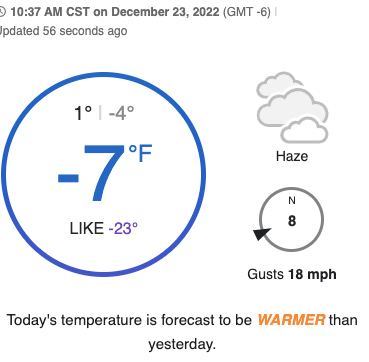
The weather right now:

That's warmer than yesterday??!! I didn't look yesterday when I was out shoveling (we got about 6 inches of snow), but it definitely was cold! I was outside for about 2.5 hours shoveling and the wind did feel cold. And when I looked at the temperature at about 8:00 last night, it was -12ºF. So I guess the wind chill would be lower than -27ºF.

Merry Christmas!

Hymn to God's holiness

100 L. M.
Holiness

HOLY as thou, O Lord, is none
   Thy holiness is all thine own;
   A drop of that unbounded sea
   Is ours,—a drop derived from thee

2 And when thy purity we share,
   Thine only glory we declare;
   And, humbled into nothing, own,
   Holy and pure is God alone.

3 Sole, self-existing God and Lord,
   By all thy heavenly hosts adored,
   Let all on earth bow down to thee,
   And own thy peerless majesty:

4 Thy power unparallel’d confess,
   Establish’d on the Rock of peace
   The Rock that never shall remove
   The Rock of pure, almighty love
              —Charles Wesley, Methodist Episcopal Hymnal (1870)

For whom do we groan?

I propose that nothing in the text warrants reading τὸ γὰρ τί προσευξώμεθα καθὸ δεῖ οὐκ οἴδαμεν [We don’t know what we should pray] in Romans 8:26 as a reference to the prayers believers should make only on their own behalf. Instead, what believers ought to pray for in Romans 8:26 and what the Spirit intercedes for in Romans 8:27 is not only for the believers’ own good but is also for the good of the creation, which currently groans, hence Paul’s transition from creation to believers in Romans 8:22–23.—Conformed to the Image of His Son, 244 (emphasis original)

Thursday, December 22, 2022

Coworkers!

I suggest that, though God’s children have not yet fully received their adoption as sons and thus are not yet in full possession of the inheritance, they are nevertheless called with the purpose of cooperating with God to bring restoration to his creation in the present. Discussions regarding humanity’s responsibility toward the nonhuman creation are increasingly popular, particularly within discussions surrounding the intersection of ecological concerns and theology. Byrne even goes so far as to suggest that “the future of the world (salvation) does to some extent lie in human hands.” He continues by stating, “Hope for the future in this sense takes human action into account. It remains hope in God but it is also hope in the prevailing power of God’s grace working through, not around or above human cooperation.”—Conformed to the Image of His Son, 242 (emphasis original in/quotation)

Wednesday, December 21, 2022

He shall glorify…

OK, I've been listening to Handel's Messiah, what can I say! Anyway, here's today's excerpt from Conformed to the Image of His Son:

Glorification, according to my working definition, occurs in two stages. On the basis of believers’ union with Christ, glorification is a present reality, at least in part. They are free from the powers of sin and death and have received the Holy Spirit, the firstfruits of their adoption. When believers’ bodies are resurrected to share in the glory of Christ, as in Philippians 3:21, then they will do so fully.—Conformed to the Image of His Son, 237

Tuesday, December 20, 2022

Tozer Tuesday

As soon as we accept the doctrine or the idea that the Bible is a book of theological toys to be played with by tender saintlings, we have missed the purpose of the Scripture and face the danger of slipping into false doctrine before very long. For the Bible was given to us not to satisfy our curiosity but to sanctify our personality.—A.W. Tozer, Living as a Christian, 33

Monday, December 19, 2022

An Advent hymn

118 C. M.
Design and object of His advent.

HARK, the glad sound! the Saviour comes,——
   The Saviour, promised long;
   Let every heart prepare a throne,
   And every voice a song.

2 He comes, the pris’ner to release.
   In Satan’s bondage held;
   The gates of brass before him burst,
   The iron fetters yield.

3 He comes, from thickest films of vice
   To clear the mental ray,
   And on the eyes oppress’d with night
   To pour celestial day.

4 He comes, the broken heart to bind,
   The wounded soul to cure,
   And, with the treasures of his grace,
   To’ enrich the humble poor.

5 Our glad hosannas, Prince of peace,
   Thy welcome shall proclaim,
   And heaven’s eternal arches ring
   With thy beloved name.
                    by Philip Doddridge
                    from the 1870 Hymns for the Methodist Episcopal Church

Sunday, December 18, 2022

Numismatic abbreviations

The last two books I've edited have had numismatic references, and therefore abbreviations. I'm not a numismatics guy—far from it! So, I had to dig around for a good site for abbreviations. The one I've had the best success with so far is this one called Wild Winds.

I also found a link to the Mionnet supplement volumes on google books here. There are nine of them!

This is mainly for my reference, but others might find it useful. If you have better sites, please add them in the comments.

See all the copyediting stuff here.

Friday, December 16, 2022

But what does the text say?

Contrary to Schreiner, Witherington, Moo, and others who maintain this guaranteed future reality, there is no indication within the context of Romans 8:30 that Paul writes from this future standpoint. Assurance alone is not a strong rationale for assuming Paul is writing about believers’ guarantee of glorification from a future perspective. I suggest that scholars take this view because their presupposed definition of δόξα [doxa] requires it: God’s people have clearly not yet been brought fully into the divine glory; therefore, the only explanation of the aorist is that, because it is so assured in the future, it can be spoken of as if it were a reality already in the present. This anticipatory interpretation, however, is unsupported.—Conformed to the Image of His Son, 236