Wednesday, January 10, 2007

Dose of Tozer for today

Ryan (our son) called us last night asking for prayer for a difficult meeting he was going to. While I was praying for him, my eyes happened to glance at a beaten up old copy of Pursuit of God that was sitting on my bookshelf. Here is what I opened to:

The doctrine of justification by faith--a Biblical truth, and a blessed relief from sterile legalism and unavailing self-effort--has in our time fallen into evil company and been interpreted by many in such manner as actually to bar men from the knowledge of God. The whole transaction of religious conversion has been made mechanical and spiritless. Faith may now be exercised without a jar to the moral life and without embarrassment to the Adamic ego. Christ may be 'received' without creating any special love for Him in the soul of the receiver. The man is 'saved,' but he is not hungry nor thirsty after God. In fact he is specifically taught to be satisfied and encouraged to be content with little.—A.W. Tozer, Pursuit of God, chapter 1

<idle musing>
Incidentally, the meeting was about that very thing!
</idle musing>

Tuesday, January 09, 2007

Ancient Near Eastern Thought and the Old Testament, continued

I'm reading Ancient Near Eastern Thought and the Old Testament right now, and this is part 2 of my impressions.

A brief recap from last time:
The book is divided into 5 parts:
1. Comparative Studies
2. Literature of the Ancient Near East
3. Religion
4. Cosmos
5. People

Last time I mentioned parts 1 & 2 and a brief note on part 3. One thing I failed to mention is that the bibliography in the book is great. The footnotes are very helpful, pointing to sources for further reference.
<cheap plug>
Of course, John is a longtime Eisenbrauns customer and it shows in the breadth of his sources.
</cheap plug>

The section on Religion deals with the state cults as well as personal deity/family religion. It is very interesting reading; a good introduction for those new to ANE and OT studies. John is well aware of the dangers inherent here, for example this quote on prayer: “Most of us would have trouble making such distinctions [between true piety and prudence] in the roots of our own prayers and should be reluctant to draw conclusions from the literary prayers that are preserved from the ancient world.” (page 146). His emphasis is on defining in what ways the ancient Israelites were in continuity with their neighbors and in what ways they were not. To that end, there are periodic “Comparative Exploration” boxes throughout the book. These take a topic that is being discussed and highlight how the ANE and Israelite outlooks were similar and different.

I just finished the Cosmos section and John does a good job of highlighting how differently we think from how the ancients thought. We think in terms of substance—dirt, rock, iron, flesh, but the ancients thought in terms of function—“In other words, something exists when it has a function, not when it takes up space or is a substance characterized by material properties. . . The physical aspects of the cosmos did not define its existence or its importance; they were merely the tools the gods used for carrying out their purposes. The purposes of the gods were of prime interest to them.” (page 167)

He has several “Comparative Exploration” boxes related to Genesis 1 in this section. This is one of his main interests, as reflected in the NIVAC Genesis commentary that he did and in at least one forthcoming book on the cosmology of Genesis (not yet announced). I’m not a big fan of the NIVAC series, but I might have to get the Genesis volume after reading this book. The information in the book is sufficient for his purposes, but it piques my interest for further reading.

Part 5 is People; I hope to read that section this week and post on it over the weekend.

Monday, January 08, 2007

New Interpreter's Bible on sale

For the next 10 days, Eisenbrauns is offering the New Interpreter's Bible at 40% off, both print and electronic version.

To purchase, or see the graphics, go here

Here's what's on sale:

"The New Interpreter's Bible, volume 1: General and Old Testament
Articles; Genesis, Exodus, Leviticus"
by Terence E. Fretheim, Walter Brueggemann, and Walter C. Kaiser, Jr.
New Interpreter's Bible - NIB 1
Abingdon, Cloth. English.
ISBN: 0687278147
List Price: $70.00 Your Price: $42.00

"The New Interpreter's Bible, volume 2: Numbers, Deuteronomy,
Introduction to Narrative Literature, Joshua, Judges,
Ruth, 1 and 2 Samuel"
by Thomas B. Dozeman, et al.
New Interpreter's Bible - NIB 2
Abingdon, Cloth. English.
ISBN: 0687278155
List Price: $70.00 Your Price: $42.00

"The New Interpreter's Bible, volume 3: 1 and 2 Kings,
1 and 2 Chronicles, Ezra-Nehemiah, Esther,
Additions to Esther, Tobit, Judith"
by Choon-Leong Seow, et al.
New Interpreter's Bible - NIB 3
Abingdon, Cloth. English.
ISBN: 0687278163
List Price: $70.00 Your Price: $42.00

"The New Interpreter's Bible, volume 4: 1 and 2 Macabees,
Introduction to Hebrew Poetry, Job, Psalms"
by Robert Doran, et al.
New Interpreter's Bible - NIB 4
Abingdon, Cloth. English.
ISBN: 0687278171
List Price: $70.00 Your Price: $42.00

"The New Interpreter's Bible, volume 5: Introduction to Wisdom
Literature, Proverbs, Ecclesiastes, Canticles, Book of Wisdom, Sirach"
by Richard J. Clifford, et al.
New Interpreter's Bible - NIB 5
Abingdon, Cloth. English.
ISBN: 068727818X
List Price: $60.00 Your Price: $36.00

"The New Interpreter's Bible, Volume 6: Introduction to Prophetic
Literature; Isaiah; Jeremiah; Baruch; Letter to Jeremiah;
Lamentations; Ezekiel"
by David L. Petersen, et al.
New Interpreter's Bible - NIB 6
Abingdon, Cloth. English.
ISBN: 0687278198
List Price: $70.00 Your Price: $42.00

"The New Interpreter's Bible, volume 7: Introduction to Apocalyptic
Literature, Daniel, Twelve Prophets"
by Frederick J. Murphy, Daniel L. Smith-Christopher, and Gale A. Yee
New Interpreter's Bible - NIB 7
Abingdon, Cloth. English.
ISBN: 0687278201
List Price: $60.00 Your Price: $36.00

"The New Interpreter's Bible, volume 8: General Articles on the
New Testament, Matthew, Mark"
by M. Eugene Boring and Pheme Perkins
New Interpreter's Bible - NIB 8
Abingdon, Cloth. English.
ISBN: 068727821X
List Price: $60.00 Your Price: $36.00

"The New Interpreter's Bible, volume 9: Luke; John"
by R. Alan Culpepper
New Interpreter's Bible - NIB 9
Abingdon, Cloth. English.
ISBN: 0687278228
List Price: $60.00 Your Price: $36.00

"The New Interpreter's Bible, Volume 10: Acts, Introduction to
Epistolary Literature, Romans, 1 Corinthians"
by Robert W. Wall, N. T. Wright, and J. Paul Sampley
New Interpreter's Bible - NIB 10
Abingdon, Cloth. English.
ISBN: 0687278236
List Price: $70.00 Your Price: $42.00

"The New Interpreter's Bible, volume 11: 2 Corinthians, Galatians,
Ephesians, Philippians, Colossians"
by Richard B. Hays, et al.
New Interpreter's Bible - NIB 11
Abingdon, Cloth. English.
ISBN: 0687278244
List Price: $60.00 Your Price: $36.00

"The New Interpreter's Bible, volume 12: Hebrews, James, 1 and
2 Peter, 1, 2 and 3 John, Jude and Revelation"
by C. Clifton Black, et al.
New Interpreter's Bible - NIB 12
Abingdon, Cloth. English.
ISBN: 0687278252
List Price: $60.00 Your Price: $36.00

"The New Interpreter's Bible: Complete Twelve Volume Commentary
on CD-ROM (Windows and Mac)"
Abingdon, CD-ROM. English.
ISBN: 0687019990
List Price: $780.00 Your Price: $468.00

Quote for the day

This is the final quote from the Conversations of Practice of the Presence of God:
“Brother Lawrence felt it was a great delusion to think that the times of prayer ought to differ from other times. We are as strictly obliged to adhere to God by action in the time of action, as by prayer in its season. His own prayer was nothing else but a sense of the presence of God, his soul being at that time insensible to everything but Divine Love. When the appointed times of prayer were past, he found no difference, because he still continued with God, praising and blessing Him with all his might. Thus he passed his life in continual joy.”

Sunday evening reading

Last night we got together with Debbie’s parents again to continue reading through The Christian’s Secret of a Happy Life, reading more 5 chapters. We are now half way through the book, which is very strong on faith. Here are a few excerpts:

Your idea of faith, I suppose, has been something like this. You have looked upon it as in some way a sort of thing, either a religious exercise of soul, or an inward gracious disposition of heart; something tangible, in fact, which, when you have got, you can look at and rejoice over, and use as a passport to God’s favor, or a coin with which to purchase His gifts. And you have been praying for faith, expecting all the while to get something
like this, and never having received any such thing, you are insisting upon it that you have no faith. Now faith, in fact, is not in the least this sort of thing. It is nothing at all tangible. It is simply believing God, and, like sight, it is nothing apart from its object. You might as well shut your eyes and look inside to see whether you have sight, as to look inside to discover whether you have faith. You see something, and thus know that you have sight; you believe something, and thus know that you have faith. For, as sight is only seeing, so faith is only believing. And as the only necessary thing about seeing is, that you see the thing as it is, so the only necessary thing about believing is, at you believe the thing as it is. The virtue does not lie in your believing, but in the thing you believe.

When a believer really trusts anything, he ceases to worry about that thing which he has trusted. And when he worries, it is a plain proof that he does not trust. Tested by this rule how little real trust there is in the Church of Christ! No wonder our Lord asked the pathetic question, “When the Son of Man cometh shall he find faith on the earth?” He will find plenty of activity, a great deal of earnestness, and doubtless many consecrated hearts; but shall he find faith, the one thing He values more than all the rest?

<idle musing>
Scary indictments, yet I fear only too true. The book was written in 1875, but it feels like it could have been written yesterday (apart from the archaisms in the language). We could substitute programs for activity, and it would describe the average church today.
</idle musing>

It seems strange that people, whose very name of Believers implies that their one chiefest characteristic is that they believe, should have to confess to such experiences. And yet it is such a universal habit that I feel if the majority of the Church were to be named over again, the only fitting and descriptive name that could be given them would be that of Doubters. In fact, most Christians have settled down under their doubts, as to a sort of
inevitable malady, from which they suffer acutely, but to which they must try to be resigned as a part of the necessary discipline of this earthly life.

<idle musing>
Ouch! And we’re only halfway through the book! Stay tuned for next week’s installment, or buy/download the book for yourself and read it.
</idle musing>

Sunday, January 07, 2007

Brother Lawrence on sanctification

“Our sanctification did not depend upon changing our works. Instead, it depended on doing that for God's sake which we commonly do for our own. He [Brother Lawrence] thought it was lamentable to see how many people mistook the means for the end, addicting themselves to certain works which they performed very imperfectly by reason of their human or selfish regards. The most excellent method he had found for going to God was that of doing our common business without any view of pleasing men but purely for the love of God.”— Brother Lawrence, The Practice of the Presence of God

<idle musing>
Wise words. God is there in the ordinary, taking it and making it holy. We need to let go of the Greek dichotomy of secular and sacred. In the biblical world view, all is sacred, since all was created by and for God.
</idle musing>

Friday, January 05, 2007

Latest on Renee

I appreciate all the prayers that have been offered. This will probably be the last I post on this, unless the situation changes.

Happy Friday morning! Renee has just come off the magnesium sulfate that decreased the contractions. She's pretty happy to be off the IV, and might get a wheelchair ride down to the nursery! Now she will be monitored for the few hours to see how she does on her own. If the contractions do not flare up we will be able to go home, hopefully yet today, with an oral drug to inhibit the contractions. She'll be placed on bed rest for a couple weeks. The baby could be born safely today but would have to stay in the hospital for a week after its born.

<snip>

We've had peace so far as long as we do not look to the right or the left at the potential worries, but keep our eyes straight ahead on Jesus who isn't worried. Renee says she keeps running into this wall of peace. I guess that would be the strong fortress.

Quote for the day

“Brother Lawrence said that many do not advance in the Christian progress because they stick in penances and particular exercises while they neglect the love of God which is the end. This appeared plainly by their works and was the reason why we see so little solid virtue. He said there needed neither art nor science for going to God, but only a heart resolutely determined to apply itself to nothing but Him and to love Him only.” —Brother Lawrence, The Practice of the Presence of God

Thursday, January 04, 2007

Update on Renee

I just received an e-mail from Joel & Renee:

Renee is doing well, the contractions really settled down and the doctor is excited about that. She will receive another shot for development of the baby's lungs this morning, and have to wait another 24 hours on the magnesium sulfate IV til we see if [we] can go home.

It looks hopeful that we'll go home tomorrow, but Renee will be on moderate bed rest, whatever that means. Now she can only get up to use the bathroom. Which is quite the process considering all the hoses and cords, and that the medication is making her weak.

I'm glad I'm here to help. With some sleeping pills and Tylenol she was finally able to sleep last night despite the nurses checking on her and the bright computer lights. We wish we were here having a baby, but its best if Sweet Pea comes full term.

Moderate bed rest with a 21 month old son? Hmm...We really do appreciate all your prayers.

Eisenbrauns' January Sale

For January, Eisenbrauns is having a clearance sale!

To help make room for all those great new titles coming in 2007, we are offering 17-77% off on 59 titles that are overstocked. The sale is limited to the quantity on hand, first come, first served, so hurry.

To see all the sale items, please visit: http://www.eisenbrauns.com/wconnect/wc.dll?ebGate~EIS~~~~SPECIAL

I'm not making money on most of these, so you probably won't find a better deal anywhere else. For example:
eBible Platinum Edition on CD-ROM (Windows)
Thomas Nelson, CD-ROM. English.
ISBN: 0785250247
List Price: $399.99 Your Price: $136.99 (66% savings and about $100 cheaper than anybody else!)
http://www.eisenbrauns.com/wconnect/wc.dll?ebGate~EIS~~I~CDWEBIBLE

Tozer on the self

The recent Tozer quote over on Jim West's blog led me to scanning back through Pursuit of God over the weekend. I ran across this quote:

"For sin has played many evil tricks upon us, and one has been the infusing into us a false sense of shame. There is hardly a man or woman who dares to be just what he or she is without doctoring up the impression. The fear of being found out gnaws like rodents within their hearts. The man of culture is haunted by the fear that he will some day come upon a man more cultured than himself. The learned man fears to meet a man more learned than he. The rich man sweats under the fear that his clothes or his car or his house will sometime be made to look cheap by comparison with those of another rich man. So-called 'society' runs by a motivation not higher than this, and the poorer classes on their level are little better…

"This unnatural condition is part of our sad heritage of sin, but in our day it is aggravated by our whole way of life. Advertising is largely based upon this habit of pretense. 'Courses' are offered in this or that field of human learning frankly appealing to the victim's desire to shine at a party. Books are sold, clothes and cosmetics are peddled, by playing continually upon this desire to appear what we are not. Artificiality is one curse that will drop away the moment we kneel at Jesus' feet and surrender ourselves to His meekness. Then we will not care what people think of us so long as God is pleased. Then what we are will be everything; what we appear will take its place far down the scale of interest for us. Apart from sin we have nothing of which to be ashamed. Only an evil desire to shine makes us want to appear other than we are."—A.W. Tozer, Pursuit of God, Chapter 9

What more is there to say?

Wednesday, January 03, 2007

A Jerusalem view

Lawson is back to blogging again, and has a good post from Jerusalem, where he is leading a group of seminary students. Here is a snippet from a very good post concerning the theological only view of the biblical text:

They rightly realize that faith cannot be tethered to the ephemeral whims of scholarly fashion. Unfortunately, they choose to ignore that insisting on the historical character of biblical truth does not necessitate enslavement to scholarly fads—unless one assumes naively (and many them do) that "the latest is the greatest" mistaking present trends for perennial truth. Similarly, to rate historical truth highly in theological interpretation doesn't necessitate historiography being a "tether" or "basis" for faith. Historical study typically enriches and enlarges, often correcting and focusing interpretations the truths already clearly implied in the text. They also get it right that the Bible's primary reference is to theological truth, but again, they ignore the centuries-old recognition, going all the way back to the Church Fathers, that the Bible refers to theological truth by means of historical reference. It is a mediated revelation: truth comes via historically shaped texts to alert, investigating, thoughtful faith. St. John says "The Word became flesh" not "The Word became text."


He has more, have a read.

Prayer request

I just received a phone call from Debbie. Renee (our daughter) is on her way to the hospital in Duluth (2 hours away from where they live in Grand Marais, MN). She is in labor, six weeks early. I would appreciate your prayers.

Update: The doctors have given Renee something to cause the contractions to stop. Apparently, they don't want the baby to be born yet. She is going to stay in the hospital overnight and then return home. I appreciate the prayers that people offered. If anything changes, I will post it here.

Quote from Brother Lawrence

“He [Brother Lawrence] said that as far as the miseries and sins he heard of daily in the world, he was so far from wondering at them, that, on the contrary, he was surprised there were not more considering the malice sinners were capable of. For his part, he prayed for them. But knowing that God could remedy the mischief they did when He pleased, he gave himself no further trouble.” —Brother Lawrence, The Practice of the Presence of God

Tuesday, January 02, 2007

New blog

I promised him I would wait until there was more than one post up before I announced it...Eisenbrauns acquisitions editor, John Cook, in association with one of his sons, Colin, has started a new blog entitled Beginning of Wisdom.

Here is how he describes it:

Having enjoyed a Latin Proverb of the Day blog and noting that nobody is doing anything similar for ancient Near Eastern wisdom literature, Colin and I have launched a new blog (mainly he picks the proverbs to discuss and I write up the post after we've discussed it over dinner).


Be sure to add it to your blogroll and check it out often. John is an excellent Hebraist and a good teacher as well.

Monday, January 01, 2007

Quote for the day

Over the weekend, I re-read the "Conversations" in The Practice of the Presence of God by Brother Lawrence. It is a delightful little book, and I will be posting quotes from it over the next few days. Here's the first one:

“Instead of taking faith for the rule of their conduct, men amused themselves with trivial devotions which changed daily. He[Brother Lawrence] said that faith was sufficient to bring us to a high degree of perfection. We ought to give ourselves up to God with regard both to things temporal and spiritual and seek our satisfaction only in the fulfilling of His will. Whether God led us by suffering or by consolation all would be equal to a soul truly resigned.”

What I'm reading now

As you probably gathered by the quote from the afterword, I have finished Bonhoeffer's Ethics. I am currently reading Ancient Near Eastern Thought and the Old Testament . As I read it, I will be making brief comments; here is the summary of the first 100 or so pages.

The first part, consisting of 2 chapters, deals with comparative studies and examines the historical uses, both those who have attempted to defend the historicity of the text and those who have sought to show it wasn't historical. Walton defines a third alternative, which is his purpose, illuminating the text in order to avoid exegetical missteps.

The second part is a brief summary of the available literature from the ANE, complete with bibliographical references for those who wish to go deeper. The summary fills the purpose of the book fine, but if you are really interested in the wealth of material available, then Sparks, Ancient Texts for the Study of the Hebrew Bible is a better source.

The third part, where I am currently reading, consists of 3 chapters on the religion of the ANE. I found this quote, relating to the function of gods, especially interesting:

“Since their ontology was function oriented, a god who does not function or act fades into virtual nonexistence.” – page 94.

<idle musing>
Hmm, how is that different from now? Most people in the U.S. are functioning atheists (including many christians). They don’t believe that any deity can affect their lives on a day to day basis, so for all intents and purposes, a god doesn’t exist. Their ontology is strictly self-oriented and self-contained. The only time they trot out their god is for patriotic events, or in an emergency, or Sunday, or to impress others with how religious/ethical/moral they are. Far cry from real Christianity, at least as portrayed in the biblical text, where God is a daily reality and prayers are offered and answered.
</idle musing>

New Year's Eve

Last night we went over to Debbie's parents place for dinner and to watch the new year come in. After dinner, we decided to read a chapter in a book that we had read the first chapter in on Christmas Eve, each of us taking a turn reading about a page out loud. Well, it turned into 4 more chapters, and we probably would have read another 1-2, except the neighbors came over.

The book is an old Christian classic called The Christian's Secret to a Happy Life, available just about everywhere, including online. We were reading from the Barbour edition. Here are a few choice quotes:

A keen observer once said to me, “You Christians seem to have a religion that makes you miserable. You are like a man with a headache. He does not want to get rid of his head, but it hurts him to keep it.”

The greatest burden we have to carry in life is self. The most difficult thing we have to manage is self. Our own daily living, our frames and feelings, our especial weaknesses and temptations, and our peculiar temperaments, our inward affairs of every kind, these are the things that perplex and worry us more than anything else, and that bring us oftenest into bondage and darkness. In laying off your burdens, therefore, the first one you must get rid of is yourself. You must hand yourself and all your inward experiences, your temptations, your temperament, your frames and feelings, all over into the care and keeping of your God, and leave them there. He made you, and therefore He understands you and knows how to manage you, and you must trust Him to do it.

“According to our faith,” is always the limit and the rule.

But this faith of which I am speaking must be a present faith. No faith that is exercised in the future tense amounts to anything. A man may believe forever that his sins will be forgiven at some future time, and he will never find peace. He has to come to the now belief, and say by faith, “My sins are now forgiven,” before he can live the new life. And, similarly, no faith which looks for a future deliverance from the power of sin, will ever lead a soul into the life we are describing. The enemy delights in this future faith, for he knows it is powerless to accomplish any practical results. But he trembles and flees when the soul of the believer dares to claim a present deliverance, and to reckon itself now to be free from his power.

Sight is not faith, and hearing is not faith, neither is feeling faith; but believing when we can neither see, hear, nor feel is faith; and everywhere the Bible tells us our salvation is to be by faith. Therefore we must believe before we feel, and often against our feelings, if we would honor God by our faith. It is always he that believeth who has the witness, not he that doubteth.

On the whole, a most enjoyable way to bring in the new year! We plan on reading about a chapter each week together.

Sunday, December 31, 2006

Catching up

Life is getting back to normal now. Over Christmas we had our 7 month pregnant daughter Renee, our son-in-law Joel, Joshua (their 21 month old), and our son Ryan visiting us. And on Christmas Eve, Debbie's parents came over. So, there were 8 of us around a 42 inch round table. Well, really only 7, because Joshua sat off to the side on a booster chair with a tray. Still, quite a few people around a table designed for 4. We had a grand time, though.

After dinner, we had a time of worship with Joel on the guitar and Ryan and Renee on the hand drums, some sharing of what God has done in our lives, and then communion. One of the joys of having adult children is being able to see and share in what God is doing in their lives. We rejoice in His goodness to us. The verse that I have always torn out of context (hey, eisegesis is good sometimes!) and asked God for in my children is III John 3 "No greater joy can I have than this, to hear that my children follow the truth." (RSV) God has answered that prayer abundantly and we praise him for it.

Friday, December 29, 2006

The continuing saga of programmers who can't spell

After a quiet few weeks, Travis is at it again. This time, though, it is a cry for help. Yesterday he posted this flyer on his door:


Since he has declared himself an independent state, he can't use company funds, I guess. Anyway, I did my part, I gave him a 10 cent Euro piece. So now he only needs $98.77. I doubt that a one day seminar is going to teach him to spell and write, though...

Why Bonhoeffer?

Why Bonhoeffer?
<idle musing>
That is the question some of us were discussing the other day. Why not Brunner, or Barth, or Moltmann, or…the list could go on ad infinitum. They are all good modern theologians, but why does Bonhoeffer seem to have something a bit different?

I can’t speak for anyone but myself, but there is something about Bonhoeffer that is unique and grabs me in a way that the other ones don’t. He seems more alive, more in touch with everyday life; his faith made a difference in the way he lived. I think that is why I like him. There is a passion that shines through in his writings; a conviction that ignites the soul and makes it feel alive.

As you read Bonhoeffer, you can sense that he had an encounter with the living God that was still alive in him. You see the difference in his writings after 1932. As Bethge (one of his students and his biographer) said of him: Before 1932 he was a good theologian, but once he encountered God, he became a Christian theologian.
</idle musing>

That’s my view anyway, anyone care to comment?

Thursday, December 28, 2006

New CAD volumes arrived

Finally, after over 6 weeks delay at the printer, The Chicago Assyrian Dictionary volume T and Tet just arrived.

Chicago Assyrian Dictionary T
Chicago Assyrian Dictionary - CAD 18
Edited by Martha T. Roth
Oriental Institute-Chicago, 2006
510 pages, English
Cloth
ISBN: 1885923422
Your Price: $145.00
www.eisenbrauns.com/wconnect/wc.dll?ebGate~EIS~~I~CADT

Chicago Assyrian Dictionary T. [Tet)
Chicago Assyrian Dictionary - CAD 19
Edited by Martha T. Roth
Oriental Institute-Chicago, Forthcoming December 22, 2006
170 pages, English
Cloth
ISBN: 1885923430
Your Price: $105.00
www.eisenbrauns.com/wconnect/wc.dll?ebGate~EIS~~I~CADTET

Update: It appears that I had the wrong prices! I have corrected them downwards!

Quote for today

“If Jesus is not the Lord of every part of my life, then He is not Lord of any of it. This is true salvation—true faith—true obedience. Yes I must die to my life, my interests, my will in order to abide in Him. However, I will make a greater exchange—my life for His. I will acquire a greater prize; for He is faithful to return to me more than I have given Him.” Marilyn Howshall, The Mystery of the Gospel

Wednesday, December 27, 2006

Quote for today

“Not I, but Christ. This is the rest of faith in which a man rests from his works. With the unconverted man it Not Christ, but I. With the feeble and slothful Christian, I and Christ: I first and Christ to fill up what is wanting. With increasing earnestness it becomes Christ and I: Christ first, but still I second. With the man who dies with Christ it is, Not I, but Christ: Christ alone and Christ all. He has ceased from his work: Christ lives in him. This is the rest of faith.” Andrew Murray, The Holiest of All

Tuesday, December 26, 2006

Quote for today

“The point of departure for Dietrich Bonhoeffer’s concrete ethics is the theological question of how the reality of God revealed in Jesus Christ can take form in human life in the world. Bonhoeffer’s ethical reflection tries to understand God’s will and the world’s reality here and now, together, the one not without the other. Rather than treating the reality of the world as a matter of indifference—it is in fact disclosed completely anew—and rather than eclipsing it in some fashion, Bonhoeffer confronts the reality of the world with the Yes and No that God’s presence means for it.”—Editors’ Afterword to the German Edition of Bonhoeffer’s Ethics, page 409 of English edition.

Thursday, December 21, 2006

Quote for today

“The church does not have a twofold word, the one general, rational, and grounded in natural law and the other Christian—that is, it does not have one word for unbelievers and another for believers. Only a pharisaical arrogance can lead the church to withhold the proclamation of Christ from some but not from others. The word of the church is justified and authorized solely by the commission of Jesus Christ. Therefore any of its words that fail to take this authorization into account must be just empty chatter…Only by fulfilling its own mandate can it legitimately question the government about fulfilling its mandate.” —Bonhoeffer, Ethics, page 399

Wednesday, December 20, 2006

Quote for the day

“Where private confession and church discipline have been lost, there God’s commandment in the sermon is merely understood as a proclamation of general moral principles, which as such are void of any concrete claim.” —Bonhoeffer, Ethics, page 395

Tuesday, December 19, 2006

Ethics for today

“Even a master has a Master, and this fact alone makes him a master and authorizes and legitimizes him vis-à-vis the servant. Master and servant owe one another the respect that springs from their respective participation in God’s mandate.” —Bonhoeffer, Ethics, page 391

Monday, December 18, 2006

Quote for the day

A Chinese house church leader once visited some major mega-churches in Los Angeles, California and when asked, “What do you think?” he responded with, ‘It’s amazing what your American Churches can do without the Holy Spirit.”

Bonhoeffer's 4 mandates

“The commandment of God revealed in Jesus Christ embraces in its unity all of human life. Its claim on human beings and the world through the reconciling love of God is all-encompassing. This commandment encounters us concretely in four different forms that find their unity only in the commandment itself, namely, in the church, marriage and family, culture, and government.” —Bonhoeffer, Ethics, page 388

Sunday, December 17, 2006

Self-righteousness

<idle musing>
Ouch! It hurt, but it had to be done.

Saturday I was frustrated. How can people be so dense? I try so hard, but it just doesn't seem to happen. I don't seem to get anywhere. I, I, I, I...

That should have been my first clue. As I am so fond of telling others, you can tell a lot about a person by the subject of the sentence. But, no, I went on bullheadedly and let my frustration rule me instead of the love of Christ.

So, if I am running the show, what do you think will come out? Yep, me, self-righteous, Pharisaical, proud, arrogant, the list goes on. Sure, it might contain truth, but is it the truth, spoken in love? That is the true test. It is only as I function in the love of Christ that anything will ever be accomplished.

A good Christian brother pointed out the problem to me, but I only saw half the problem. Even after I posted the Bonhoeffer quote, and mused on it, I didn't realize the extent of my sin. Only now, two days after, and who knows how many people hurt, did it become evident to me.

What am I talking about? I made some posts that I should not have—probably not the first time—but these were different; they weren't just frivolous. These were mean-spirited; they reflected the worst of me, my pride and desire to be right at all costs. Self-vindication is a cruel task master and loves to eat its victims up, all the while making them think they are justified in their actions. But, the light of God shines brighter and shone through, setting me free once again.

So, I did something I've never done before, I took down some posts. They were posted in arrogance and pride, and if anyone was hurt, I ask your forgiveness.

I am not given to this kind of public confession. But, the sin was public, therefore the confession should also be public.
</idle musing>

Quote for today

“The commandment of God as the commandment revealed in Jesus Christ is always a concrete speaking to someone, and never an abstract speaking about something or someone. It always addresses and claims the hearer in such a comprehensive and at the same time definitive way that it no longer permits the freedom of interpretation and application, but only the freedom of obedience or disobedience.”—Bonhoeffer, Ethics, page 381

<idle musing>
Ouch! I don't know how many times I've heard something and instantly applied it to someone else's life. Yes, even—no, especially—when it was very relevant to my own life. Or, just as bad, I've explained my sin away, justifying it in my own eyes. Or, worse yet, set myself up as judge of someone else's situation...Lord! Deliver me from myself! Oh, wait he has! "For the law of the Spirit of life in Christ Jesus has set me free from the law of sin and death." Romans 8:2 RSV
</idle musing>

Saturday, December 16, 2006

Bonhoeffer for a Saturday

“God’s commandment is God’s speech to human beings. Both in its content and in its form, it is concrete speech to concrete human beings. God’s commandment leaves human beings no room for application and interpretation, but only for obedience or disobedience. God’s commandment cannot be found and known apart from time and place; indeed, it can only be heard by one who is bound to a specific place and time. God’s commandment is either utterly specific, clear, and concrete or it is not God’s commandment.”—Bonhoeffer, Ethics, pages 378-379

Friday, December 15, 2006

Ethics again

"Jesus’ demand that the rich young man give up one of his rights makes clear that his ‘keeping of the Ten Commandments since his youth’ was not obedience to God, but ignoring the living God in the midst of keeping the so-called divine orders. The Decalogue and the Sermon on the Mount are thus not two different ethical ideals, but the one call to concrete obedience to the God and Father of Jesus Christ. Responsibly affirming property rights is no different from giving up one’s property, when done out of faith in God. Neither ‘fighting for rights’ nor ‘giving up rights’ is essential as such, as if it were a particular subject of the church’s proclamation. However, when done in faith either stance amounts to a submission to the right of God alone." —Bonhoeffer, Ethics, page 359 (emphasis his)

Thursday, December 14, 2006

Wish list is live at Eisenbrauns!

We've been working diligently (well, Travis and Andy have, all I did was try to break it!) on this for quite a while now, but it is finally ready for prime-time. You can now create a wish list and publish it (if you wish). Perfect timing, right? You just finished that final and need to relax. What better way than creating a wish list for next semester/quarter? Or, to take your mind off all the grading that you need to do (ugh!), why not create a wish list at Eisenbrauns?

You can see mine here.

If you are feeling generous, the large BHS would be very nice. My eyes can't always tell the difference between a resh and a dahlet anymore in my small BHS, even with reading glasses :(

Wednesday, December 13, 2006

Around the blogosphere

Some very good posts today and yesterday that are worth reading.

Yesterday, over at the The M Blog there is a very good post about Church Planting, Baptists & Charismatics together:

I have been told 80% of evangelicals in Ecuador are either charismatics or pentecostals. To ignore and disassociate ourselves from them is not only unbiblical, it is ministry suicide, and quite clearly sin if you ask me.

He goes on for quite a while, well worth the read.

Meantime, here in the States, Jim Martin has a good post on The Wonderful World of Self:

Years ago, I was the minister to a church that met on the campus of a Bible college. The school and the church were their own separate entities. Yet, there was some overlap. After all, I taught part-time at the college (a senior level ministry class each semester). One Sunday, a man employed by the school was in our assembly. He approached me afterward and said that he was scheduled to preach in chapel that week and would like to use much of what I had just said in that morning’s sermon. I said something like "sure" and went on. As I recall, I felt encouraged that he wanted to use much of that material for his own message.

That week, I was in chapel and heard his message. It was very familiar — very, very familiar. Maybe I just wanted him to acknowledge that he heard much of this last Sunday morning in our assembly. Yet, not one word.

This bothered me.

This bothered me — a lot.

You really should read it all. One commenter on the blog said it is the "Somebody didn’t push my ‘I’m important!’ button." Well put. Definitely worth the read.

And Ted Gossard has an excellent post as well on Living out life

This is why, though rules have their place, they really do not have a kind of prior place in the living out of this life. For example, as one in Jesus, I don't refuse to steal, simply because it's a rule from God I must keep, and because it's part of a choice, among the many choices I must make along the way. No. But I refuse to steal, or fight any temptation I may have to do so, because I have this life in Jesus. And having this life, I want to live it out. And I have the dynamic in God to do so.

I was brought up with a form of legalism that made how one dresses (especially women), or what one does (and doesn't do) to be of prior importance in living out Christianity, in being a Christian. Fortunately there were those who knew better. But by and large Christianity was seen more for what we do and don't do, rather than who we are and "the life" that we have in Jesus. When I finally became a Christian, the new life in Jesus was at the forefront of my experience. I overflowed with this new love and grace I had found. But I gradually receded back into a kind of orientation, that, while not surrendering "the life" aspect entirely, nevertheless relegated it to a status that put the onus on me. As if living out this life, and remaining in it, depends on me

He continues on, worth the read.

More from Bonhoeffer

"Jesus is hardly ever involved in solving worldly problems; whenever he is requested to do so, he is strangely evasive (Matt. 22:15; Luke 12:13), just as generally he almost never answers people’s questions directly, but from a completely different plain. His word is not an answer to human questions and problems, but the divine answer to the divine question addressed to human beings. His word is essentially determined not from below, but from above; it is not a solution but redemption. His word does not spring from the human problematic of the disunity of good and evil, but from the complete unity of the Son with the will of the Father. He stands beyond the human problematic. This is the first thing that must be understood. Since Jesus brings the redemption of human beings, rather than the solution to problems, he indeed brings the solution to all human problems—”all these things will be given”—though from a completely different vantage point.” —Bonhoeffer, Ethics, page 354 (emphasis his)

Tuesday, December 12, 2006

Yeah, right!

John Cook, our acquisitions editor, forwarded the following graphic to all of us today. He told us the underlining was not his. (You might have to click on it to make it big enough to read.)


All I can say is that I wouldn't want to be married to a woman like that. It sure would be boring.

Best books of 2006

I was delighted to see that some of Eisenbrauns' finest publications were recently nominated for best books of 2006 by Biblische Ausbildung. You can see which ones I mean by clicking here

Barth for today

"In 1932 I did not know the Fundamentalists so well. The Fundamentalist says he knows the Bible, but he must have become master over the Bible, which means master over revelation… I consider it just another kind of natural theology: a view of the modern man who wants to control revelation."—Karl Barth

Quote for the day

“Only that which participates in Christ can endure and overcome. Christ is the center and power of the Bible, of the church, of theology, but also of humanity, reason, justice, and culture. To Christ everything must return; only under Christ’s protection can it live.”—Bonhoeffer, Ethics, page 341

Monday, December 11, 2006

Eisenbrauns 2 week sale

For the next 2 weeks (December 11-26), Eisenbrauns is offering 30% off on volumes 1-9 of the Reallexikon der Assyriologie und Vorderasiatischen Archaeologie. Details here

Call it an early Christmas present for Assyriologists!

Reflecting on The Great Giveaway

I just finished The Great Giveaway by David Fitch, published by Baker Books. I found it a very stimulating book. His basic thesis is that the Evangelical Church has given away the formation of disciples of Jesus Christ to popular culture. Specifically, we allow the values of capitalism, consumerism, democracy, self-actualization, materialism, and patriotism as found in popular culture to influence our life more than we do the Christ in the Bible.

We form our churches on the model of big business, with our pastors expected to be CEOs, without even thinking about how that changes the focus of the church (as an aside, I know of one church that justifies the multi-million dollar per year salary of their head pastor on the basis of the pay for the CEO of a similar size business!). We give away counseling to psychotherapists, even Christian ones, who are trained to focus on the self as the source of solutions instead of taking the necessary time to see if the problems are sin issues, economic issues, etc., in stark contrast to Christ’s command to die to self. Seems that listening to the voice of someone/thing other than God is what got us into this whole mess in the first place (Genesis 3). The list goes on.

I basically agree with his analysis of the situation, but his solution is equally problematic. He wants to return to liturgy, catechesis, etc. He freely admits that his answers are not necessarily the best, but they are the ones he is using in the church he pastors. He also has some other suggestions, some good, some not as good. I think in some cases he goes too far; in others, not far enough.

<soap box alert>
For example, he wants to change the sermon to make it more relevant and less spoon feeding of propositional truths to hearers. I agree, we should change it, but the best change is to abolish it! We need to have teaching as interaction, not teaching as lecture!

Think about the last conversation you had. Do you remember more clearly what you said, or what the other person said? Exactly! The Socratic Method needs to be brought back into the church (DIALOGOS, in its best Greek meaning).
</soap box alert>

There are a few nitpicky things that bothered me about this otherwise very worthwhile read:
1. Use footnotes, not endnotes! The notes are essential to forwarding the argument of the book in many places. Don’t relegate them to the back of the book.
2. Edit out the department of redundancy department phrases. The book could have benefited dramatically from a heavier editing. The book could easily have lost 50 pages if the editor had made him clarify his thoughts. Of course, that same editor would probably have made him incorporate some of the notes into the text, so the end result would be a book of the same length. : )

But, the book is definitely worth the read. I have already offered it to 2 people, and no, Eisenbrauns doesn’t sell it!

Update:
I was catching up on a blog whose RSS feed doesn't work, and ran across this:

Alternatives to monologue preaching
Both the New Testament and church planting movements offer very effective alternatives to the monologue. As mentors of emerging leaders of new congregations, we should be able to train others in these alternatives.

Dialogue. (Acts 17:2; 20:7; 17:11; 24:25) The apostles preferred to “dialogue” with both seekers and believers, both individuals and groups. Dialogue, conversations with a purpose, allow a teacher to answer folk’s questions, allay their fears, inform their ignorance, appeal to their conscience, and help them choose what they will do. Believers are to teach and instruct “one another” (Col. 3:16; Rom 15:14). Dialogue is easier to do in small groups than in big congregations. Since most folks already know how to dialogue with their friends and relatives, doing so is a superior way to share about Jesus and the way of life that He calls everyone to follow.


You should read the rest.

Sunday, December 10, 2006

Emerging?

Hmmm...there has been a bit of noise around the blogs this week about the emerging church. It appears that a well known radio preacher has sent out a fund-raising letter blasting the emerging church as heretical, or at least dangerous, doctrinally. Nice response here by Dan Kimball, and another one here from Leighton Tebay. Very nice responses, so I won't add to them.

<idle musing>
This does raise a very interesting question, though. What is the biblical basis for fund raising letters for oneself/one's own ministry?

I know that Paul writes about money a good deal, and we would do well to take it to heart. But, does Paul ever ask for money for his own stuff? I don't recall it. He asks on behalf of the church in Jerusalem, which is loaded with theological significance to him, since it is the first fruits of the inflow of the gentiles described in the prophets. But, does he ever ask for it on his own behalf?

Maybe I am wrong (wouldn't be the first time), but I tend to think the model shown by George Mueller and Hudson Taylor is more scriptural. They made their requests known to God, and he supplied their needs.

In fact, if you read Hudson Taylor's biography, you will see that he was more concerned that God would send the right people than he was with money. At one point he had more money than missionaries to use it, which caused him to opine that he always figured that when God sent the person, the money would follow and that money was of secondary importance.

Perhaps our current obsession with fund raising letters is a result of how we view the church. Is the church the organic body of Christ, or is it just another organization to be run on American business principles? How we answer that question is foundational to how we act. Are "decisions for Christ" what the church is all about? Is spoon feeding hearers propositional truth what the church is all about? If so, then business principles might apply. If, however, the church is about relationships between people and between people and God, then we need to seriously reexamine how we "do church." To run a church (or ministry) on business principles, complete with surveys and 5 year plans and mass mailings and logo-ed charge cards(!!! don't get me started on that one) is to do violence to the concept of the kingdom of God present in an assembled body of believers.

How can we expect to bring about the kingdom of God by fleshly effort and methods? Well, the subject of that sentence says it all, doesn't it? Anytime the subject of the sentence is anything other than the triune God, results are, at best, poor substitutes for the presence of the living God in the church as a body of believers (2 or more!).

Now there is a radical thought—two or more. That means that when I am with my wife, or my kids, or co-workers, or friends, we are "doing church." Kinda blows the mind, doesn't it? Drop the dichotomy of secular-sacred and walk in the presence of God all the time! Wow! Sounds so—well, scriptural!

OK, enough rambling for one day...
</idle musing>

Friday, December 08, 2006

Inside Eisenbrauns, update

For those of you following the continuing saga, I present the evidence. Below is Travis' declaration of independence, complete with bad grammar.


Poor, misguided young lad! He doesn't know how much he needs our assistance. Those of us who are part of the coalition to re-annex the Independent Office of Travis Spangle are committed to doing so peacefully, if possible.

As a show of good will on our part, we translated our Petition into Wingding, the official language of said office. Since there is no Google Language tool or Babelfish for Wingding, We enlisted the skills of our resident linguist, John Cook. John put forth significant effort, the results of which are below.

Thursday, December 07, 2006

Inside Eisenbrauns

As you probably know, we hired a programmer last Spring. He has assisted us greatly in bringing such things as the RSS feeds to life. He does have a problem: he can't spell and his English grammar sometimes needs a bit of help.

In the interest of assisting him, some of us began editing his e-mails and returning them to him, in the hopes that he would take to heart our assistance. Sorry to say, he did not appreciate our attempts. In fact, he issued a statement of secession! He posted it on his office door, complete with bad grammar and spelling mistakes. It has remained there for over a month.

Today, in an attempt to help him see the error of his ways, a petition was posted on his office door, encouraging him to return to the Eisenbiz.


I will keep you updated as the situation escalates :)

Wednesday, December 06, 2006

Used books on sale all December

I almost forgot to post this...I must be too busy.

For the entire month of December, Eisenbrauns is offering 15% off the price on all used books. Be sure to take advantage of this chance to save even more on the already low cost of our used books. Complete details can be found here

Pride redivus

Monday night I was going through some archived data, trying to find something that Debbie needed. In the process, I came across some stuff I had written back 6 years ago, and some stuff from 3 years ago. What an arrogant jerk I was! I couldn't believe the pride that emanated from the writing.

Well, maybe I can, because it opened a door in my soul that stuck with me throughout Tuesday. I found myself acting in a way and saying things that were arrogant, inconsiderate, uncaring, and unloving. It wasn't until last night that I realized how I had been acting all day. I had to spend a bit of time with God, allowing him to once again crucify what I had thought was dead—and it was/is dead according to scripture. I just chose to live outside of what Christ has already done, and once you do that...well it ain't pretty.

Quote for the day

“The New Testament answers quite unambiguously the question about what love is by pointing exclusively to Jesus Christ. Christ is the sole definition of love. But everything would be misunderstood once more if a general definition of love were to be derived from looking at Jesus Christ and Christ’s doing and suffering. Love is not what Christ does and suffers, but what Christ does and suffers. Love is always Jesus Christ himself. Love is always God himself. Love is always God’s revelation in Jesus Christ.” —Bonhoeffer, Ethics, page 335.

Tuesday, December 05, 2006

OK, I fell for it

I just couldn't resist...

What Kind of Reader Are You?
Your Result: Obsessive-Compulsive Bookworm

You're probably in the final stages of a Ph.D. or otherwise finding a way to make your living out of reading. You are one of the literati. Other people's grammatical mistakes make you insane.

Book Snob
Dedicated Reader
Literate Good Citizen
Non-Reader
Fad Reader
What Kind of Reader Are You?
Create Your Own Quiz


Hmm, the colors didn't seem to come through. Just so you know: The very top one is at about 85-90%. Of the five below it, the top two are at about 75%, the third one at 50%, and the other two have nothing.

No surprise, is there?

HT: Rick Mansfield

Quote for the day

Thus says the Lord:
Cursed are those who trust in mere mortals
and make mere flesh their strength,
whose hearts turn away from the Lord.
They shall be like a shrub in the desert,
and shall not see when relief comes.
They shall live in the parched places of the wilderness,
in an uninhabited salt land.
Blessed are those who trust in the Lord,
whose trust is the Lord.
They shall be like a tree planted by water,
sending out its roots by the stream.
It shall not fear when heat comes,
and its leaves shall stay green;
in the year of drought it is not anxious,
and it does not cease to bear fruit.
The heart is devious above all else;
it is perverse—
who can understand it?
I the Lord test the mind
and search the heart,
to give to all according to their ways,
according to the fruit of their doings.

Jeremiah 17:5-10 RSV

Ethics

“It is evident that the only appropriate attitude of human beings toward God is doing God’s will. The purpose of the Sermon on the Mount is to do it (see the ending of Matthew 7!). Only in doing does submission to the will of God happen. In doing the will of God, human beings completely relinquish any right of their own, nay justification of their own; in doing, they humbly subject themselves to the gracious judge. Holy Scripture insists so emphatically on our doing because it intends to deprive us of any self-justification before God that is grounded in our won knowledge of good and evil. It seeks to prevent human beings’ own deeds from being placed side by side with God’s deed, even if as thanksgiving or as sacrifice. Instead, Holy Scripture puts human beings completely within God’s doing, and subjects human doing completely to the doing of God. The mistake of the Pharisees was not their adamant insistence on the necessity of doing, but rather that they themselves did not get around to doing actual deeds. ‘They say and do not do it.’

“In demanding the deed, scripture actually does not point people to their own capacities but to Jesus Christ himself. ‘Without me you can do nothing’ (John 15:5). This sentence must be understood in the strictest sense. There really is no doing without Jesus Christ. All the multiple activities that otherwise have the appearance of doing, all the countless tasks, are considered in Jesus’ judgment as if nothing had been done.”—Bonhoeffer, Ethics, pages 326-327

Monday, December 04, 2006

Ethics for a Monday

“The freedom of Jesus is not arbitrary choice of one among countless possibilities. Instead, it consists precisely in the complete simplicity of his action, for which there are never several possibilities, conflicts, or alternatives, but always only one. Jesus call this one option the will of God. He calls it his food to do this wil. This ill of God is his life. He lives and acts not out of the knowledge of good and evil, but out of the will of God. There is only one will of God. In it, the origin of everything is regained. It is the source of freedom and simplicity in everything that is done” —Bonhoeffer, Ethics, page 313

Sunday, December 03, 2006

Ethics for December 3

“It is the encounter of Jesus with the Pharisees that most clearly highlights the contrast of the old and the new. The proper understanding of this encounter is very important for understanding the gospel as such; the Pharisees are not an accidental historical phenomenon of Jesus’ time, but human beings for whom nothing but the knowledge of good and evil has come to be important for their entire lives. The Pharisee is the epitome of the human being in the state of disunion. Any caricature of the Pharisees takes away the seriousness and importance of Jesus’ confrontation with them. Pharisees are those human beings, admirable to the highest degree, who subject their entire lives to the knowledge of good and evil and who judge themselves as sternly as their neighbors—and all to the glory of God, whom they humbly thank for this knowledge. For Pharisees, every moment of life turns into a situation of conflict in which they have to choose between good and evil. In order to avoid wrongdoing, all their thought day and night are intensely focused on the unfathomable number of possible conflicts in order to think them trough in advance, come to a decision, and determine their own choice. Innumerable facts have to be taken into account, weighed, and distinguished. The more minute the distinctions, the more indisputable the correct decision. Life in all its variety is certainly taken into account.”—Bonhoeffer, Ethics, pages 309-310

<idle musing>
Wow, talk about an impossible task! But, that seems to be what a lot of christians do. They want to make sure that God is pleased, so every possible scenario is examined under a microscope…Bonhoeffer is calling us to freedom. The freedom of surrendering all decisions to the grace of God. Listening to the Spirit and walking in true freedom. I’ll take that any day over hyper-analyzing every decision.
</idle musing>

Saturday, December 02, 2006

Revival thoughts

Over at The Heresy Leighton Tebay has some good thoughts Reconsidering Revival. The post is about a week old now, but I have been digesting his thoughts since last weekend.

It is thought that if we pray the right way, or have the right anointed leader, or have attained enough spiritual authority revival will come.

Spiritual authority is a concept that shifts from group to group. Some believe that there is a hierarchical governing authority to everything flowing down from apostles to prophets to pastors to elders to men to women and finally children. Others also believe that through a spiritual process individuals or groups gain more authority to break down oppressive spiritual strongholds. For revival to come they must go through a continual process of empowerment and refinement. Leaders must strive to achieve a level of prophetic clarity so they can hear God accurately and speak powerful words. When they reach a certain level they will be able to pull down the spiritual strongholds that hold a particular geographic area captive. The strategy employed to do this is called spiritual mapping. When this is successful the spiritual bonds that keep people from Christ are broken, the Holy Spirit floods out and people flood back in to the church.

How this looks in the real world is sometimes far from the ideal. In all my years of observing such groups the spiritual breakthrough has never arrived. Some maintain that it is still coming...

I think the overwhelming message of the Spirit these days is "clean up your act and get your show on the road". It is a terrible mistake to hide behind safe walls in sheltered enclaves waiting for something to happen. I think the impetus behind an obsessive focus on intercession and spiritual warfare could be a terrible deception designed to keep spiritually empowered Christians away from the rest of the world.

I believe the most powerful vehicle for building the kingdom of God that we can employ is the local church. As a simple church advocate I'd say the local church can be something very small and relatively unstructured and still be a church. I've lost a lot of faith in independent ministries and para-church organizations. It feels odd for me to say this because the best influences in the first 10 years of my Christian life were para-church ministries. I really think all these smart gifted people that are frustrated with the inaction of the church need to find their way back. Things like evangelism, teaching and discipleship work best in a community of believers that are actually committed to each other.

Some might think I would oppose a revival if one actually occurred. I'm not against it because a true revival will be the work of God. I believe it has become an idol in some elements of the Christian church. Our focus on what we want God to do (through us usually) has distracted us from stepping out in faith and doing what we know we are supposed to do. I don't believe God would bring a flood of people in to a church that is already full of people indistinguishable from the world.

<idle musing>
I come from a revivalist background. I firmly believe in revival. But, Leighton's comments are right on. Some of us have idolized revival and made it the answer instead of Jesus. Jesus is always the source of any revival that there might be. The surest way to experience revival is to surrender our will to his and allow the Holy Spirit to transform us.

Obedience, not manifestations or experiences, is the evidence of revival. As long as there is no difference between those in the church and those outside the church, don't look for a revival in the land. The revival must begin in the church. I read once that the best way to pray for revival was to get down on your knees on the floor, draw a circle around yourself and start praying for revival within the circle! And that revival will be a fresh realization of who Jesus is and what he demands from us–not a feel-good experience that allows us to continue to wallow in our sins.
</idle musing>

Bonhoeffer's Ethics returns

“Only by the call of grace heard in Jesus Christ, by which I am claimed, may I live justified before God as slave or free, married or single. From Christ’s perspective this life is now my vocation; from my own perspective it is my responsibility.

“This rules out two disastrous misunderstandings, that of cultural Protestantism and that of monasticism. People do not fulfill the responsibility laid on them by faithfully performing their earthly vocational obligations as citizens, workers, and parents, but by hearing the call of Jesus Christ that, although it leads them also into earthly obligations, is never synonymous with these, but instead always transcends them as a reality standing before and behind them. Vocation in the New Testament sense is never a sanctioning of the worldly orders as such. Its Yes always includes at the same time the sharpest No, the sharpest protest against the world…Vocation is the place at which one responds to the call of Christ and thus lives responsibly. The task given to me by my vocation is thus limited; but my responsibility to the call of Jesus Christ knows no bounds.”—Bonhoeffer, Ethics, pages 290-291

Friday, December 01, 2006

Biblical Studies Carnival

Jim West has posted the latest Biblical Studies Carnival, and what a carnival it is. AAR/SBL makes the sideshow...

With the expansion of blogdom, I find these helpful in keeping track of what is happening and where. Thanks, Jim, for an entertaining update.

Thursday, November 30, 2006

How do you follow up AAR/SBL?

Choosing a sale after AAR/SBL is always a dilemma. A large percentage of our customers attend AAR/SBL and have just purchased a fair number of books at a good discount. So, that pretty much eliminates Eisenbrauns titles and the newer distributed books. It also eliminates most other publishers' books, too, since they can offer a deeper discount than I can.

So, what to do? One obvious answer is to put used books on sale. Nobody was selling used books at AAR/SBL, so that market is open. So, watch for that to happen on Monday. Meantime, what to do for a 10 day sale? It's too late to give me feedback for this sale, but I still have 2 more before the end of the year.

What would you like Eisenbrauns to put on sale (and why)?

Wednesday, November 29, 2006

Quote for the day

The stuff of which the future society will be made is Man himself and you cannot build a marble temple with a mixture of mud and manure. — Eugene O'Neill

Tuesday, November 28, 2006

Appearance versus reality?

<idle musing>
Yesterday, as I was walking home, I saw a nicely lit Christmas tree. It was a tall pine in the park I walk through. The tree is between the sidewalk that goes through the park and the road. As I got closer, something seemed wrong. The front of the tree was fully covered with lights, but the back of the tree had none. Obviously, the people in charge of decorations were concerned with putting on a show for people who would be driving to the nearby shops.

Sort of like the post I did on veneer a while back, only here there is no load bearing. The tree looks good, but only from a distance. How typical of our shallow existence in this post-modern world. We look good, but only from a distance. Our christianity can look good to an outsider, but don't get too close, only one side is decorated; we never really died to self. We don't really believe in the radical power of the Holy Spirit to truly transform/make new/regenerate. After all, we have to live the christian life, and we know we can't do it! How easily we forget that the truly Christian life is lived by the power of the Holy Spirit through people who have died to self and its desires.

This seems especially pertinent after coming back from the annual exhibit of pride called AAR/SBL. Don't get me wrong, I love AAR/SBL, but the amount of pride exhibited there is enough to fill a building 10 times the convention center (and I'm not exempt!). The alternative is moment by moment dependence on the Holy Spirit; trusting him to direct our thoughts and actions...of course, that isn't academic, since you can't measure and analyze it. But, it is more real than most things we can measure and analyze.

Just an idle musing on the last Tuesday before December...
</idle musing>

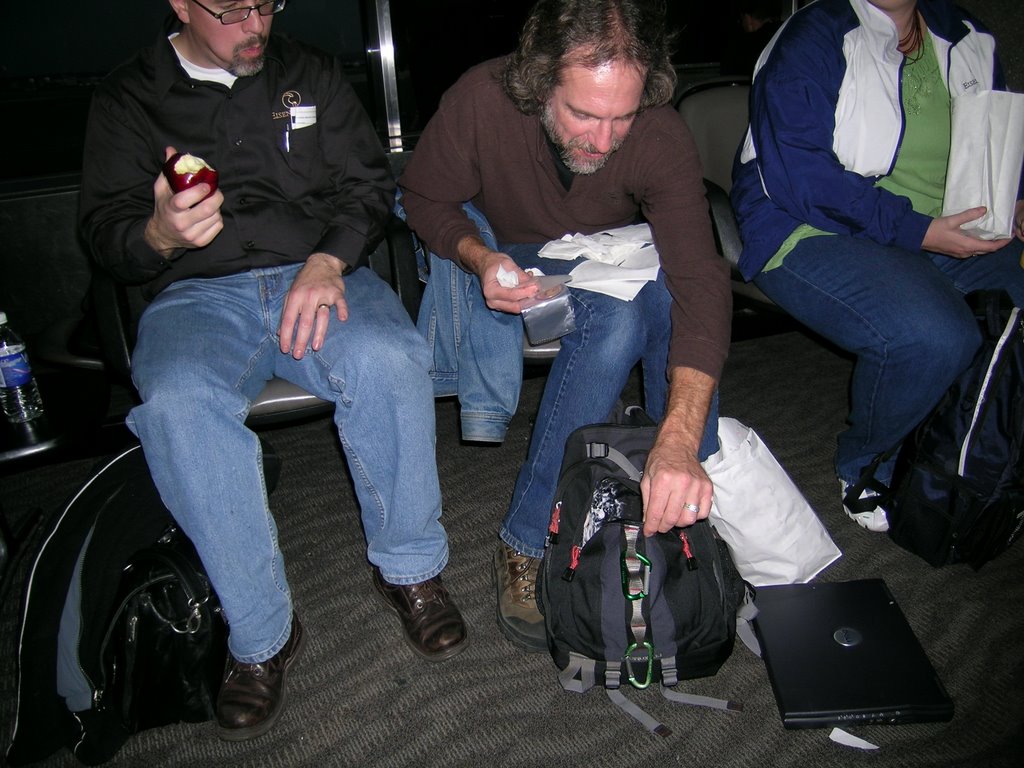
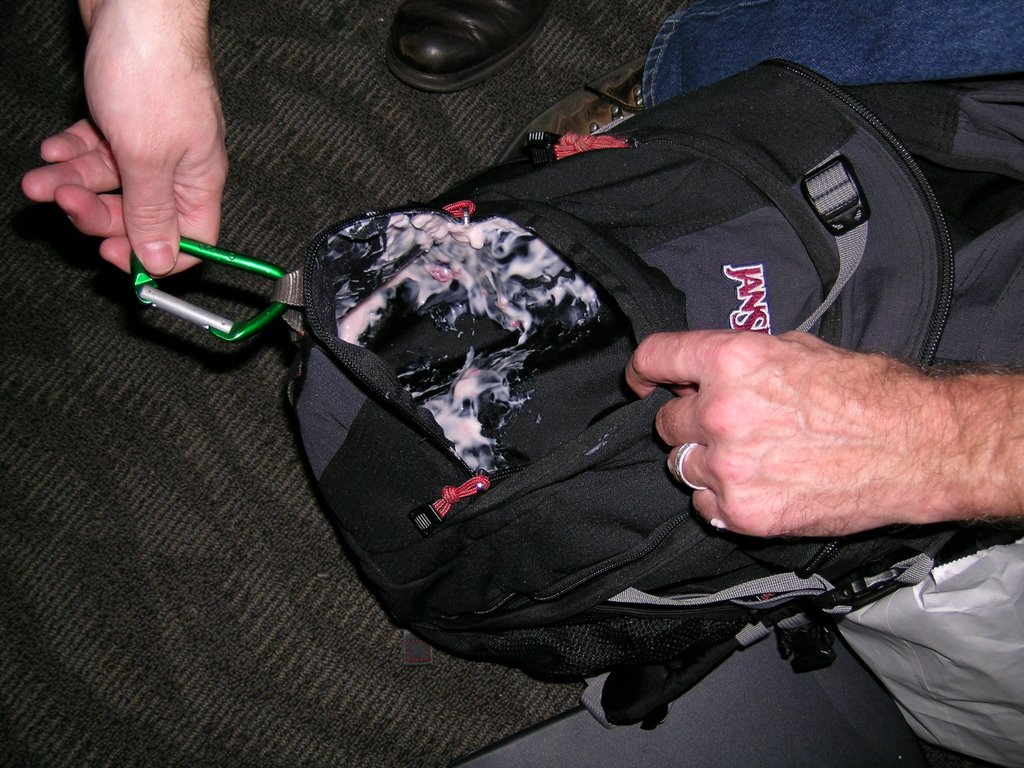
Yogurt explosion

Dave gave me the pictures from my "yogurt explosion" on the way back from AAR/SBL. I thought you might enjoy seeing my remodeled backpack :)


Quote for the day

“I, I am he that comforts you; who are you that you are afraid of man who dies, of the son of man who is made like grass, and have forgotten the Lord, your Maker, who stretched out the heavens and laid the foundations of the earth, and fear continually all the day because of the fury of the oppressor, when he sets himself to destroy? And where is the fury of the oppressor? He who is bowed down shall speedily be released; he shall not die and go down to the Pit, neither shall his bread fail. For I am the Lord your God, who stirs up the sea so that its waves roar— the Lord of hosts is his name. 16 And I have put my words in your mouth, and hid you in the shadow of my hand, stretching out the heavens and laying the foundations of the earth, and saying to Zion, ‘You are my people.’” Isaiah 51:12-15 RSV

Sunday, November 26, 2006

Quote for the day


A quaint old divine of the seventeenth century says:

“There is nothing so contrary to God as sin, and God will not suffer sin always to rule his masterpiece, man. When we consider the infiniteness of God’s power for destroying that which is contrary to Him, who can believe that the devil must always stand and prevail? I believe it is inconsistent and disagreeable with true faith for people to be Christians, and yet to believe that Christ, the eternal Son of God, to whom all power in heaven and earth is given, will suffer sin and the devil to have dominion over them.

“But you will say no man by all the power he hath can redeem himself, and no man can live without sin. We will say, Amen, to it. But if men tell us, that when God’s power comes to help us and to redeem us out of sin, that it cannot be effected, then this doctrine we cannot away with; nor I hope you neither.

“Would you approve of it, if I should tell you that God puts forth His power to do such a thing, but the devil hinders Him? That it is impossible for God to do it because the devil does not like it? That it is impossible that any one should be free from sin because the devil hath got such a power in them that God cannot cast him out? This is lamentable doctrine, yet hath not this been preached? It doth in plain terms say, though God doth interpose His power, it is impossible, because the devil hath so rooted sin in the nature of man. Is not man God’s creature, and cannot He new make him, and cast sin out of him? If you say sin is deeply rooted in man, I say so, too, yet not so deeply rooted but Christ Jesus hath entered so deeply into the root of the nature of man that He hath received power to destroy the devil and his works, and to recover and redeem man into righteousness and holiness. Or else it is false that ‘He is able to save to the uttermost all that come unto God by Him.’ We must throw away the Bible, if we say that it is impossible for God to deliver man out of sin.

“We know,” he continues, “when our friends are in captivity, as in Turkey, or elsewhere, we pay our money for their redemption; but we will not pay our money if they be kept in their fetters still. Would not any one think himself cheated to pay so much money for their redemption, and the bargain be made so that he shall be said to be redeemed, and be called a redeemed captive, but he must wear his fetters still? How long? As long as he hath a day to live.

“This is for bodies, but now I am speaking of souls. Christ must be made to me redemption, and rescue me from captivity. Am I a prisoner any where? Yes, verily, verily, he that committeth sin, saith Christ, he is a servant of sin, he is a slave of sin. If thou hast sinned, thou art a slave, a captive that must be redeemed out of captivity. Who will pay a price for me? I am poor; I have nothing; I cannot redeem myself; who will pay a price for me? There is One come who hath paid a price for me. That is well; that is good news, then I hope I shall come out of my captivity. What is His name, is He called a Redeemer? So, then, I do expect the benefit of my redemption, and that I shall go out of my captivity. No, say they, you must abide in sin as long as you live. What! must we never be delivered? Must this crooked heart and perverse will always remain? Must I be a believer, and yet have no faith that reacheth to sanctification and holy living? Is there no mastery to be had, no getting victory over sin? Must it prevail over me as long as I live? What sort of a Redeemer, then, is this, or what benefit have I in this life, of my redemption?”—Hannah Whitall Smith in The Christian's Secret of a Happy Life

Saturday, November 25, 2006

Franchise church

Great post over at Out of Ur

If the church is to be merely a dispenser of spiritual goods and advice, a place people pass through to get their religion fix, then we should follow the example of brand-driven corporate giants. But, if we hope to form meaningful communities of Christ-followers we shouldn’t neglect the power of being local. Rather than reading the latest branding book, why not gather mature leaders and listen for the Holy Spirit? How is he advising us to be the community of Christ in this unique place at this unique time?

<idle musing>
Now isn't that a novel idea, listening to the Holy Spirit! Dangerous, too. You never know what God might tell you to do. It probably won't be from the corporate play book, but it will definitely be for the building up of the saints. And, last time I checked anyway, the goal of the church was not numbers and glitz, but transformed lives that give glory to God in their daily living.
</idle musing>

Friday, November 24, 2006

Quote for the day

"We mass administer Myers-Briggs personality type and skill profile tests. Yet this misunderstands and changes the very functions of the gifts in community. Gifts are more than just one's inherent talent slots or personality traits best suited to a particular task. They are supernaturally endowed capacities to be discovered and owned within a living body of Christ. They are not merely inherent skill sets or propensities that can be tested for."—David Fitch in The Great Giveaway

<idle musing>
This has been a beef of mine for decades now. People confuse natural giftedness, which is definitely a gift from God at birth, with supernatural giftedness, which is a gift from God after rebirth. Everyone, whether Christian or not, is gifted by God at birth with certain talents. Those can be tested for, analyzed, categorized, developed, studied, whatever, to our heart's content. But, they are distinct and different from supernatural giftedness. Supernatural gifts are given by the Holy Spirit to the body of Christ for the edification of the church after regeneration.

But grace was given to each of us according to the measure of Christ’s gift. Therefore it is said, “When he ascended on high he led a host of captives, and he gave gifts to men.” (In saying, “He ascended,” what does it mean but that he had also descended into the lower parts of the earth? He who descended is he who also ascended far above all the heavens, that he might fill all things.) And his gifts were that some should be apostles, some prophets, some evangelists, some pastors and teachers, to equip the saints for the work of ministry, for building up the body of Christ, until we all attain to the unity of the faith and of the knowledge of the Son of God, to mature manhood, to the measure of the stature of the fulness of Christ; so that we may no longer be children, tossed to and fro and carried about with every wind of doctrine, by the cunning of men, by their craftiness in deceitful wiles. Rather, speaking the truth in love, we are to grow up in every way into him who is the head, into Christ, from whom the whole body, joined and knit together by every joint with which it is supplied, when each part is working properly, makes bodily growth and upbuilds itself in love. Ephesians 4:7-17, RSV

Watchman Nee used to say that we should take people with no natural abilities and put them in positions of authority, that way they would know that they had to depend on God! I think that is going too far, but the point is valid. In my last job, I had no formal training for the position I held. Therefore, I knew I was totally dependent on God to survive. In this job, given the 13 years of college, seminary, graduate school, etc., I am able to depend on my natural skills. All too often the results are pride, unless I remember that even this is a gift of God.
</idle musing>

Bonhoeffer

There is a new blog—well, I am sure there are thousands of them—but this one is about Bonhoeffer. So far he has reviewed 4 books. Be sure to check it out here.

HT: Jim West

Speaking of Bonhoeffer, with AAR/SBL and all, I haven't had a chance to read in Ethics for over a week. But, while there, I did get a copy of a delightful little book by Hendrickson Reflections on the Bible: Human Word and Word of God, a 2004 book which I somehow missed.

Thursday, November 23, 2006

Thanksgiving

Today is Thanksgiving Day in the U.S. For many that just means another day off and lots of food. But for others, and I wish I could say the majority, it is a time to consciously give thanks to God for all his rich blessings. I am truly thankful for all that God has done in my life in the last year, and I look forward to what he will do in the coming one, knowing "that in everything God works for good with those who love him, who are called according to his purpose." Romans 8:28 (RSV)


1 Praise the Lord!
Praise the Lord, O my soul!
2 I will praise the Lord as long as I live;
I will sing praises to my God while I have being.
3 Put not your trust in princes,
in a son of man, in whom there is no help.
4 When his breath departs he returns to his earth;
on that very day his plans perish.
5 Happy is he whose help is the God of Jacob,
whose hope is in the Lord his God,
6 who made heaven and earth,
the sea, and all that is in them;
who keeps faith for ever;
7 who executes justice for the oppressed;
who gives food to the hungry.
The Lord sets the prisoners free;
8 the Lord opens the eyes of the blind.
The Lord lifts up those who are bowed down;
the Lord loves the righteous.
9 The Lord watches over the sojourners,
he upholds the widow and the fatherless;
but the way of the wicked he brings to ruin.
10 The Lord will reign for ever,
thy God, O Zion, to all generations.
Praise the Lord!

Psalm 146, RSV

What is human?

Over at Faith and Theology, Kim Fabricius has ten points on being human. Here is a short excerpt:

1. To be human is to be contingent. This has to be said first because while ontologically it is rather obvious, existentially it is deeply problematical. One way or another, we all know that we are not necessary, that we are here without a by-your-leave, that we have been “thrown” into existence. Whether by a vicious fastball, a deceptive slider, or a graceful curve depends on your faith – or, better, your trust. But human beings do not live this knowledge of contingency. Gifts of God to the world, we live like we are God’s gift to the world. We act like we are self-caused, self-made, independent, indispensable, as though our non-existence were inconceivable. We act, in other words, like God. And in acting like God we act against God. We sin.

2. To be human is to be self-contradictory. Sin is a surd, or, as Barth said, an impossible possibility. That is why we cannot fit sin into any system: it is inherently inexplicable, irrational – it doesn’t compute. To be human is also to be self-contradictory in the sense that in acting against God, we act against ourselves: we are self-destructive – we are always pushing our delete key. Indeed, left to ourselves we would destroy ourselves, irretrievably, which is not only murder but intended mass murder, for in destroying ourselves we would destroy the world. Homicide is always misdirected suicide. War always begins with a Blitzkrieg on the self. Augustine’s amor sui is in fact self-hatred.

9. To be human is to be Christ-like. Indeed we are not truly human, only Christ is truly human, the iconic human, the imago Dei: and God himself “is Christ-like, and in him there is no un-Christ-likeness at all” (John V. Taylor). Here is the truth in the Eastern concept of deification, better, perhaps, called Christification. We are human only as we are conformed to the imago Christi, only as we are in Christ, dead and risen in him. Thus anthropology is a corollary of Christology – and staurology: Ecce homo! Thus baptism is the sacrament of humanity, because it is the sacrament of our death and resurrection en Christo (Romans 6:1-11) – and this is no metaphor! Through baptism, we become human beings – proleptically.

You should definitely read the whole post.

Wednesday, November 22, 2006

AAR/SBL last day

The last day is always interesting. It can be very slow, especially if the weather is bad and people don't want to get stuck in the airport, or it can be extremely busy with people rushing to get that last minute book that they almost forgot. Today was a bit in between.

I, on the other hand, was running around like a maniac trying to get last minute deals from the other publishers that I could pass on to you. I did manage to get a few, and you will see some sales related to them in the coming months.

Once the exhibit hall closes our fun begins. Here are a few pictures for your enjoyment:

Tearing down the V&R and Carta booths

Tearing down our booth, and boxing the books that didn't sell.

This is what the book exhibit looks like after about 2 hours

John decided to take a nap; you know those first year guys. He has threatened to start a blog just to tell the other side of the story :)

I don't have a picture of this, Dave took it with his camera, but I had put 3 yogurts in my backpack for the airport. Once we got to the airport, I opened up that section of my pack only to find that they had been crushed and burst open. Yuck! My keys were covered with yogurt, the whole inner part of that section of the pack was a mess. It took about 20 napkins to clean it up enough to be good enough to get home. Worst of it was, I didn't have any yogurt to eat.

Next year in San Diego...

Tuesday, November 21, 2006

BookNews and CAD update

While I am here in Washington, I asked our graphic designer/webmaster to choose his favorite books. I figured it would give a different perspective. So, he chose about 15 different books and explained why he chose them. You can read the whole thing on the Eisenbrauns website here

Another item that I got too late to put in BookNews is the ship date for CAD T and Tet. There were some problems with finding the correct paper and it delayed it about a month. The actual ship date is December 18; just in time for Christmas :) One of those "what do I get the guy who has everything" kind of presents.

AAR/SBL day 3, continued

Another busy day. I was in the booth most of the day. It was quite busy, with many questions on what books were available for various subjects. I did my best to help people, even when the books weren't Eisenbrauns books. I felt sort of like Kris Kringle in "Miracle on 34th Street" as I would send people to Peeters or Peter Lang or Fortress for the books they needed.

Today was the Brill paperback sale; here is a picture of the balcony by the entrance. The people are jammed together, waiting to be let in. We all thought it meant that we were going to be inundated like the first day. Nope, they all ran over to Brill's booth.


We had our youngest scholar visit the booth today:
I wonder if she sounds like a native speaker :)

We have the most delightful interchanges at the booth sometimes. Mel Peters was hassling John van Seters about his book and how it was too expensive, so John pulls out his credit card and buys it for him. Then, he even signs it.

Monday, November 20, 2006

Beginning of day 3

<idle musing>
I like to do a workout in the morning, especially when I am on the road. So, as usual, I got up at 6:00 and went to the hotel's exercise room. I got there before anyone else, and got on the recumbent bicycle. I was pedaling for about 2-3 minutes when the next person arrived. The first thing he did was turn on the television.

What is it about our society that we can't handle silence? I was reminded of the Rocky & Bullwinkle Movie with the mesmerizing effect of "Really Bad TV." What is even worse, is that the "news" was mainly about celebrity stuff and recycled every 15 minutes. So, I listened to the same stuff twice! I agree with C.S. Lewis: "The newspaper makes you dumb"—although he would have to update it to say the TV makes you dumb.
</idle musing>

AAR/SBL day 2

Sorry for the delay between postings. There is no free wireless that I have found, anyway, at the convention center, so I am posting from the hotel lobby and the room.

As predicted, we ran out of mugs around noon yesterday. You can still order them, but no more are here. Well, there are some, but they are in pieces, see what I mean:


That was Merna's idea; looks pretty neat, doesn't it?

Yesterday was not as busy as the day before, but it came in spurts between sessions. I was in the booth almost the whole day and had a good time meeting a lot of people. Lots of interesting questions come our way, ranging from modern Ethiopia (about which we have nothing) to Zoroaster, from Ge'ez to how children were raised in the ANE. Sometimes we can help, sometimes we can't. Usually we can at least direct them to the right booth.

<idle musing>
Another interesting observation. Yesterday I was talking to two world-class scholars, one recently retired, the other one about to. The one was full of himself, talking about what he was doing, what he had done, etc. The other one wanted to know what was going on in the life of others. He was asking questions and genuinely listening. One was somewhat jaded and bitter. There was no light in his eyes. The other, while serious, had a smile in his eyes. He was looking forward to life with anticipation, waiting with expectancy for what God would do next.
</idle musing>